Glossary · 46 terms
The jargon, translated.
Every dog sport has its shorthand. Q's, MACHs, NW1s, decoys, leg counts. Here's what they all mean, in one short paragraph each.
Titles & abbreviations
Titles & abbreviations
Letters that go before or after a dog's registered name to indicate earned achievements.
- Title
- A formal designation earned after a fixed number of qualifying runs at a given level. Titles append letters to the dog's registered name (e.g. "Rex CD") and become part of the dog's permanent record with the sanctioning body.
- NW1, NW2, NW3, Elite, Summit
- NACSW Nose Work levels. NW1 (one odor — birch), NW2 (two — birch and anise), NW3 (three — birch, anise, clove), Elite (multi-element trials with the full odor set), Summit (championship-tier).
- MACH
- Master Agility Champion — AKC Agility's championship title, earned by accumulating 750 speed points and 20 double-Qs (two Q's on the same trial day in both Standard and Jumpers With Weaves classes) at the Master level.
- PACH
- Preferred Agility Champion — the AKC Preferred-class equivalent of MACH (lowered jump heights, longer course times). Same 750 speed points and 20 double-Qs, all in the Preferred class.
- ADCH
- Agility Dog Champion — USDAA's championship title. Earned through accumulated qualifying runs across USDAA's tournament-style classes (Gamblers, Snooker, Pairs Relay, Jumpers, Standard).
- CD, CDX, UD, UDX, OTCH
- AKC Obedience progression. CD = Companion Dog (Novice). CDX = Companion Dog Excellent (Open). UD = Utility Dog. UDX = Utility Dog Excellent (multiple Q's in Open and Utility same day). OTCH = Obedience Trial Champion, the championship title.
- BCAT, DCAT, FCAT
- AKC Fast CAT title tiers based on accumulated 100-yard timed points across qualifying runs. BCAT = 150 points. DCAT = 500. FCAT = 1,000. Subsequent FCAT titles add a number (FCAT 2, FCAT 3, ...) every additional 500 points.
- RBI, RBIS
- Reserve Best In and Reserve Best In Show — second-place placements at tournament-style trials.
- RATN, RATO, RATS, RATM, RATCH, RATCHX
- Barn Hunt's title ladder. RATN = Novice. RATO = Open. RATS = Senior. RATM = Master. RATCH = Champion. RATCHX = Champion Excellent — each tier adding additional hunt elements, rat counts, and time limits.
- TKN, TKI, TKA, TKP, TKE
- AKC Trick Dog levels. TKN = Novice. TKI = Intermediate. TKA = Advanced. TKP = Performer. TKE = Elite Performer. Lower tiers are checklist-based; higher tiers require choreographed routines.
- IGP1, IGP2, IGP3
- IGP / Schutzhund progression. Each title requires the dog to qualify in tracking, obedience, and protection at increasing complexity. IGP3 is the championship-eligible tier.
Trial mechanics
Trial mechanics
How sports work in practice — the day-of vocabulary.
- Q
- Short for qualification. A Q means the dog met the scoring threshold on a single run; most sports require multiple Qs (often three) at a given level before the dog earns the matching title.
- Leg
- A single qualifying run that counts toward a multi-Q title. Three legs in Novice Agility, for example, earn the Novice Agility title.
- Trial
- A sanctioned event where dogs compete for qualifying scores. Trials are run under a specific sanctioning body's rules and judged by certified judges.
- Match
- A practice event run under trial-like conditions but not for official scores. Used to acclimate green dogs and handlers to a real trial environment.
- Walk-through
- The handler's eight-minute (varies by sport) on-foot inspection of a course before a class begins. Handlers walk the course without the dog, plan their handling, and visualize timing.
- Class
- A specific event format within a trial — e.g. "Standard" and "Jumpers With Weaves" are two AKC Agility classes. Each class has its own course, judge, and scoring.
- Course
- The numbered sequence of obstacles, stations, or tasks a dog runs in a single class. Set by the judge and revealed on trial day in many sports.
- NQ
- Non-qualifying. The run didn't meet the qualifying threshold — too many faults, off-course, or out of time. The dog still runs but earns no Q.
- Hide
- A target odor source placed somewhere in a Nose Work or scent-work search area. Dogs locate hides and communicate the find to the handler. Hides vary in difficulty by height, accessibility, and search-area complexity.
- Alert
- The dog's trained communication that it has found a hide — a sit, a freeze, a paw, or a hard stare. The handler reads the alert and calls the find to the judge.
- Decoy / Helper
- The trained person who works the protection phase of bitework sports. Wearing a sleeve or full suit, the decoy presents the dog with scenarios that test courage, control, and grip. Decoy work is a specialty in itself.
- Out / Aus
- The command for a dog to release a grip on a sleeve or decoy in bitework sports. "Aus" is the German command used in IGP/Schutzhund; "out" is the English equivalent.
- Lure
- The mechanical bait sighthounds chase in coursing sports. Usually a white plastic bag pulled along a course by a continuous-loop pulley system. Dogs are scored on enthusiasm, speed, agility, and follow.
- Track
- A scent trail laid by a tracklayer (a person walking a specific route) for the dog to follow. Track age, surface, length, and complexity vary by sport and level.
Training concepts
Training concepts
Methodology shorthand handlers use to describe what they're working on.
- Cue
- A signal — verbal, visual, or environmental — that tells the dog what behavior is expected. Cues are different from commands in that they're paired with a specific learned behavior through reinforcement.
- Marker
- A short, distinct sound — a clicker, a marker word like "yes" — that tells the dog the precise moment it did something right. The marker is followed by a reward, which over time strengthens the marked behavior.
- Reinforcement
- Anything that follows a behavior and makes that behavior more likely to repeat. Food, play, praise, or environmental access can all be reinforcers depending on the dog.
- Threshold
- The point at which a dog stops responding to cues because arousal, fear, or distraction has overwhelmed it. Training "under threshold" means working at a distance or intensity the dog can still think through.
- Reactive
- A dog that responds with intensity (barking, lunging, freezing) to specific triggers — other dogs, strangers, motion. Reactivity is a training and management challenge, not a personality verdict.
- Drive
- A dog's innate motivation to do something — prey drive (chase), food drive, toy drive, hunt drive, defense drive. Different sports tap different drives.
- Off-leash reliability
- The standard a dog has to meet before it can safely work without a leash — recall, stop on cue, default check-ins. Required for any sport where the dog works at distance from the handler.
- Foundation
- The set of base skills a dog needs before sport-specific training begins — focus, name response, basic obedience, body awareness, comfort with handling. Foundation work pays back tenfold once specialized training starts.
Organizations
Organizations
The major sanctioning bodies. Each runs its own rulebook, titling system, and trials.
- AKC (American Kennel Club)
- The largest US dog registry. Sanctions a wide range of sports — Agility, Obedience, Rally, Fast CAT, Scent Work, Tracking, Coursing Ability Test, Trick Dog, and more. AKC events generally require AKC registration or a PAL/ILP number for mixed-breed dogs.
- UKC (United Kennel Club)
- The second-largest US dog registry. Runs its own parallel sport programs — Obedience, Agility, Nosework, Precision Coursing, and several breed-specific working events. UKC welcomes mixed breeds in all sports.
- USDAA (United States Dog Agility Association)
- An agility-only sanctioning body that runs tournament-style classes — Gamblers, Snooker, Pairs Relay — alongside Standard and Jumpers. Mixed breeds welcome; titles include the ADCH championship.
- NADAC (North American Dog Agility Council)
- An agility sanctioning body emphasizing distance-handling and flowing courses with no contact obstacles in some classes. Mixed breeds welcome.
- NACSW (National Association of Canine Scent Work)
- The founding sanctioning body for the Nose Work sport. Runs the NW1–Summit title ladder, certifies instructors (CNWI), and licenses the Odor Recognition Test (ORT) that gates entry to NW1 trials.
- AAC (Agility Association of Canada)
- Canada's largest agility sanctioning body. Several US clubs run AAC trials. Mixed breeds welcome.
- BHA (Barn Hunt Association)
- The sole sanctioning body for Barn Hunt in the US. AKC and UKC recognize BHA titles through their Title Recognition Programs.
Equipment
Equipment
The gear sports actually require.
- Sleeve
- A padded protective arm cover worn by a decoy in IGP/Schutzhund protection work. The dog grips the sleeve, not the decoy.
- Suit
- A full-body protective suit worn by decoys in French Ring, Mondioring, and PSA. Allows dogs to grip anywhere on the decoy's body legally — leg, arm, torso — depending on the exercise.
- Bungee line
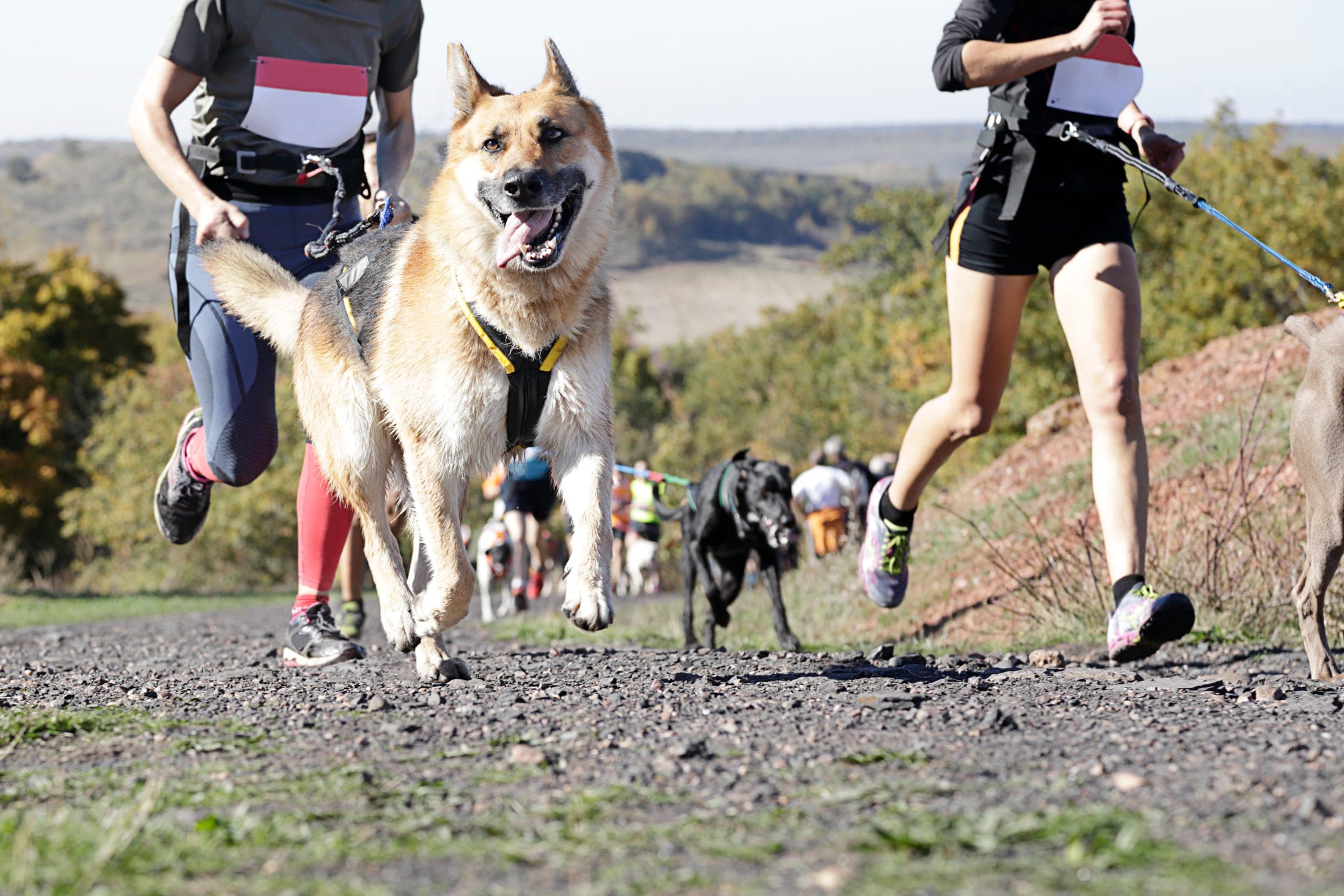
- An elastic-cored tow line connecting a dog (or team of dogs) to the handler's harness or rig in dog-powered sports. The elasticity absorbs sudden tension changes when the dog accelerates or the handler brakes.
- X-back / H-back harness
- Pulling-harness styles for dog-powered sports. X-back is the traditional sled-dog style with crossed straps; H-back distributes force across the dog's chest and shoulders. Both transfer pulling load to the dog's body without restricting movement.
- Contact obstacle
- An agility obstacle (A-frame, dogwalk, teeter) painted with a contrasting "contact zone" at the bottom that the dog must touch with at least one paw. Missed contacts are scored as faults.
- Weave poles
- A series of vertical poles (six or twelve in most classes) the dog enters left-shoulder-first and weaves through. One of the more difficult agility obstacles to train and the most often-faulted.