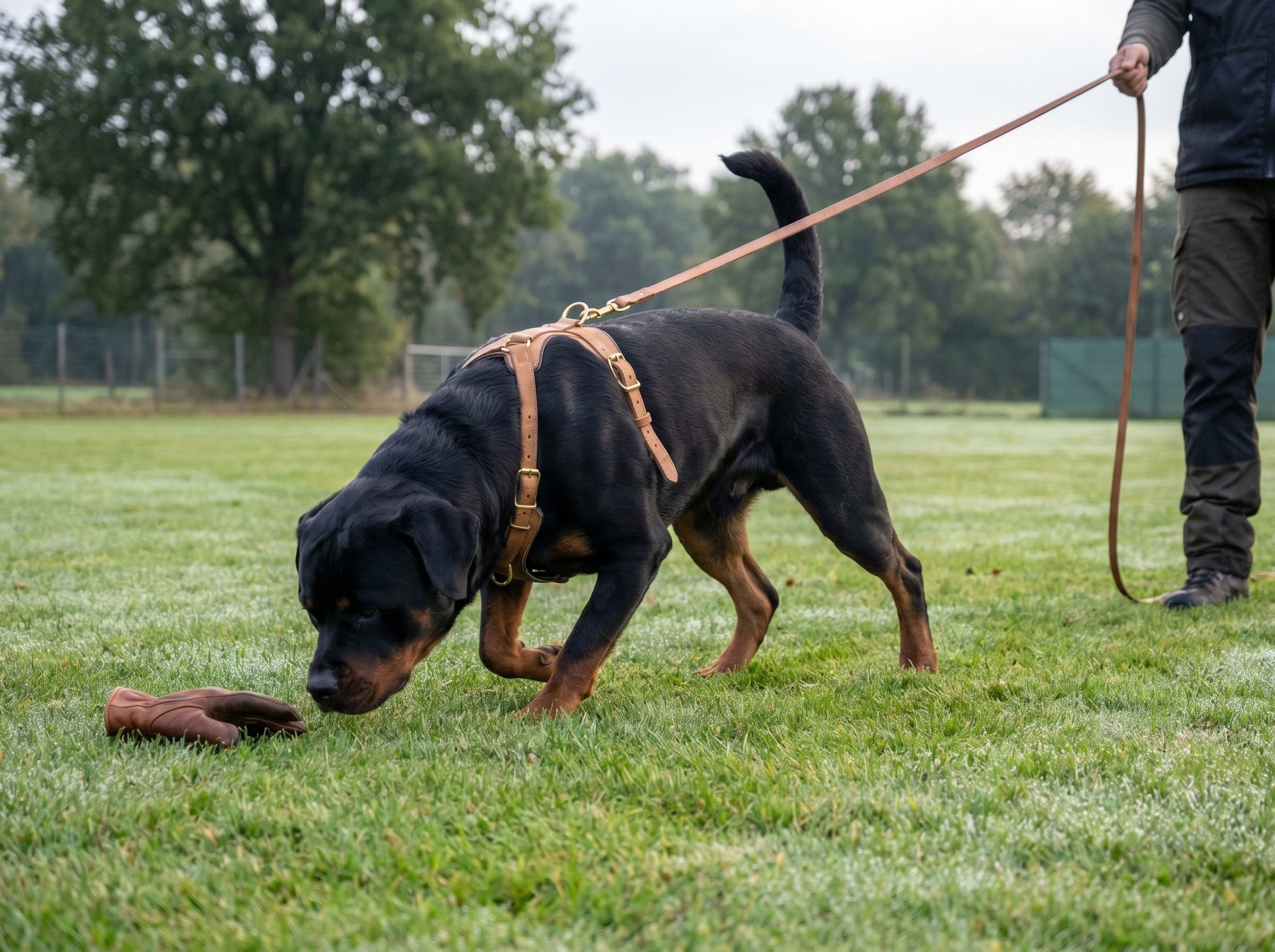
A Rottweiler with natural undocked tail working the tracking phase in a leather Schutzhund harness on overcast field grass.

Photo · AI generated · Sporting Hound

Sport Profile

Discover American Schutzhund

A US-developed three-phase working-dog sport — scent work, obedience, protection — built to test character, power, and environmental soundness over technical polish.

Jump to a section

01 · What is it

American Schutzhund is a three-phase working-dog sport developed in the United States that tests scent work, formal obedience, and protection in a single trial day. It was built as an Americanized response to perceived drift in IGP toward sport-style technicality, with an explicit focus on what its founders call the total dog — character, power, environmental soundness, and handler relationship over minor technical correctness. The sport runs under one rulebook published by PSAK9-AS, with the most recent revision dated January 25, 2025.

Entry runs through a Behavior/Temperament Test (BT) or BTX — both include a dog aggression test, a gunshot soundness check, formal obedience, and six environmental evaluations. Once the BT or BTX is complete, dogs progress through the AS1, AS2, and AS3 titling ladder. Each title is earned in a single trial day — article search or scent detection, off-leash obedience, and protection, each scored out of 100, with minimum scores of 70/70/80 across the three phases. The sport is not a casual weekend hobby. The protection phase requires a trained helper, obedience runs off-leash with gunshot and environmental distractions, and the dog aggression test is an explicit eligibility gate. Best suited to handlers who already train in a working-dog club and care about environmental soundness as much as title scores.

Origins
Pre-2010s
Dissatisfaction in parts of the US working-dog community with the direction of FCI Schutzhund / IPO rules. Handlers and breeders inside the Penn State K9 Association (PSAK9) begin discussing a US-based alternative built around real-world working traits.
2019
The first American Schutzhund Rulebook is issued under PSAK9-AS, with Deb Zappia and other PSAK9 figures driving the codification. The BT, BTX, and AS1–AS3 titling ladder are set out in the founding rulebook.
Early 2020s
The sport spreads through working-dog clubs in the Northeast and Mid-Atlantic, then into the Midwest and parts of the South via affiliated clubs adopting the rulebook and hosting trials. Annual Nationals events begin rotating through host clubs such as Empire Working Dog Club near Rochester, NY.
2025
Most recent rulebook revision dated January 25, 2025. Publicized complaints following the 2025 Nationals lead to active rule and policy adjustments via the organization's website and social channels.

02 · The phases

Every American Schutzhund trial day tests three skill sets in sequence. Before a team can enter the AS1–AS3 ladder, the dog has to pass a separate temperament gate. Each phase is scored out of 100, and a team must clear all three on the same day to title — scores don't accumulate across trials.

Gate · BT / BTX
The temperament gate
The Behavior/Temperament Test is the entry requirement for the titling ladder. Two parts: an obedience and soundness portion judged on a 45-point pass/fail scale (including a gunshot response), and a set of six environmental evaluations that record the dog's character permanently in the scorebook. The BTX adds a protection phase and requires the dog to be 15 months or older. A separate dog aggression test is required before the BT can be attempted. Environmental results are recorded for life and cannot be retaken — the BT card travels with the dog.
Phase A
Article search · scent detection
AS1 uses an article search: the team works an area of at least 8,000 square feet looking for two articles whose locations are unknown to the handler. Judged on intensity, drive, control, directability, and a clear indication at the source. AS2 and AS3 shift Phase A to scent detection, with increasing search complexity, aging, and environmental pressure as the level rises.
Phase B
Obedience
Off-leash heeling, positions under motion, retrieves, and a send-away — performed on a field with gunshots and environmental distractors. AS1 includes a single retrieve on the flat (30 points) and a send-away (15 points). AS2 adds a hurdle retrieve. AS3 adds a scaling-wall retrieve. Judges deduct for technical errors but have explicit latitude to credit power, attitude, and harmony with the handler.
Phase C · The minimum
Protection
Locating and guarding a helper in a blind, courage tests, transports, and out-and-recall under pressure. The protection minimum is 80/100 — higher than the 70/100 minimums in scent and obedience — and the phase is built around grips, guarding, and stability rather than flashy sport presentation. Helper work tightens at AS2 and AS3, with longer routines, more pressure, and stricter expectations on control under stress. 70/70/80 must hit in a single trial; a 95 in obedience and a 78 in protection still doesn't title that day.
Same-day requirement

03 · PSAK9-AS

American Schutzhund has no parallel governing organizations in the United States. PSAK9-AS — the Penn State K9 Association's American Schutzhund program — writes the rulebook, licenses every titling event, certifies judges and helpers, runs the annual Nationals, and maintains the scorebooks. One ladder, one rulebook, one database. Many AS handlers also train and trial in IGP or PSA, but those titles do not transfer into the AS system. Eligibility runs through behavior and temperament rather than pedigree — all breeds eligible on paper, but two gates apply before AS titles: a dog aggression test, then the BT or BTX.

BT
Behavior / Temperament Test
The entry gate. Pass the dog aggression test, then the 45-point obedience/soundness portion (including a gunshot response), then complete the six environmental evaluations. Environmental results record permanently in the scorebook — the BT card stays with the dog for life and cannot be retaken.
BTX
BT plus protection
The alternative entry gate. BT components plus a protection phase. Minimum age 15 months. Same lifetime-record framing on the scorebook — environmental results carry forward regardless of whether a dog later titles AS1–AS3.
AS1
Entry-level three-phase title
Article search of an area of at least 8,000 sq ft for two unknown-location articles, off-leash obedience with a single retrieve on the flat (30 pts) and a send-away (15 pts), and protection. 70/70/80 minimum scores in one trial under a licensed AS judge.
AS2
Mid-level three-phase title
Phase A shifts to scent detection. Obedience adds a hurdle retrieve. Protection routines lengthen and helper pressure increases. Same 70/70/80 single-trial requirement — scores don't accumulate across trials, so the team either clears it on the day or comes back to try again.
AS3
Top three-phase title
Scent detection is at its most demanding — aging, complexity, and environmental stressors are highest. Obedience adds the scaling-wall retrieve, the AS3 marquee exercise. Protection is the longest and tightest, with maximum expectations on control under pressure. 70/70/80 in one trial.
Key facts
Founded
First rulebook 2019; latest revision Jan 25, 2025
Sole sanctioning body
PSAK9-AS
Eligibility
All breeds; dog aggression test is a hard gate
BTX min age
15 months
Title scoring
70 / 70 / 80 in one trial — no accumulation
Junior division
Roughly 7–14 years (per social-media posts)
The scorebook is a lifetime record
Environmental evaluations on the BT card stay with the dog for life. Failing evaluations doesn't necessarily block an AS title, but the record is permanent — breeders and titled-handler peers read the BT card as a working-dog résumé, not a one-trial result. Two independent certifications also exist alongside the AS ladder: an Independent Obedience certification and a Stadium-Only Protection certification, both reachable after BT or BTX.

04 · The ladder

American Schutzhund titles are pass/fail per trial. There is no point accumulation across trial days — the team either clears the minimum scores in a single trial under a licensed AS judge, or comes back and tries again. The three AS levels separate by what each phase adds, not by easing the minimum.

AS1 · entry
Article search + foundational obedience
Phase A is an area article search of at least 8,000 sq ft for two unknown-location articles. Obedience runs the foundational pattern: single retrieve on the flat (30 pts), send-away (15 pts), off-leash heeling and positions under gunshot and environmental distractions. Protection introduces the AS emphasis on power and stability. 70/70/80 in one trial.
AS2 · mid
Scent detection + hurdle retrieve
Phase A becomes scent detection with increased difficulty and environmental challenge. Obedience adds a hurdle retrieve on top of the AS1 pattern. Protection routines lengthen and helper pressure increases. Same single-trial 70/70/80. Most teams who clear AS1 cleanly need additional preparation time before they pass AS2 on the first attempt — handler anecdote, not Q-rate data.
AS3 · top
Scaling-wall retrieve + advanced everything
Scent detection at its most demanding (aging, complexity, environmental stressors). Obedience adds the scaling-wall retrieve — the AS3 marquee exercise, found at no other AS level. Protection is the longest and tightest, with maximum expectations on control under pressure. The scaling wall and the AS-style protection together are what define the AS3 title visually and structurally.
Runs-to-title — anecdotal, not published
American Schutzhund does not publish Q-rates, average runs-to-title, or scoring distributions, and AS-specific stats aren't centrally aggregated. Handler reports suggest most teams need more than one trial to clear AS1 — protection scores are the most common holdback, since 80 is the highest of the three minimums and the phase is the longest. Independent Obedience and Stadium-Only Protection certifications exist for handlers who want parts of the program without the full three-phase progression.

05 · Side by side

Because PSAK9-AS has no parallel governing body, the comparison most newcomers actually need is between American Schutzhund and the other US protection-sport options — IGP and PSA. They share handlers, helpers, club training nights, and breed pools, but they test different things and reward different scoring philosophies.

American SchutzhundIGP / SchutzhundPSA
FormatBT/BTX gate, then AS1–AS3 three-phase trials in one dayBH/VT companion-dog gate, then IGP1–IGP3 three-phase trialsPSA1–PSA3 + PDC entry test; scenario-based trials with variable obedience and protection sequences
PhasesArticle search or scent detection · obedience · protectionTracking · obedience · protectionObedience · protection (no tracking)
Scoring philosophyPower, character, environmental soundness — judges credit attitude over technical correctnessFCI rubric — V/SG/G/B ratings, 70/100 per phase minimum, 220/300 overallReal-world scenario testing — courage, problem-solving, decoy work under unpredictable conditions
Open toAll breeds; club culture favors high-drive working breedsAll breeds; working-line German Shepherds and Belgian Malinois dominateAll breeds; high-drive working breeds dominate
Known forUS-developed rulebook · BT card as lifetime environmental record · scaling-wall retrieve at AS3International FCI rule alignment · breed surveys · championship selection pathsHidden sleeves · varied scenarios · aggressive helper work that rewards adaptable dogs

American Schutzhund sits between IGP and PSA on the spectrum from rule-precision to scenario-pressure. It keeps the three-phase Schutzhund structure that IGP handlers know, swaps tracking for scent search, and pulls the scoring philosophy toward AS-style total-dog judgment. Titles do not transfer across these three sports — an IGP3 dog still has to clear the AS pathway from BT forward.

Which one fits *you*?
International rule alignment + traditional tracking
IGP. FCI scoring rubric, breed surveys, the largest international working-dog community. The most established of the three with the deepest published rulebook and the broadest helper pool.
Scenario-based protection + hidden sleeves
PSA. Trials where every routine looks different, decoys work aggressively, and the dog has to read situations rather than execute pre-known patterns. Rewards adaptable dogs over pattern-trained dogs.
US-developed ladder + lifetime environmental record
American Schutzhund. A three-phase ladder that scores character as heavily as technique, with a permanent BT card on every dog. The scaling-wall retrieve at AS3 is the marquee exercise — no other US protection sport uses it.

06 · Getting started

American Schutzhund is not a drop-in class sport. The protection phase requires a trained helper, the BT/BTX requires environmental and gunshot exposure under qualified eyes, and the AS1–AS3 ladder rewards multi-year preparation. The first step is finding a working-dog club that runs AS — or a club with experienced AS, IGP, or PSA helpers willing to take on a foundation team.

Months 0–6 · Foundation
Join a club
Build engagement, foundation obedience, and tracking-style search behavior. Begin environmental exposure (surfaces, sounds, mild distractions). For dogs raised in this from puppyhood, growth-plate-aware foundations come first — heavy jumping and full-impact protection wait. Clubs supply blinds, jumps, the scaling wall, and bite equipment; handlers bring a flat collar, harness, long line, short leashes, and high-value reward gear.
Months 6–18 · Build to the gate
BT or BTX
Expand obedience to off-leash patterns, introduce gunshot exposure under controlled conditions, and start formal helper work for BTX-track dogs. Many teams attempt BT or BTX in this window. The environmental evaluations are recorded permanently — the BT card travels with the dog for life, so handlers don't rush a marginal dog through the gate just to be done with it.
Year 2+ · Title chase
AS1 → AS2 → AS3
Preparation for AS1, then AS2 and AS3. For most handlers, reaching AS1 realistically takes one to three years of consistent training and club participation. AS3 with the scaling-wall retrieve takes longer — the marquee exercise is not introduced until AS3 itself, so dogs come to it without the trial-environment reps that build out lower-level confidence.
Before you enroll
High-drive working breeds dominate — German Shepherds, Belgian Malinois, Dutch Shepherds, working-line Rottweilers, and similar. Dog aggression is a hard gate; handlers managing significant dog reactivity need to weigh whether AS is the right sport or whether substantial behavior work is needed first. Minimum BTX age is 15 months. Many handlers run hip and elbow radiographs before serious protection work, especially for medium-to-large dogs. Travel readiness matters — clubs are unevenly distributed and handlers in regions without a local AS club may drive multiple hours each way for training nights.

07 · Trial day

AS trials run with the controlled-but-intense atmosphere of working-dog sport. Helpers and bite equipment are visible from the sidelines, gunshots fire during obedience and BT, and the day stretches across multiple phases. Well-prepared dogs handle the environment when their club training has matched the pressure. First-time handlers get more nervous than they expect.

The day
Three phases, one shot
Check-in covers scorebook review, ID verification, and confirmation of BT/BTX status for AS-ladder entries. A judge's briefing follows. Phase A (article search or scent detection) runs on a separate field. Phase B (obedience) is on the trial field with another dog working in parallel for the long down — gunshots and field distractions are part of the routine. Phase C (protection) is often the latest phase of the day and draws the biggest crowd. Either you clear 70/70/80 in this trial or you don't title today.
The kit
What to bring
Crate and shade canopy — multi-phase days mean significant downtime between routines, and crate rest matters as much as the work. Water, weather-appropriate gear, snacks for both dog and handler. Scorebook, AS membership and registration paperwork, and any required ID for the dog (microchip or tattoo verification can apply). Sport-specific gear: collars, leashes, harness, long line. Helper equipment is supplied by the club.
The mistakes
What to avoid
Underestimating the wait — multi-phase trials run all day and handlers who can't pace their dog's arousal between phases pay for it in protection. Over-arousing on the sidelines watching every other team work from the fence is a fast track to a fried dog by Phase C; crate or walk the dog away from the field. Treating AS like IGP with a different name — it isn't; the BT/BTX gate is its own evaluation and an IGP-titled dog still has to clear the AS pathway from BT forward.
The reality
What videos don't show
The waiting — highlight reels of Phase C don't include the four hours of crate rest, judge briefings, helper warm-ups, and field setup that surround the routine. The volume of gunshots, helper work, dogs barking on the line, and trial-secretary announcements stacked across a full day. The travel — AS clubs are unevenly distributed, and Nationals draws teams from across the country.

08 · What it costs

AS-specific cost data is not centrally published, and entry-fee schedules generally live inside trial premiums posted to social media rather than on a public website. The estimates below combine the limited public AS data with norms from comparable working-dog sports (IGP, PSA), which share helpers, clubs, and trial logistics with AS.
One-time setup
$300$800
Sport-quality gear + national membership + scorebook; pre-protection imaging extra
Club dues
$60$150
Per month, depending on facilities and helper access
Private lessons
$75$150
Per hour with experienced helpers; seminars run higher
Active annual
$3k$8k
Multiple trials, frequent training, regional travel; Nationals scales higher
The honest truth
American Schutzhund's cost shape looks like IGP and PSA, not Nose Work or Barn Hunt. The reason serious handlers pay club dues and travel for monthly seminars is the same reason they do in IGP — weekly structured helper work and a community that knows how to move a dog from foundation through AS3. Casual entry is possible at the low-four-figure level. Title chasing rapidly pushes into mid-four figures and beyond, with travel often matching or exceeding entry costs.
Related sports

If American Schutzhund interests you, look at these too.