Discover Parkour
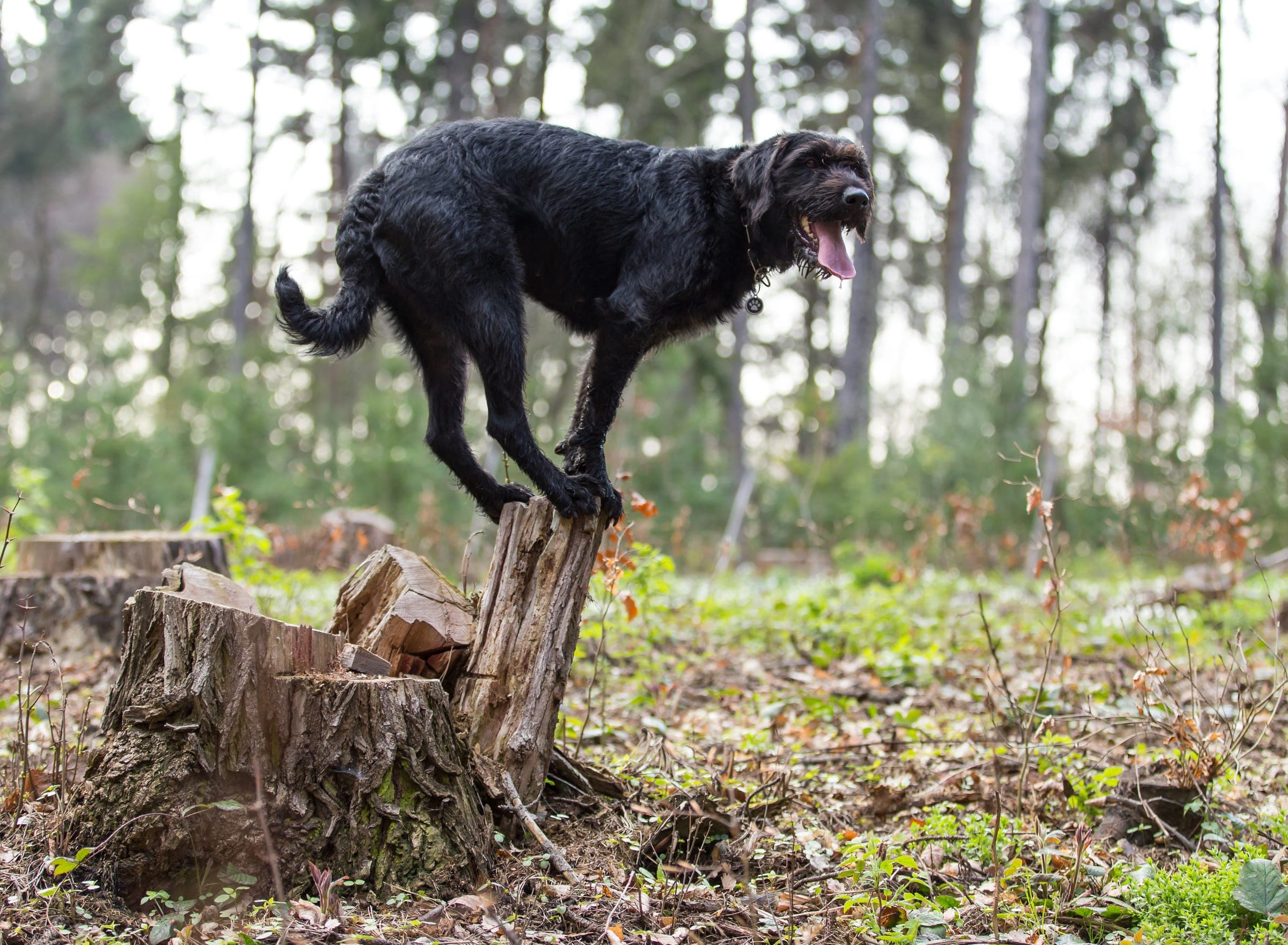
A video-titled sport where dogs use everyday environmental features — benches, logs, low walls, railings — to demonstrate confidence, body awareness, and team handling under strict safety rules.
01 · What is it
Dog parkour is a video-titled sport where the dog interacts with naturally occurring environmental features — benches, walls, logs, stumps, railings, playground equipment — instead of standardized agility obstacles. Teams perform a defined behavior set: four feet on, two feet on, going under, going through, balancing, backing up, jumping over, and going around. Handlers choose obstacles that meet rulebook criteria for height, surface, and stability, and they spot the dog through every interaction. Lifting the dog onto an obstacle is prohibited; touching for safety support is allowed.
Most titling happens through video submission rather than in-person trials, which means a lot of the work happens on regular walks in parks and quiet urban settings. The sport suits dogs who are curious, environmentally engaged, and willing to problem-solve at moderate speeds — it is not a flat-out speed sport. Reactive and noise-sensitive dogs participate at much higher rates than they do in most sports because video titling lets handlers pick quiet locations and off-hours. Long-backed, giant, and mobility-impaired dogs participate at modified levels, and IDPKA's rulebook explicitly welcomes dogs with physical disabilities. Joint health, controlled landing heights, and surface traction are the physical realities to plan around.
02 · The behaviors
A title submission isn't a continuous course run — it's a curated set of video clips showing specific behaviors on different obstacles that meet level-appropriate criteria. IDPKA and ADP each define which behaviors must be demonstrated, what makes an obstacle acceptable, and how the handler must spot. Evaluators score for confidence, control, and adherence to safety rules — not for speed.
03 · IDPKA
IDPKA is the original and most widely referenced dog parkour venue. Its ladder runs from a Training Level open to dogs of any age, through Novice (the first level requiring a minimum age of 18 months), Intermediate, and Expert, with Champion Parkour Dog (CH-PKD) as the exploration-based capstone — plus a separate set of Specialty Titles running parallel to the core ladder. Every level is evaluated pass/fail on a single video submission demonstrating all required behaviors. No numeric scoring, no leg math.
04 · ADP
All Dogs Parkour launched as a separate online titling venue after IDPKA and published its current multi-level Rules & Guidelines in April 2024. ADP runs two parallel tracks: a Regular ladder that mirrors the IDPKA-style behavior progression, and a set of themed Creative Challenges where teams earn Level 1–5 titles within each theme (Level 5 typically designated as the championship title for that theme). Like IDPKA, every title is earned by video submission. Registration is $15 one-time per dog — one of the most affordable formal sport-titling registrations in dog sports.
05 · Side by side
The two venues with the strongest US footprint and most-referenced rulebooks are IDPKA and ADP. Dog Parkour UK is the regional UK alternative that some US handlers also use as a third titling stream. Titles do not transfer formally across venues, but the behavior vocabulary transfers cleanly.
| IDPKA | ADP | Dog Parkour UK | |
|---|---|---|---|
| Role | Original / flagship titling venue | Parallel and complementary online venue | UK-based regional venue · secondary US footprint |
| Primary focus | Environmental exploration · codified safety · multi-environment championship | Regular ladder plus themed Creative Challenge series | Foundation Level titles for built and natural environments |
| Levels (core) | PKD-T → PKD-N → PKD-I → PKD-E → CH-PKD, plus Specialty Titles | Regular Track levels + Creative Challenge Level 1–5 across multiple themes | Foundation Level (built / natural) plus Advanced Level challenges |
| Titling mode | Video submission only | Video submission only | Video submission only |
| Registration | Per-dog registration via online form | $15 one-time / dog (or existing Cyber Rally-O #) | Per-program enrollment |
| Known for | Most widely referenced rulebook · exploration-based CH-PKD | Flexible creative challenges · Cyber Rally-O partnership | Built / natural distinction in Foundation Level |
Titles do not transfer between organizations. All three venues use video submission only, all welcome dogs of all ages and abilities at appropriate levels, and all use behavior-checklist evaluation rather than scored runs. Many US handlers cross-title between IDPKA and ADP — the behavior vocabulary transfers cleanly, even if the titles themselves don't.
06 · Getting started
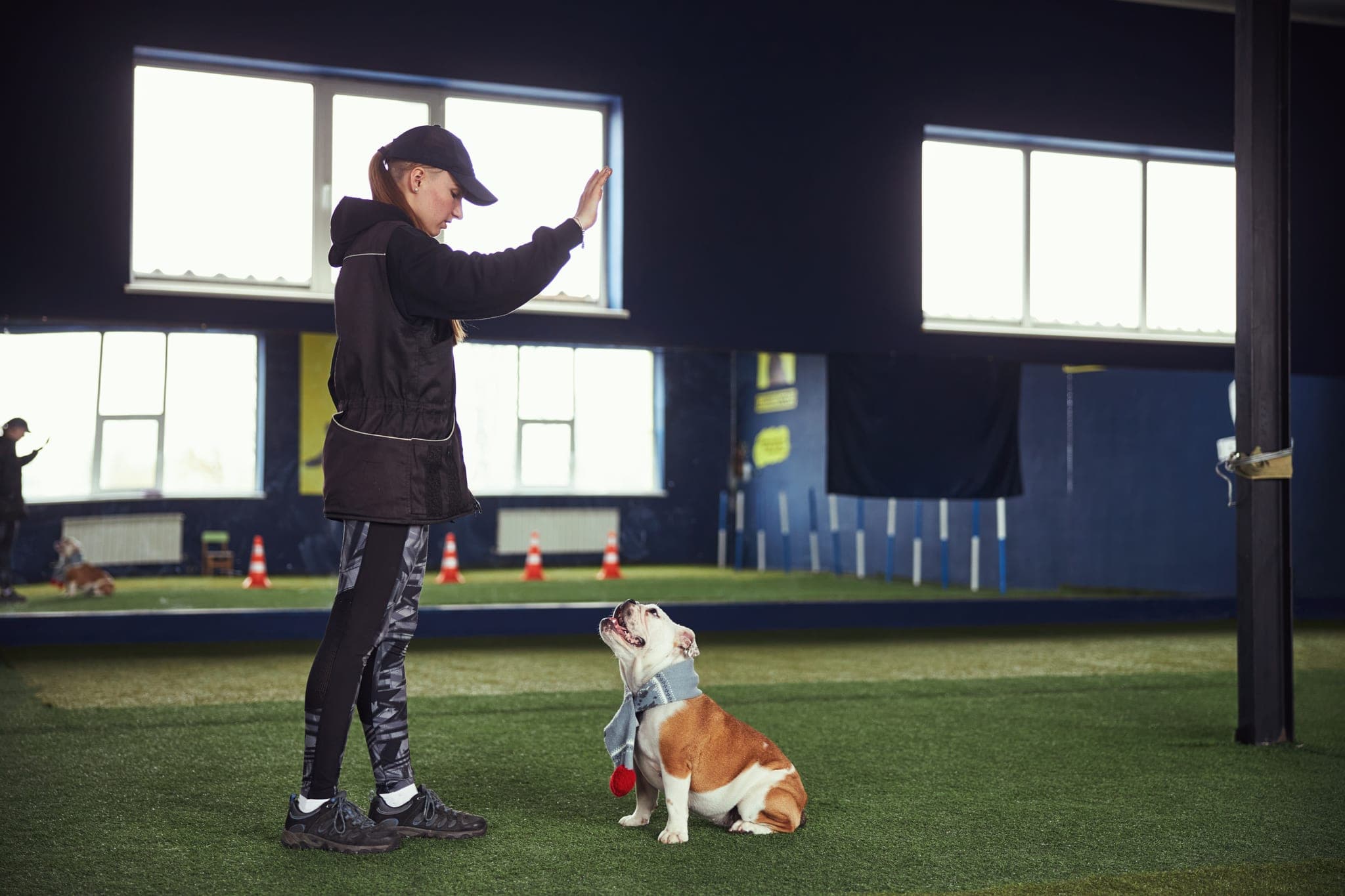
Most dog parkour beginners start through a local urban-agility or parkour workshop, a dedicated multi-week class, or a structured online introductory course. Because the sport uses existing environmental features — benches, low walls, logs, sturdy planters — handlers can do a substantial amount of training on regular walks with no specialized equipment beyond a flat collar or harness, a 4–6-foot leash, and rewards. Club membership isn't required; instruction comes from independent trainers, online schools, and occasional IDPKA-associated seminars.
07 · Your first event
Most dog parkour titling happens via video, but trainers and clubs do host workshops, play days, and evaluation days associated with IDPKA or ADP. The atmosphere is lower-key than a large agility trial, with smaller groups working in rotation around an urban or park environment. First-time handlers often feel unsure about obstacle safety and filming angles — that's the point of a workshop.
08 · What it costs
Dog parkour costs concentrate on training and per-entry video fees, not travel. Most titling happens locally — handlers walk to neighborhood parks, low walls, sturdy benches — and submit clips remotely. Casual participants who treat parkour as structured enrichment spend relatively little. Active titling teams invest more in classes, seminars, and per-entry submissions.
Sources & verificationLast reviewed May 2026
Our Dog Parkour guide is an independent, plain-English orientation — not an official rulebook. Rules, titles, eligibility, and fees vary by organization and change over time, so always confirm the specifics with the current rulebook or event premium before you enter.
Checked against
Spot something out of date? Tell us and we’ll fix it.