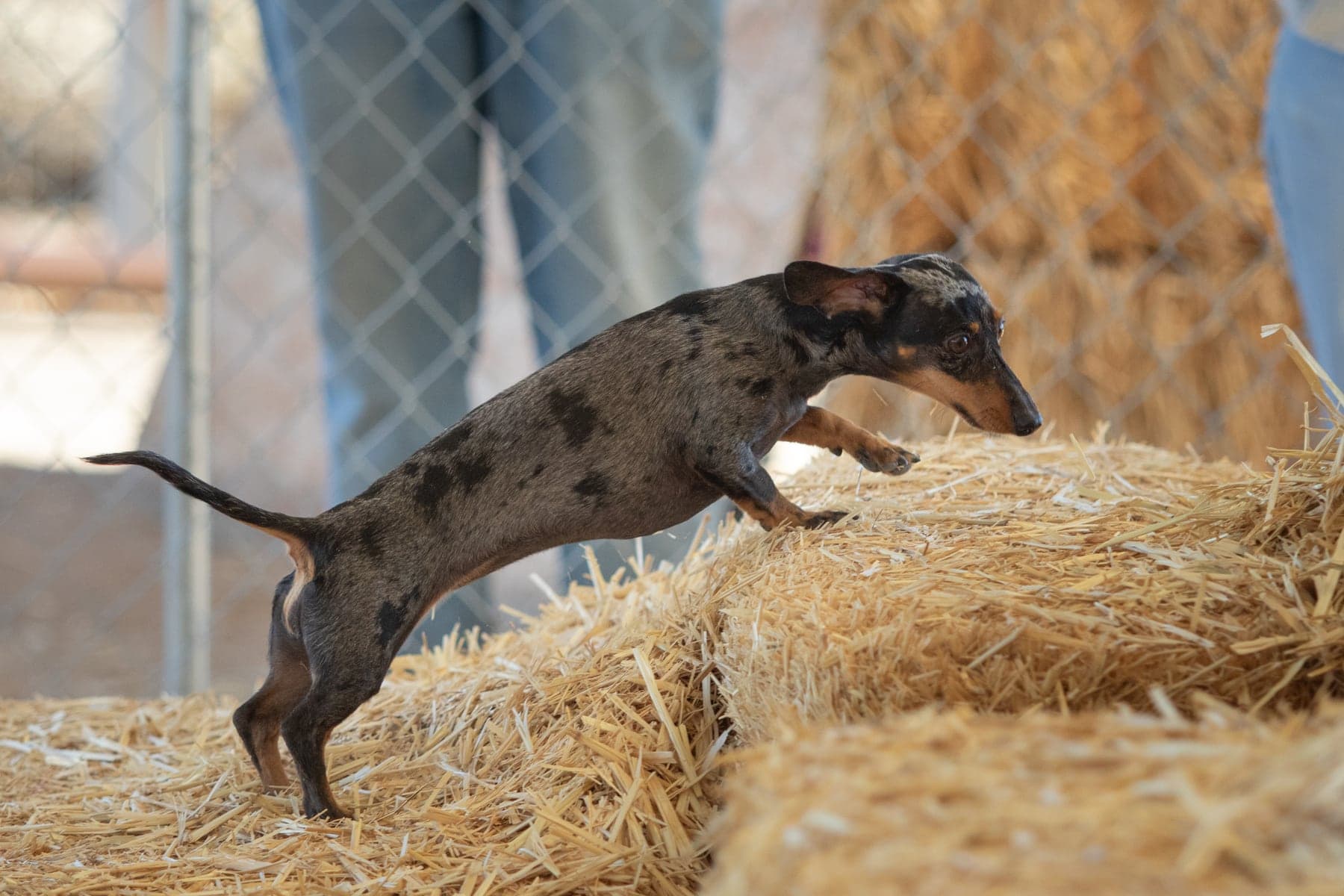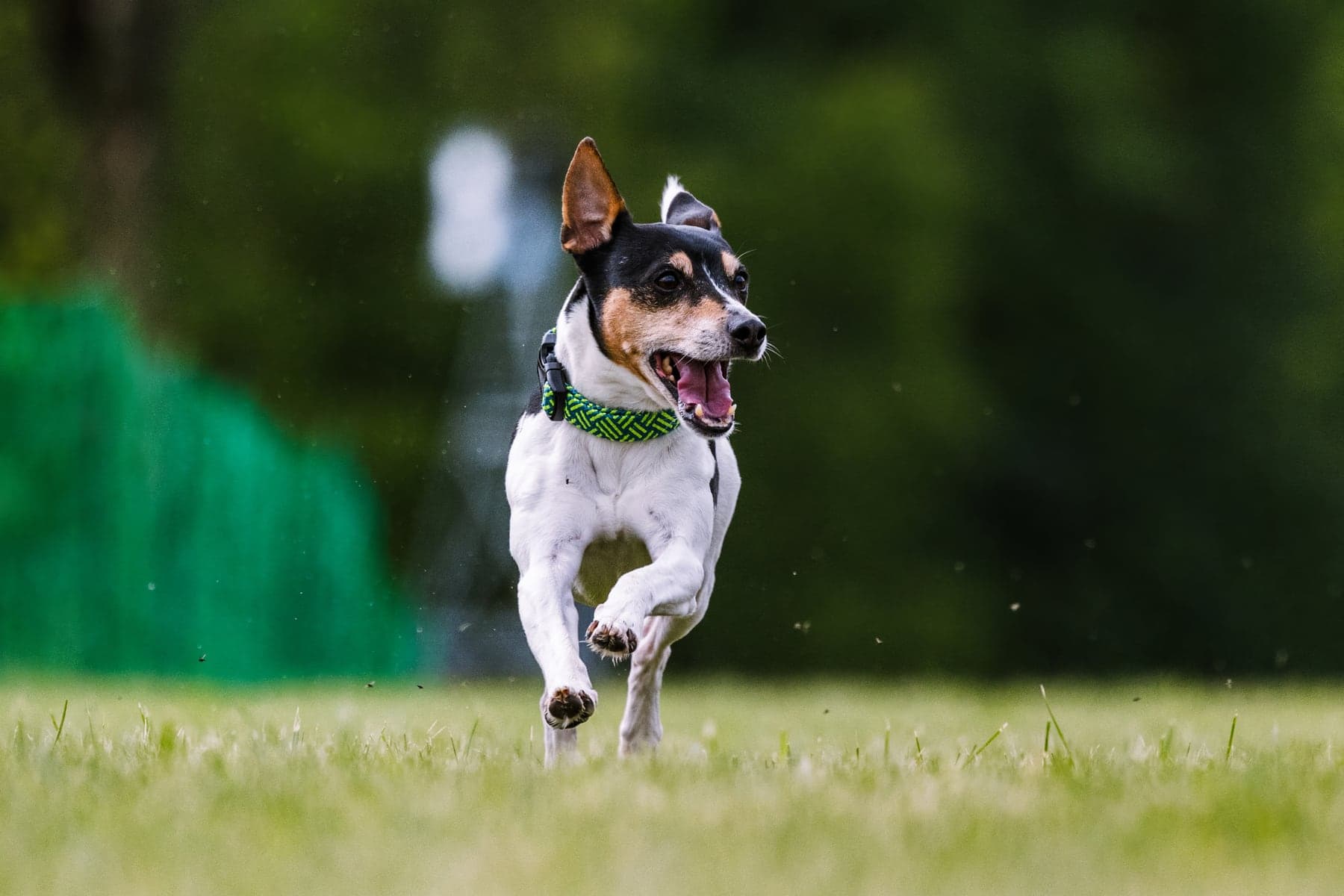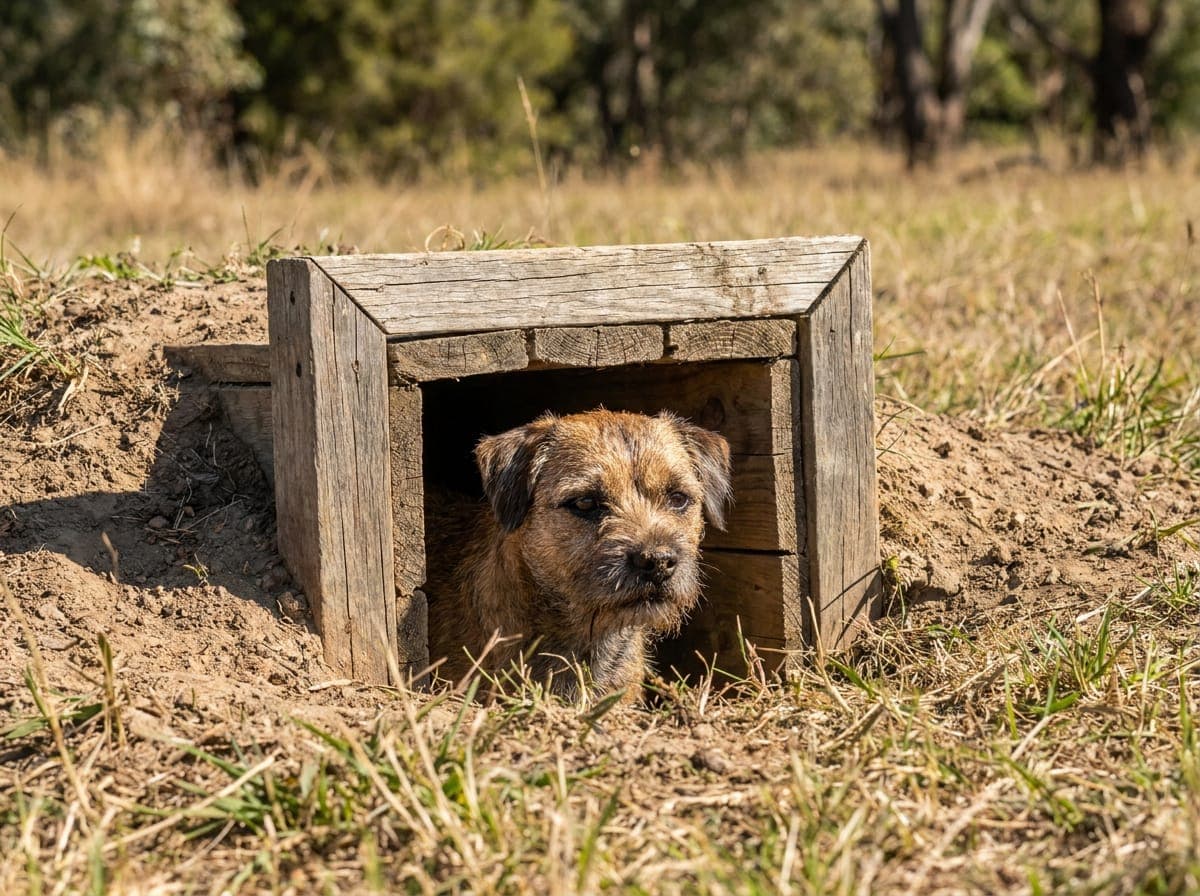
A small terrier at the wooden tunnel mouth of an Earthdog den, ears forward, about to commit underground.

Photo · AI generated · Sporting Hound

Sport Profile

Discover Earthdog

An underground hunting test for small terriers and Dachshunds — the dog navigates a man-made den, locates safely caged rats at the end, and works the quarry through barking, scratching, and digging while the handler waits aboveground.

Jump to a section

01 · What is it

Earthdog is an underground hunting test for small terriers and Dachshunds. Wooden- or PVC-lined tunnels are buried in the ground to mimic a natural burrow, with right-angle turns running 30 feet or longer at titled levels. Caged rats sit at the end of the den, protected from contact by mesh and a heavy lid. The dog runs off-leash, follows scent through the turns, locates the quarry, and works the rats — barking, scratching, digging at the cage, focused attention held against the time limit. The handler waits at the tunnel entrance. Once the dog commits underground, the dog is on its own.

The sport rewards a specific dog: small, gamey, persistent, comfortable in tight dark spaces, and willing to work independently away from the handler. Traditional working terriers — Cairns, Borders, Norfolks, Norwiches, Smooth and Wire Fox, the Russell breeds — and Dachshunds make up most of the entries. Reactive dogs can run; tests are one dog at a time and dogs are kept separated in staging. Sound-sensitive dogs need a management plan — bark spikes around the tunnel can be intense. Long-backed breeds benefit from careful conditioning and weight management before sustained underground work.

Origins
Working roots
Earthdog descends from working-terrier vermin control across rural Europe and North America. Small terriers and Dachshunds were bred to follow foxes and other quarry underground, kill or bolt them, and clear barns and grain stores.
Informal origin
Informal go-to-ground competitions among working-terrier enthusiasts compared dogs' willingness to enter dens and persist on quarry — the direct ancestor of the modern sport.
Late 20th c.
The American Working Terrier Association (AWTA) began offering structured go-to-ground tests in the late 20th century — among the earliest formal working trials for small terriers in North America.
1990s
AKC formalized its own Regulations for Earthdog Tests for Small Terriers and Dachshunds, standardizing tunnel dimensions, time limits, and a titling ladder for sanctioned events.
Humane testing
Both programs use safely caged rats — the rats are never killed or made contactable — replacing historical live-quarry confrontation with a humane, repeatable test that preserves the breed function.
2022
AKC announced a new Excellent title and a Novice class. AWTA's most recent rulebook is dated 2025. Both programs are actively maintained; the ladders below reflect current sources.

02 · The course

Every Earthdog test, at every level, is built from the same components — tunnel, quarry, time. Difficulty scales by stretching distance, adding turns, layering in decoys, requiring hunt-up to find the den, and (at the top levels) asking the dog to recall out of the tunnel after sustained work.

Element 01
The den
A buried or surface-set tunnel built from wooden liners or PVC, roughly 9 inches square inside. 10 feet at the introductory level, 30 feet with three right-angle turns at Junior and Senior, more complex layouts with multiple entrances and false dens at Master. Dark inside. The dog cannot see the handler once it commits past the first turn.
Element 02
The quarry
Two adult rats in a wood-and-metal cage at the end of the tunnel, mesh and a heavy lid between the dog and the rats. The dog never touches the rats. Working the quarry means barking, scratching, digging at the cage, holding focus — the behaviors that, in real work, would tell a handler the quarry was located.
Element 03
Hunt-up & false dens
At Master, the dog hunts an open field 100–300 yards across to locate the tunnel mouth, investigates an empty den on cue, and decisively marks the active entrance among multiple options. Senior adds a false unscented exit and an unscented bedding area near the quarry. Tests nose use and problem-solving before the dog even reaches the tunnel.
Element 04
Work & recall
Junior: 30 seconds to reach the quarry, 60 seconds of continuous work. Senior: 90 seconds to the quarry, work begins within 15 seconds of arrival, 90 seconds of sustained work — then recall from underground within 90 seconds after the rats are removed. Recall after sustained high-arousal work is the hard part.
Element 05 · The verdict
Pass or fail
Earthdog is pass/fail. No placements, no scoring scale, no points. A dog either meets all the components of the level — travel time, start-to-work, work duration, recall where required — or it fails and re-enters at the next event. Endurance Earthdog stacks two passes (Senior + Master) on the same trial day as one Endurance leg.
Format-defining

03 · AKC Earthdog

AKC is the dominant US Earthdog program by event count, club coverage, and titled-dog population. Tests are non-competitive performance evaluations — pass/fail across a clear titling ladder from a non-titling introductory test through the Endurance Earthdog series. Eligibility is breed-restricted: specific small terriers and Dachshunds only, and the dog must hold an AKC number through full registration, Limited Registration, PAL, or FSS. Mixed breeds cannot enter AKC Earthdog. Minimum age is 6 months.

IQ
Intro to Quarry
Non-titling. 10-foot tunnel leading straight to the cage. Generous time limits — a confidence-builder before titled levels. The honest first answer to whether your dog will commit to the tunnel at all.
01
Junior Earthdog (JE)
30-foot tunnel, three right-angle turns. 30 seconds to reach the quarry, 60 seconds of continuous work, dog must allow safe removal. Two qualifying passes under two different judges earn the title.
02
Senior Earthdog (SE)
30-foot tunnel with a false unscented exit and an unscented bedding area near the quarry. 90 seconds to the quarry, 90 seconds of sustained work, recall from underground within 90 seconds of the rats being removed. Three passes at three separate tests under two different judges.
03
Master Earthdog (ME)
Brace work — two dogs hunt together. 100–300 yard hunt-up to find the den, an empty-den investigation on cue, decisive marking of the active entrance, then full tunnel work judged on hunting initiative and steadiness with the bracemate. Four qualifying passes under three different judges.
04
Endurance Earthdog (EE)
Pass SE and ME at the same trial event — that's one Endurance leg. Five legs earn the EE title; continued double-passes earn numbered titles (EE2, EE3, and higher). Pulling clean SE and ME runs in a single weekend is what gives the EE its prestige.
Key facts
Eligibility
Specific small terriers + Dachshunds
Registration
AKC number required (Full, Limited, PAL, FSS)
Mixed breeds
Not eligible
Min age
6 months
Bitches in season
Not eligible to compete
Format
Pass / fail, no placements
Recent rule updates
AKC announced a new Excellent title and a Novice class in 2022. How the Excellent title slots into the JE/SE/ME/EE ladder isn't summarized cleanly in secondary sources — confirm against the current AKC Earthdog Regulations. A 2019 update also clarified handler commands allowed in the Senior test.

04 · AWTA

The American Working Terrier Association is the older of the two US Earthdog sanctioning bodies and the one with the stronger working-terrier cultural identity. Events are fewer, often hosted by dedicated terrier clubs, and the rule set leans closer to the traditional go-to-ground roots of the sport. Eligibility is defined more broadly than AKC: recognized small working-terrier breeds and similar types are admitted, with the rulebook framed around working function rather than registry status. AWTA's most recent rulebook is dated 2025.

01
Working Certificate (WC)
AWTA's standard working-test recognition. Earned through qualifying performances at AWTA tests. Specific titling math per level is defined in the 2025 rulebook and should be drawn from that source rather than secondary summaries.
02
Veteran Earthdog Award
Earned by a dog that has accumulated ten Working Certificates. A longevity-of-performance recognition rather than a single advanced level — rewards repeated qualifying performance across years.
03
Veteran Earthworker Award
A handler-side award for sustained participation across events. Recognizes the human half of the team rather than a single dog's progression.
Key facts
Eligibility
Recognized small working-terrier breeds + similar types
Registration
Per current event policy
Mixed breeds
Varies by event policy
Identity
Working-terrier program, traditional go-to-ground roots
Current rulebook
2025
Format
Pass / fail; longevity awards
Cross-org recognition
AWTA awards do not appear as AKC titles on AKC records. A dog can hold AWTA awards and AKC Earthdog titles simultaneously — they sit on separate pedigree systems. Some judges and handlers cross over between the two programs; some communities are loyal to one over the other.

05 · Compare them

Both programs run underground vermin-hunting tests with safely caged rats. They diverge on eligibility, titling structure, event density, and cultural identity. Most US Earthdog handlers participate in only one; a smaller group cross-competes. Titles do not transfer — a JE doesn't produce an AWTA Working Certificate, and a stack of WCs doesn't earn the dog an AKC Junior Earthdog.

AKC Earthdog
Footprint
Dominant — most events, most titled dogs
Eligibility
Specific terriers + Dachshunds, AKC # required
Ladder
IQ → JE → SE → ME → EE (and EE#)
Bitches in season
Not eligible
Recent updates
Excellent title + Novice class (2022)
Best for
Clear titling math, broad club network
AWTA
Footprint
Smaller, specialist terrier-club presence
Eligibility
Working-terrier types; broader registration tolerance
Ladder
WC → Veteran Earthdog (10 WCs) + handler award
Bitches in season
Per current rulebook
Recent updates
2025 rulebook is current source of truth
Best for
Working-terrier culture, fewer registry constraints

06 · Getting started

Most handlers come into Earthdog through a local terrier or Earthdog club rather than a private trainer — there is very little remote instruction in the sport, and the equipment (tunnels, caged rats, a fenced field) is hard to recreate at home. Foundation work focuses on confidence in dark tight spaces, interest in quarry scent and sound, recall, and crate stability in a busy outdoor environment.

Weeks 1–8 · Foundation
Find a club
Short tunnel introductions, scent exposure, crate stability, recall in a busy environment. Most clubs run a 4–6 week introductory series. A confident, gamey dog can enter Intro to Quarry and even Junior Earthdog within a few months. A more cautious dog can take a year or more to commit reliably to the tunnel in new field conditions.
Months 2–6 · Build
Progressive tunnel work
Progressive work building up to JE distances and confidence with quarry. The willingness to enter a dark tight space alone is the single biggest filter. Love of digging in the yard does not predict it — some dogs that look like obvious candidates never fully commit underground. Try an IQ run before paying for titled entries; the answer comes in under a minute.
Year 1+ · Compete
JE → SE → ME → EE
Most active teams need 1–3 seasons to reach SE and ME, given the added complexity (false exits, recalls, hunt-up, brace work) and the requirement for multiple judges and multiple events at each level. EE-track handlers travel widely and pull stacked SE/ME passes across five-plus events. The math is not faster than the calendar.
Before you enroll
Eligible breed for AKC Earthdog — confirm the breed appears on AKC's current eligibility list before committing. Min age 6 months. Recall is essential at SE and ME — the dog has to come out of an underground tunnel after sustained high-arousal work. Long-backed breeds need spinal conditioning and weight management. Bitches in season are not eligible at AKC trials.

07 · Trial day

An Earthdog trial is quieter than a flyball or agility weekend but louder than an obedience trial — short bursts of barking at the tunnel mouth, dogs in crates between runs, long stretches of conversation in the staging area. Most teams get a few runs across a day. The actual underground work is over in under two minutes per run at most levels.

The flow
How a day runs
Check-in at the secretary's table, sign waivers, receive your running order. AKC events verify the dog's AKC number; AWTA events follow their own event policy. Judge's briefing covers rules for the level, tunnel layout, time limits. Tunnels are not walked-through in detail the way an agility course is — the dog uses scent, not pre-mapped routes. Off-leash at the tunnel mouth, release on the judge's signal, pass or fail communicated shortly after.
The kit
What to bring
Crate or X-pen, pop-up shade canopy, water. Comfortable shoes for uneven ground. Cooling gear in warm-weather regions — Dachshunds and double-coated terriers heat-stress fast in the sun. High-value rewards for after the run, not at the tunnel mouth. A way to crate away from the tunnel area so the dog isn't hearing rats and barking for hours.
The mistakes
What to avoid
Too much talking at the tunnel mouth — once the dog commits past the first turn it cannot hear the handler clearly anyway. Crowding the entrance and making a nervous dog less willing to commit. Underestimating how mentally tiring quarry work is — stacking too many runs across a day burns out a dog that would have passed earlier. Reading the premium too late; bitches-in-season policy and crating allowances vary by club.
The reality
What videos don't show
The long crate hours, the wait between runs, the dog that turns at the second corner and trots back out, the rat-fixated dog that cannot recall on cue after working too hard. Multi-day weekends compound the load: early departures, long drives, motel stays with crated dogs, and unfamiliar lodging stress that does not show up in a 45-second clip of dramatic barking at the cage.

08 · What it costs

Earthdog is on the moderate end of titled AKC field sports. Entries are low — but the limited number of clubs and events in many regions pushes travel up. Practice requires tunnels and live quarry, which means club access rather than backyard setups.

One-time setup
$200$500
AKC reg/PAL/Limited/FSS plus basic gear (crate, canopy, leash, harness)
Class series
$100$200
4–6 week club-run series in mid-cost regions
Per-trial weekend
$75$150
Two tests per level entered at $20–$35 per test
Active annual
$1k$2.5k
6–10 trial days · regular training · moderate travel
The honest truth
Entries are the cheap part — $20–$35 per test. The recurring expense newcomers underestimate is travel. A casual JE is reachable for well under $500 all-in if a club is local. ME and EE belong to handlers who travel — five stacked SE/ME passes across five events is the math, and the math is set by the calendar's geographic spread, not by per-entry fees.
Related sports

If Earthdog interests you, look at these too.