Sport Profile

Discover French Ring

A high-intensity protection sport — jumps, off-leash obedience, and decoy-driven bitework run as a single tactical contest. Built on French ring tradition; judged on courage, control, and composure under pressure.

Jump to a section

01 · What is it

French Ring is a protection sport that pits a dog-and-handler team against a decoy in a sanctioned tactical contest. Everything except a single heel-on-leash exercise runs off leash. The dog wears no collar, the handler carries no food and no toys, and physical corrections inside the ring are not permitted. The judge draws the order of exercises before each trial — the handler does not know in advance which exercise comes first or how the routine will flow. Slowness is expensive in literal points: 2 points per second on a late bite, 1 point per meter on a late escape, 30 points lost outright if the decoy steals the guarded object.

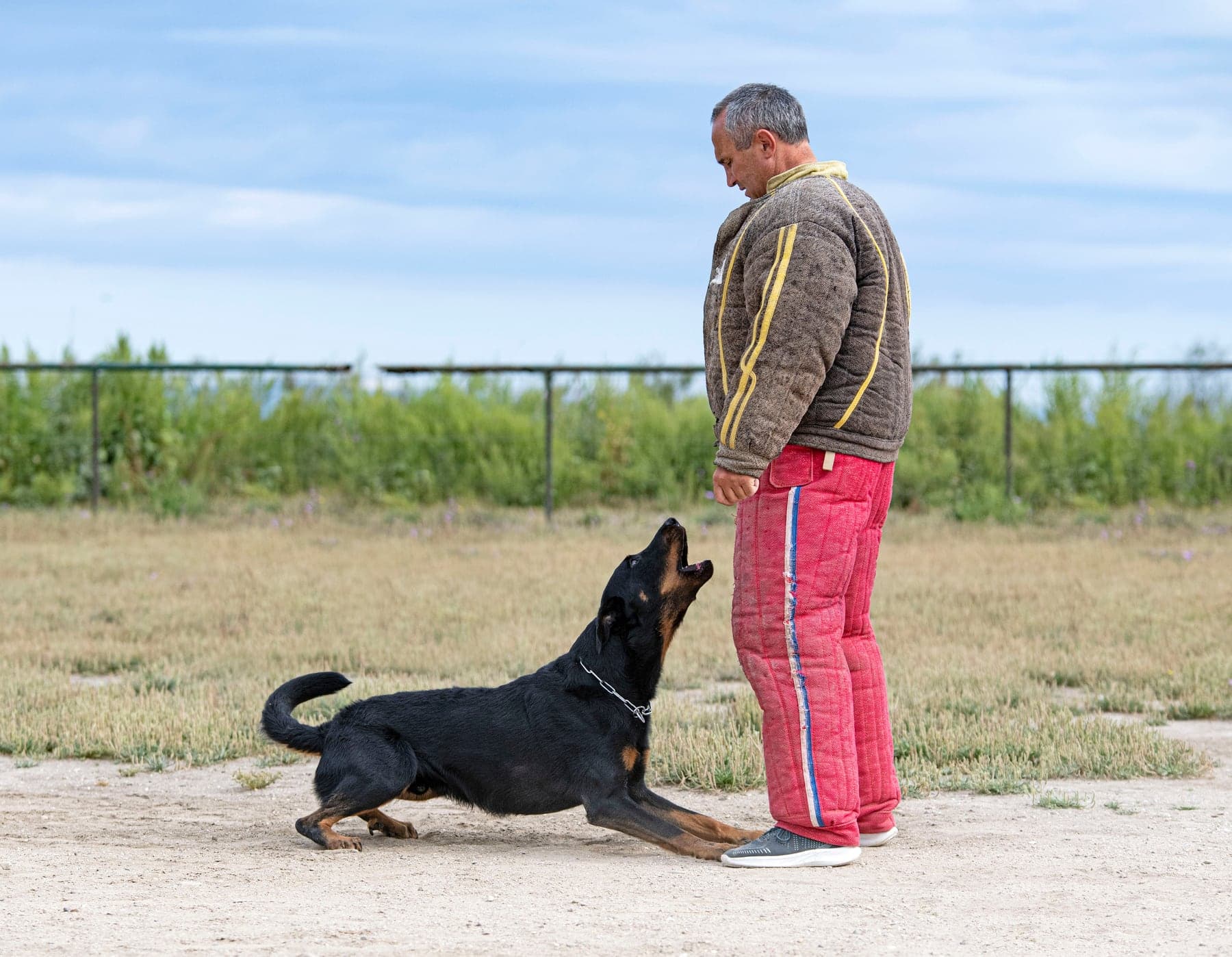
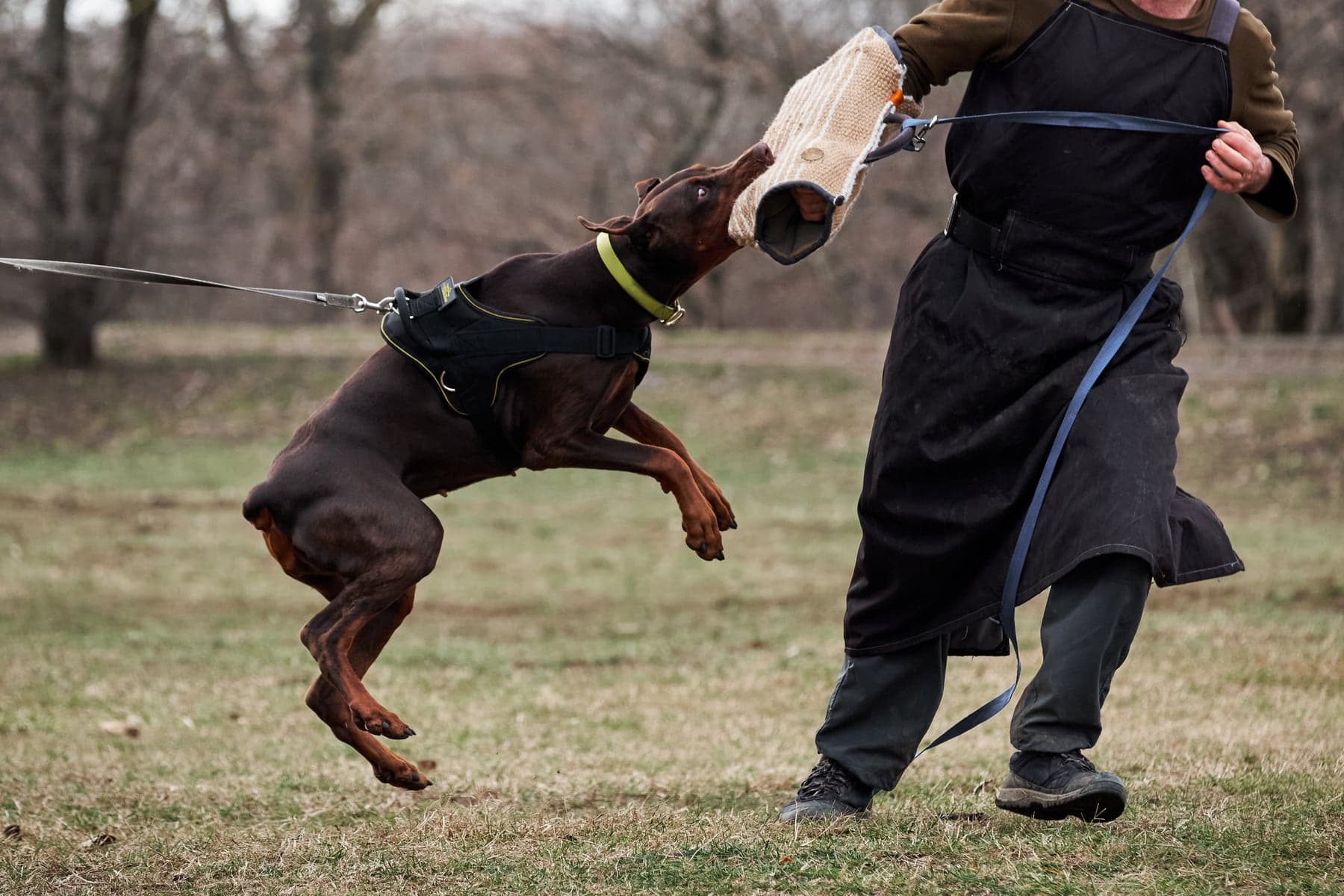
The decoy is the engine of the sport. Unlike protection programs where the helper presents a relatively standardized picture, the French Ring decoy is an active opponent — using the 'esquive' (a lateral dodge that strips momentum from an incoming dog), theatrical movement, and barrage stick work to test the dog's character and expose weaknesses in training. A successful French Ring dog has high prey and defense drives, explosive speed, environmental confidence, and the structure to clear a 2.3-meter palisade at full extension. Reactivity to dogs or to people is a hard barrier: trials happen in close quarters with other handlers, spectators, and decoys moving around the field, and an off-leash dog that bites anyone outside the sanctioned decoy work faces suspension. The Belgian Malinois dominates modern entries; German Shepherds, Doberman Pinschers, and Rottweilers compete where structure and temperament hold up to the demand.

Origins
Late 1800s
Police-dog demonstrations in France and Belgium draw paying crowds. Edmond Moecheron — later called the father of Ringsport — formalizes early demonstrations with his Belgian Shepherds. The exercises are practical breeding tests, not yet a codified sport.
1903
The first recorded Ringsport trial is held in Mechelen, Belgium. Exercises are not yet standardized, but jumping, obedience, and protection are present from the start.
1913
The first National Ringsport Championship in Belgium is won by the Groenendael 'Jules du Moulin.'
1986
The North American Ring Association (NARA) is founded with support from France's Société Centrale Canine (SCC), which validates NARA titles internationally. Canada establishes the Canadian Ring Association (CRA) as a separate national body.
Mid-1990s
The sport is briefly renamed 'International Ring Sport' before reverting to French Ring.
2023
NARA publishes a revised rulebook that clarifies the split-program protocol for hot weather (Ring III only) and refines decoy conduct standards. The current rulebook all US trials run under.

02 · The routine

A French Ring routine is run as a single program drawn into a random order by the judge before the trial begins. Three exercise categories — jumps, obedience, and protection — interleave across the program. A Brevet runs about 15 minutes; a Ring III runs about 40 minutes, and splits into two series with a rest period when the judge declares hot-weather protocol.

Element 01
Jumps
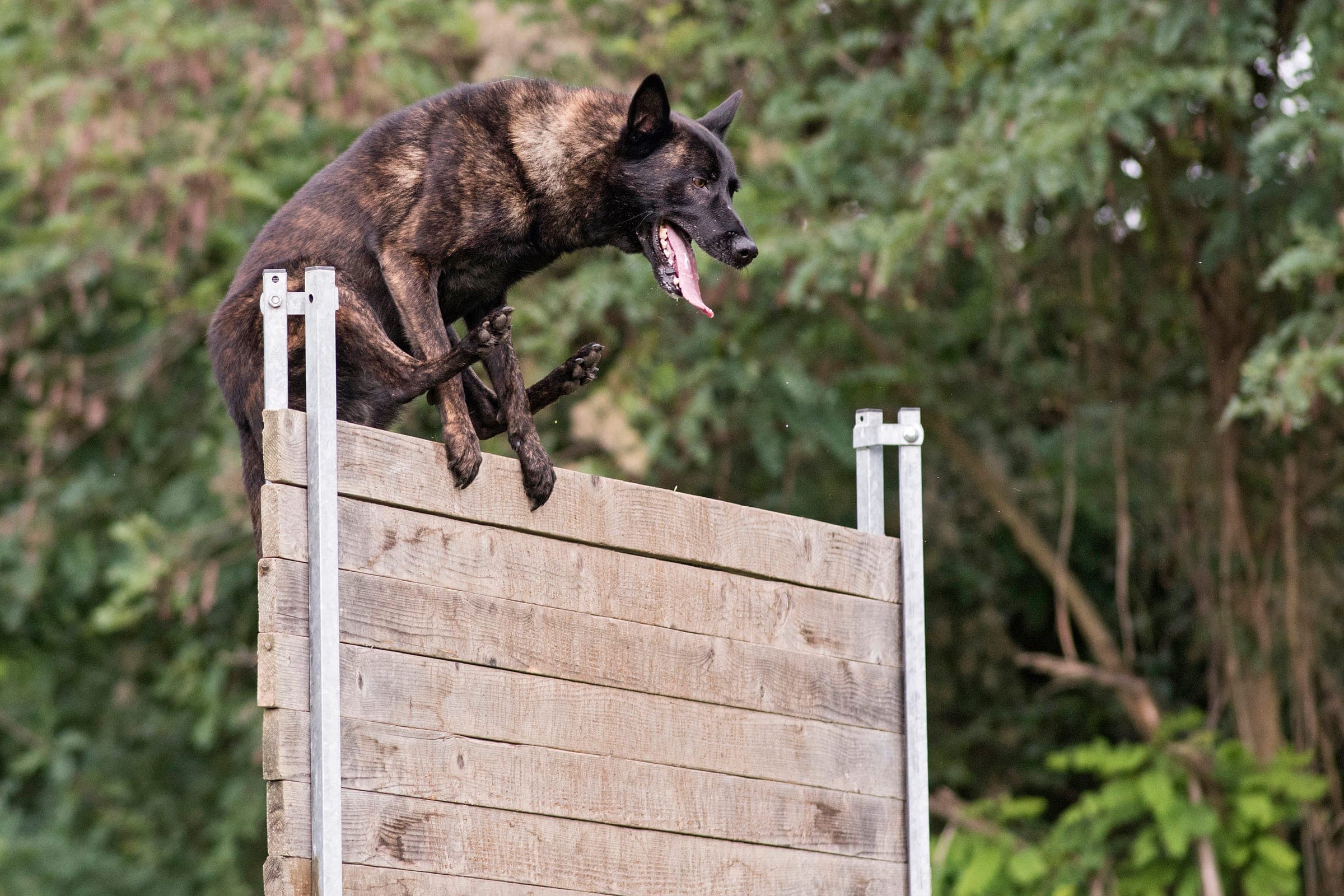
Hurdle, long jump, and palisade — taken lengthwise across the field. The hurdle scales by level, the long jump tests horizontal extension, and the palisade is a vertical wooden wall that reaches 2.3 meters at Ring III. Each jump scores 8 to 20 points depending on level and execution. The palisade is what separates structurally sound athletic dogs from the rest of the field.
Element 02
Obedience
Heeling on leash, heeling muzzled (the only collared exercise), positions at distance, seen and unseen retrieves, food refusal both on the ground and thrown at the mouth, a one-minute out-of-sight absence, and a send-away to a distant line. The field itself is baited with distractor food the dog must walk past without acknowledging.
Element 03
Protection
Face Attack (engaging a stationary threatening decoy head-on), Flee Attack and Stopped Attack (pursuit and engagement, the second adding a sudden halt that demands a controlled grip), Gun Guard (preventing escape from a decoy firing a blank gun, then escorting the disarmed decoy), and Defense of Handler (responding to a simulated attack on the handler).
Element 04
Object Guard
The handler places the dog with an object and walks out of view. The decoy makes three theft attempts. The dog must bite only when the decoy enters a defined zone, release on disengagement, and stay near the object. No recall, no handler intervention, no second chance. A stolen object costs the full 30 points. The cleanest test in the sport of whether the dog has internalized the work.
Independent-decision exercise
Element 05
The decoy as opponent
Not a uniform helper presenting a standardized picture. The decoy uses the 'esquive' (lateral dodge), barrage stick work, theatrical motion, and unpredictable timing within rule limits. NARA decoys are certified through a three-level program; Level 3 is earned through the Decoy Super Selection competition. Skilled decoys are what most distinguishes French Ring from IGP and similar protection programs.

03 · NARA

The North American Ring Association is the sole US governing body for French Ring. Founded in 1986 with support from France's Société Centrale Canine (SCC), NARA writes the US rulebook in line with SCC standards, sanctions every US trial, certifies judges and decoys, runs Regional Championships and the annual NARA Cup, and selects the US team for international competition. Titles earned at NARA-sanctioned trials in the Standard category are recognized by the SCC and its FCI-affiliated network. There is no parallel US French Ring organization with an independent title structure.

01
Sanction trials, maintain the rulebook
Every US French Ring trial runs under NARA's rulebook — the current revision was published in 2023 with refinements to hot-weather split-program protocol and decoy conduct.
02
Certify judges and decoys
Decoy certification runs at three levels; Level 3 is earned through the NARA Decoy Super Selection competition. Judges are certified through a separate program.
03
Run Regional Championships and the NARA Cup
The annual NARA Champion title is awarded to the highest-scoring team across both events using a weighted formula that prioritizes Excellent ratings — a season-aggregate award, not a single-event win.
04
Maintain scorebooks and title records
Every dog competing at a NARA trial carries a scorebook that tracks results across the dog's career.
05
Liaise with SCC for international recognition
Dogs titled in the Standard category have those titles validated by the SCC and its FCI-affiliated network. Alternative-category titles are not internationally recognized.
Key facts
Founded
1986
Marquee
Regionals + NARA Cup
Membership
$75 annual
Rulebook
NARA Rules 2023
International
SCC validates Standard titles
Canada
CRA — separate national body
Entry requirements
NARA membership ($75 annual), a dog scorebook issued through NARA or a sponsoring club, and the CSAU temperament test before entering Brevet. Standard category requires sexually intact, purebred, registered dogs from the SCC's authorized breed list. Alternative category accepts mixed breeds, altered dogs, and unauthorized breeds — but Alternative titles are not internationally recognized.

04 · The ladder

NARA's title structure is the French progression: Brevet, Ring I, Ring II, Ring III. Each level requires earning at least 80% of available points in two trials under two different judges. Two consecutive Non-Qualifying scores (below 60%) inside a 12-month window trigger automatic demotion to the previous level for one year. Dogs entering with a Brevet title from another ring sport — Belgian Ring, Mondioring, IGP — may enter directly at Ring I.

Level 01
Brevet — the entry test
A mandatory temperament and aptitude test required before any Ring I attempt. Minimum age 12 months. At least 80% of total points, with a minimum 80% (24/30) in each protection exercise. ~15-minute routine. Fewer exercises than the numbered levels — the Brevet confirms the dog has the temperament and foundational ability for the sport.
Level 02
Ring I
The first numbered title. All three exercise categories — jumps, obedience, protection — are present. Minimum age 12 months. Two scores of at least 80% under two different judges. ~20-minute routine. Handlers may forfeit specific exercises, but food refusal on the ground is mandatory. The exercise draw is randomized.
Level 03
Ring II
The middle competitive level. More exercises and harder scoring than Ring I. Minimum age 12 months. Two scores of at least 80% under two different judges. ~30-minute routine. Handlers may still forfeit some exercises, but mandatory food refusal on the ground remains. The decoy work intensifies and the obedience patterns lengthen.
Level 04
Ring III — the top
19 exercises across jumps, obedience, and protection. Maximum jump dimensions; the palisade reaches 2.3 meters. Minimum age 18 months. Two scores of at least 80% under two different judges. No forfeits — the entire program must be run. ~40 minutes; in hot weather the judge may split the program into two series with a rest period. The qualifying level for international competition through SCC-affiliated events.
The top of the ladder

05 · Which path

Most newcomers do not pick the international path on day one. They start where their dog and access support: Standard if the dog meets eligibility and the handler wants the international ladder open, Alternative if the dog does not meet Standard requirements but the work is the point. The skills, training plan, and trial-day routine are identical between the two — what differs is which registries print the title.

Standard category
Full path · SCC recognition
NARA-sanctioned, SCC-recognized. The full program from Brevet through Ring III. Dog must be sexually intact, purebred, registered with a nationally accepted registry (AKC, CKC, SCC), and on the SCC's authorized breed list. Titles transfer to SCC and FCI-affiliated networks. The path for handlers with a working-line dog from an authorized breed who want internationally legible credentials.
Alternative category
Same program · US-only titles
Same routines, same scoring, same trial-day structure. Mixed breeds, altered dogs, and dogs from breeds not on the SCC list compete here. Titles earned do not transfer to SCC. The path for handlers who want to do the work and earn US-recognized credentials without the breed-and-intact eligibility constraint.
International competition
Ring III · SCC-affiliated events
Selection runs through NARA according to its published criteria — qualifying scores at Ring III, championship results, and SCC-recognized title status. The premier international French Ring competition is held in France under SCC governance. Handlers chasing this path operate at Ring III and follow NARA's selection cycle.

06 · Getting started

French Ring is not a drop-in class sport. The first step is finding a NARA-affiliated club or a ring-sport club with active decoy access. Foundation work — engagement, off-leash control, drive-building, retrieves, and bite mechanics on a tug or wedge — comes before any decoy work. Self-training on the protection side is not workable for beginners; the bitework requires certified decoys, proper equipment, and ongoing mentorship.

The club
Find your decoy
The gating resource. Suits, palisades, regulation jumps, and certified decoy time are club-level investments, not handler purchases. Some handlers begin in a broader protection-sport club (IGP, Mondioring) for early decoy access and migrate to French Ring as the dog matures and a NARA club becomes reachable.
Foundation · 6–12 months
Drive, control, retrieves
Engagement, off-leash control, retrieves, food refusal foundation, drive-building on tugs and wedges, low-impact jump conditioning. The randomized exercise draw means the dog has to know the entire pattern cold — there is no rehearsal of 'today's order.' No full-decoy pressure for young dogs.
Brevet · year 1–2
First trial readiness
Bite development with a club decoy, structured obedience patterns, introduction to the exercise vocabulary. Most teams trial Brevet between 12 and 18 months and reach Ring I title in the 18–30 month range from the start of training. Ring II and Ring III progression depends on training consistency, trial access, and the dog's working ability — a competitive Ring III campaign represents 3–7+ years of focused work.
Before you enroll
Age: minimum competition age is 12 months for Brevet, Ring I, and Ring II; 18 months for Ring III. Soundness: sound hips, elbows, shoulders, and cardiovascular fitness — palisade jumps and repeated full-speed bitework demand structural quality. Reactivity: dog- or human-reactive dogs do not fit the trial environment; a dog that bites outside the sanctioned decoy work faces suspension. Reproductive status: Standard category requires sexually intact dogs. Females in heat may compete and must run at the end of the trial order. Travel: US trials are sparse — California, Texas, and the Northeast carry the heaviest schedule; many handlers drive several hours or fly to compete.

07 · Trial day

French Ring trials are long, focused days with intense field time per team. The atmosphere is working-dog: rule-driven, technically rigorous, social among regulars. First-time handlers report nerves around the randomized draw and the scrutiny of experienced judges. Routines run 15 to 40 minutes depending on level — short by the clock, long by the load on dog and handler.

The flow
How the day runs
Check-in with scorebook, NARA membership verification, and CSAU paperwork at the trial secretary. Before each level begins, a non-competing 'Dog in White' runs a demonstration to show the day's exercise sequence and let the judge test field setup and timing. Handlers must be present at the start of the Dog in White or risk forfeiting. The judge then draws the exercise order in front of all handlers. Scores are announced through a microphone after each exercise; scoresheets are posted within 15 minutes.
The kit
What to bring
Crate, shade, water — long days with significant downtime between runs. Flat collar and six-foot leash for the heel-on-leash exercise, muzzle for muzzled heeling, retrieve articles per trial rules. Chair, snacks, weather-appropriate clothing. High-value rewards for after the routine — none of it goes on the field.
The mistakes
What goes wrong
Excessive praise during the routine — costs General Allure points. Verbal corrections inside the ring — even minor handler intervention costs Allure points; brutal handling is grounds for disqualification. Treating the running order as predictable — the draw is randomized; a handler who has rehearsed a fixed sequence is not ready to trial. Arriving late or unprepared — handlers not at the field entrance when called lose 2 Allure points and may miss the mandatory Dog in White.
The reality
What videos don't show
The waiting — trials run hours; handlers spend most of the day off the field, managing their dog between runs. The noise and visual chaos — blank gunfire, decoy yelling, dogs barking across an active field. The mental fatigue across multi-day events — Ring III split programs, General Allure scrutiny, and the social weight of a small competitive community add up. The travel — many US handlers drive several hours or fly to a trial, then turn around for the next weekend's event.

08 · What it costs

French Ring is among the more expensive dog sports. Costs concentrate in three places: club access for decoy work, travel to sparse trials, and the per-trial entry plus weekend logistics. The range between casual participation and a serious championship campaign is wide because of how decoy time, training intensity, and travel scale.

One-time setup
$150$400
Handler equipment — collar, leash, muzzle, bite tugs, wedges, crate. NARA membership $75 annual on top.
Per-trial entry
$120$200
Per dog per trial — $150 anchor from a 2025 Inland Empire, CA trial across Brevet through Ring III
Private lesson
$75$200
Per hour with a French Ring coach. Seminars with nationally recognized decoys and judges run $300–$600 per day.
Active annual
$6k$30k+
Active competitor $6k–$12k; championship-level campaigner $15k–$30k+. Travel scales fastest.
The honest truth
A season of training and a Brevet attempt sits in the $2,500–$4,500 range for handlers near a club. The gap between casual participation and a Ring III campaign is wider than in most dog sports because of decoy access, travel to sparse trials, and the multi-year timeline to advanced titles. Costs scale most steeply with travel range and trial frequency, not with equipment.
Related sports

If French Ring interests you, look at these too.