Sport Profile

Discover Hoopers

A numbered-course sport where the dog runs flowing patterns of hoops, barrels, gates, and tunnels at speed while the handler stays in a small zone and directs from a distance — no jumps, no contacts, no scrambling.

Jump to a section

01 · What is it

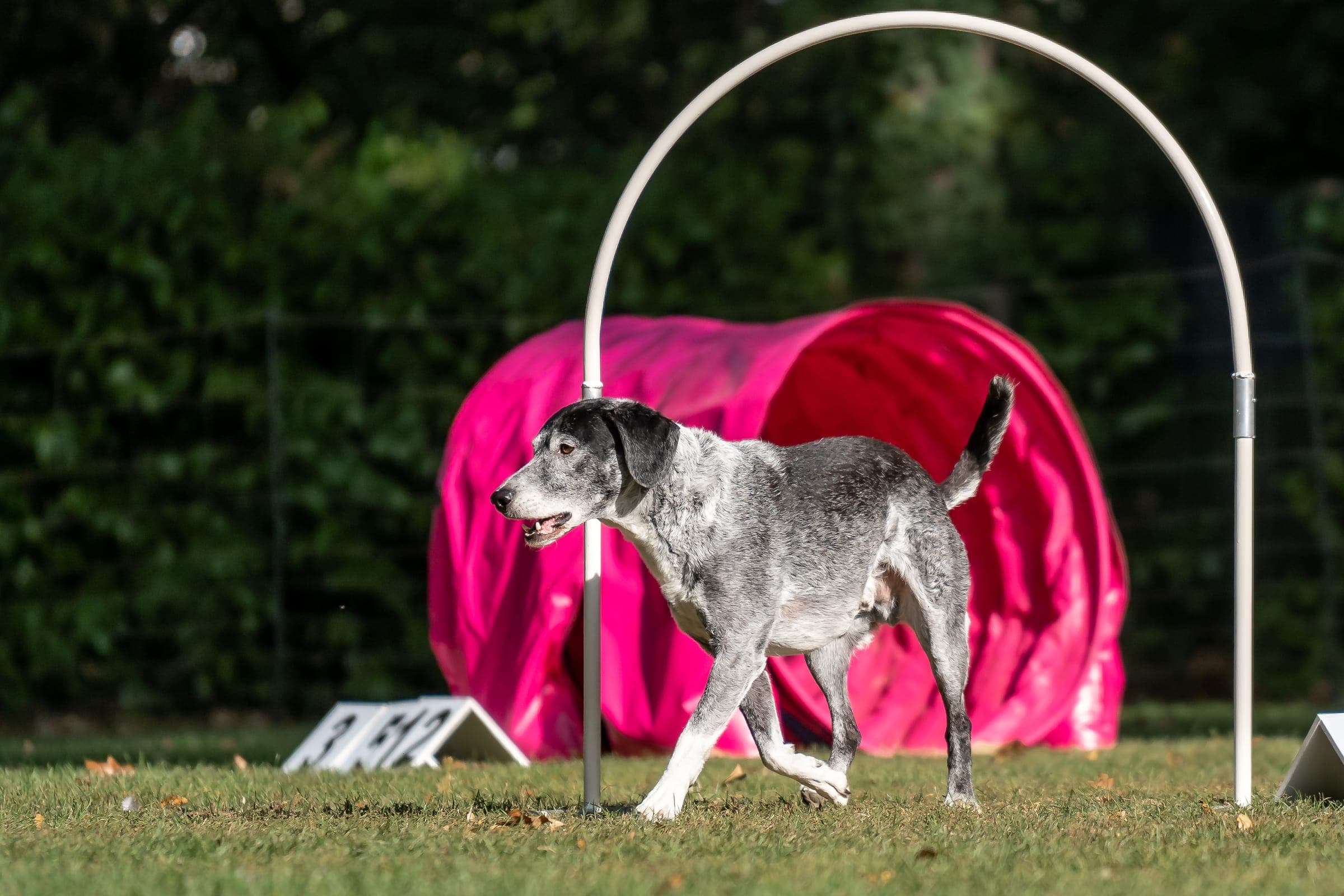
Hoopers is a course-running sport where the dog follows a numbered path through ground-level obstacles — plastic hoops, upright barrels, wing-style gates, and short large-diameter tunnels — with no jumps, no contacts, and no weave poles. The lines are designed to flow. Sharp turns are minimized by design, and the dog is expected to keep a steady ground-level stride rather than launch, land, or scramble. In modern rule sets the handler stays inside a small handling zone for most of the course and directs the dog from a distance using verbal cues, body language, and pre-trained sends.

The sport rewards a specific profile: a dog that enjoys pattern work, can read lines, and is comfortable working out away from the handler. Distance is the headline skill — not speed alone, and not micromanaged proximity handling. Because Hoopers strips jumps and contacts out of the equipment list and uses wide-bore tunnels with sweeping approaches, it's promoted as a fit for senior dogs, large and long-backed breeds, dogs recovering from a higher-impact sport, and puppies who aren't ready for jump training. "Low impact" should not be read as "no impact" for any dog with an existing orthopedic concern — turning forces at speed still load shoulders, backs, and stifles.

Origins
Early 2000s — UK origins
Hoopers grew out of the broader effort to create lower-impact alternatives to traditional agility — sports that kept the puzzle-solving and team-handling rewards of agility but stripped out the jumps, contacts, and weave poles that wear on dogs' bodies over time. The format took shape first in the UK, where private trainers developed numbered courses built around ground-level hoops, barrels, and short large-diameter tunnels. Canine Hoopers UK (CHUK) and later Hoopers International formalized the rule sets and core specifications — including the roughly 80 cm tunnel bore.
Early-mid 2000s — US adoption through NADAC
The North American Dog Agility Council brought Hoopers to the US, framing it as part of a broader "ground games" identity within its agility program. NADAC ran Hoopers as a standalone titling class through a four-level structure — Intro (HP-I), Novice (HP-N), Open (HP-O), and Elite (HP-E) — and Hoopers points contributed to NADAC's broader aggregate awards including All Around NATCH.
Mid-2010s — expansion
Canine Performance Events (CPE) folded Hoopers into its games-style class options, slotted alongside Standard, Jumpers, Snooker, and other CPE classes within the same trial weekends. UK Agility International (UKI), the US region of an international agility organization, added Hoops-and-Tunnels-style classes within its broader rulebook framework. Each org's implementation differed from the others — different handling-zone rules, different scoring patterns, different title structures.
2022 — the Grounders merger
NADAC merged Hoopers and Barrelers into a combined Grounders class. The Hoopers standalone title path was rolled into the Grounders progression, while Hoopers points continued to count toward several aggregate awards. Many older trainer blogs and references still cite the pre-2022 HP-coded structure — current NADAC handlers are working a slightly different titling picture than what those references describe.

02 · Obstacles & the line

Hoopers' obstacle list is short by design, and the equipment is ground-level by rule. Five moving parts make the picture readable from the sidelines on day one, plus one structural feature — the handling zone — that defines the sport as much as the obstacles themselves.

Element 01
Hoops
Ground-level arched frames the dog runs underneath. Hoops are the main path-defining obstacle and are arranged in arcs, lines, and serpentines to shape the numbered sequence. A correct performance has the dog choosing the right hoop in order, holding rhythm and speed, and not ducking around the frame or hesitating at the entry.
Element 02
Barrels
Upright barrels or similar markers used as wrap points. The dog is sent to circle or pass the barrel on a designated side and then drive on to the next obstacle in line. A clean wrap is tight without being sharp — the dog reads the wrap, commits, and exits on the correct line without coming around to the wrong side.
Element 03
Gates and wings
Freestanding wing or panel obstacles that define entries, exits, lane lines, and discrimination points. Gates function as path-shaping markers — sometimes as a "virtual tunnel" entrance, sometimes as a lane edge that holds the dog on a line. Success means the dog passes through or around as the course map indicates.
Element 04
Tunnels
Short large-diameter pipe tunnels, designed for sweeping approaches and exits. UK-origin rule sets specify roughly 80 cm tunnel diameter; US specs are similarly oversized relative to standard agility chute tunnels. A clean run has the dog entering the correct end at speed, exiting on line, and continuing the sequence without popping out early.
Element 05
The handling zone
A marked area on the ground from which the handler must direct the dog. The zone is the structural feature that makes Hoopers a distance-handling sport rather than a low-jump variant of agility — the dog has to work the course while the handler stays put. Zone size, shape, and how strictly it's enforced vary by organization and level.
The defining feature

03 · NADAC Grounders

NADAC is the largest US Hoopers program and the longest-running. From the early 2000s through 2022, NADAC ran Hoopers as a standalone titling class with a four-level structure: Intro (HP-I), Novice (HP-N), Open (HP-O), and Elite (HP-E). In 2022, NADAC merged Hoopers and Barrelers into a combined Grounders class — the Hoopers standalone title path was rolled into the Grounders progression, while Hoopers points continue to count toward several aggregate awards including All Around NATCH. Purebred and mixed-breed dogs are welcome; NADAC requires a dog registration number for titling rather than a kennel-club pedigree.

01
Legacy Intro (HP-I)
Entry-level Hoopers course with the shortest distances and the most generous time parameters. Foundation handling zone work; limited send-aways. Pre-2022 standalone title.
02
Legacy Novice (HP-N)
Slightly more complex courses with longer distances. More committed send-aways; cleaner zone discipline expected. Pre-2022 standalone title.
03
Legacy Open (HP-O)
Significantly more demanding distance-handling problems. Discriminations introduced; the dog must commit to obstacles further from the handler. Pre-2022 standalone title.
04
Legacy Elite (HP-E)
Highest level of pre-2022 Hoopers titling. Full distance handling, sustained zone discipline, complex sequencing.
05
Current — Grounders
Since 2022, Hoopers and Barrelers run together as the Grounders class. Hoopers points continue to count toward aggregate awards rather than standing as a standalone title. All Around NATCH requires Hoopers and Barrelers points alongside other classes; long-term awards including Platinum designations and MODSQUAD recognition incorporate Hoopers performances among many other classes.
Key facts
Eligibility
All breeds and mixes
Current class
Grounders (Hoopers + Barrelers)
Aggregate award
All Around NATCH
Prereq
NADAC dog registration
US footprint
Largest, longest-running
Good to know
Many older Hoopers references use the legacy HP-I / HP-N / HP-O / HP-E structure that predates the 2022 merger. New handlers reading older trainer blogs will be confused without context — Grounders is the current class; the HP-coded ladder is the framing those references describe.

04 · CPE Hoopers

CPE is a US agility organization with a long-running games-style philosophy — Standard, Jumpers, Snooker, Jackpot, and other named classes offered alongside core agility within the same trial weekends. Hoopers has been folded into that program as one of CPE's games options. CPE agility runs on a five-level-plus-Championship structure applied across most of its classes, and Hoopers inherits the same level shell. The trial culture is friendly and club-level where Hoopers is offered, but availability depends on what each host club puts on its premium.

01
Level 1
Entry-level CPE Hoopers course. First step in the CPE Hoopers ladder. Qualifying requirements per current CPE rulebook.
02
Level 2
Modest increase in complexity over Level 1.
03
Level 3
Mid-ladder course difficulty.
04
Level 4
Advanced-level course design.
05
Level 5
Highest standard CPE Hoopers level before Championship.
06
Level C — Championship
CPE's Championship-level designation. Specific Hoopers-Championship structure carries the broader CPE Championship rubric.
Key facts
Eligibility
All breeds and mixes
Levels
Levels 1–5 + C (Championship)
Trial culture
Games-style, club-level
Prereq
CPE ID number
Availability
Varies by host club premium
Good to know
CPE Hoopers is more accessible in some regions than others. Where it's offered, it sits inside a friendly club-level trial culture known for variety and approachability. Where it's not offered, a handler interested in CPE-style Hoopers may need to drive — or train Hoopers under another org's rules and ask a host CPE club to add the class.

05 · Compare them

Titles do not transfer. A NADAC Grounders accumulation does not confer CPE status, a CPE Level 5 Hoopers title does not appear on a NADAC record, and neither carries over to UKI. Handlers who cross-compete carry separate registrations and separate scorebooks. The foundation work — sends, wraps, distance discriminations, tunnel commitment — is the same across all three. UKI (UK Agility International, US region) runs Hoops-and-Tunnels-style classes inside an agility-first program; it's the third option but not a US Hoopers flagship.

NADAC Grounders
Role
Longest-running US program
Current class
Grounders (Hoopers + Barrelers)
Aggregate
All Around NATCH
Divisions
Proficient · Skilled
Best for
Handlers wanting the broadest US footprint
CPE Hoopers
Role
Games-style class within CPE program
Levels
1–5 plus C
Aggregate
CPE program-wide titling
Divisions
CPE standard divisional structure
Best for
Handlers near active CPE Hoopers clubs

06 · Getting started

Hoopers is one of the easier course sports to start from scratch. The equipment list is short, the obstacles don't require jump training or contact criteria, and a usable backyard setup is achievable. Most handlers still begin with a foundation class — either at a Hoopers-specific training group or at an agility school that runs Hoopers as part of its course lineup — because distance handling, send-aways, and independent obstacle commitment are easier to learn with an experienced instructor watching the picture from outside the handling zone.

What you'll need
The kit
A small set of hoops — three to six is enough for foundation work (commercial hoops $25–60 each, or PVC build-your-own). One or two barrels — free local find or about $40 each new. A short large-diameter tunnel — a used agility chute tunnel works for early foundation. High-value reward — food, toy, or both. A flat collar and standard leash for off-the-course time; runs themselves are off-leash. NADAC dog number, CPE ID, or UKI registration once you're trial-bound.
Optional but useful
Round out the setup
A handling-zone marker for backyard practice — a hula hoop on the ground, a chalk box, or four cones. Training inside the zone from day one builds the body habits the sport asks for. Video of your own runs — distance handling looks different from inside the zone than from outside it, and self-review is how most handlers diagnose late or early cue timing. A vet conditioning consult before pushing speed work for senior dogs, dogs returning from a higher-impact sport, or large and long-backed breeds.
Typical timeline
How fast it moves
Weeks 1–4: a foundation class — three to four weekly 60–90 minute sessions covering send-aways, basic distance, hoop commitment, and zone discipline. Months 1–6: confident, motivated dogs progress to first low-stakes runs within a few months of weekly practice. Year 1: a first season of trialing under one org's rules — reaching Open or Level 3 within a single season is achievable for teams training weekly. Years 2 and beyond: aggregate awards like All Around NATCH require both Hoopers and Barrelers points (in NADAC) and a sustained class schedule.
Before you enroll
Eligibility
The dog needs to be willing to drive out away from the handler. Velcro dogs can be trained into distance work, but it takes longer than starting with a dog that already enjoys working at a distance. Reactive dogs can sometimes be managed at Hoopers trials with careful timing and crating, but the venue is a standard agility-style trial environment with adjacent rings and other dogs nearby. Bitches in season face the same restrictions as in other agility-style classes; specifics vary by org.
Who Hoopers welcomes
First-time sport handlers. Handlers managing their own mobility or balance — the sport can be played from a small handling zone. Retired agility teams stepping a dog down from higher-impact work. Senior dogs, large and long-backed breeds, and puppies who aren't ready for jump training. Less of a fit for handlers who like the close-quarters running of traditional agility, and for dogs that need handler proximity to stay engaged.

07 · Trial day

Most US Hoopers trials run inside larger NADAC or CPE agility weekends rather than as standalone Hoopers-only events, so the atmosphere is the atmosphere of a small-to-mid-sized agility trial — crating areas, gated rings, a mix of seasoned competitors and brand-new teams. Independent Hoopers fun days happen at training facilities that specialize in the sport and run lower-pressure than a sanctioned trial. Either way, plan for a long day around short runs.

Day flow
How the day runs
Check-in at the secretary's table: confirm entries, present the org-specific dog registration, sign waivers, pick up the running order and any walkthrough schedule. Briefing and walkthroughs — handlers walk the course on foot, in the handling zone, to plan their cues. The run itself: handler enters with the dog leashed, removes the leash at the start area, takes position inside the handling zone, and signals readiness. Time stops when the last obstacle is completed.
What to bring
The kit
Crate, pop-up shade, water, cooling gear for warm-weather outdoor trials. A flat collar and standard leash for transit between the crating area and the ring. A folding chair, snacks, a course map highlighter, and a printed copy of the premium. High-value reward for outside-the-ring use as the host club allows.
Common mistakes
What to avoid
Stepping out of the handling zone mid-cue — the body habit of moving with the dog is hard to break, and a handler who drifts toward the next obstacle pulls the dog off line. Cuing too late — distance handling lives or dies on cue timing; the dog needs the signal early enough to commit to the obstacle while still moving. Walking the course once and trusting it — walking the same line two or three times until the sequence is automatic costs nothing and pays off immediately. Inadvertent body cues — shoulder rotation, hand direction, and weight shift do a lot of work even when feet stay planted.
What videos don't show
The reality
The walking. Highlight reels show the runs. The day is mostly walkthroughs, gate-sheet checking, crate management, and waiting for the next briefing. The waiting — Hoopers runs are short (most are under a minute) but the gaps between them stretch across hours. The variance between trials: NADAC and CPE rule cultures differ in ways that matter — gating norms, treats-in-ring policies, fun-class availability — and a handler who learned the sport at one club is sometimes startled by how a different org's trial runs.

08 · What it costs

Hoopers' cost structure tracks closely with local agility pricing — cheaper than IGP or dock diving, comparable to Barn Hunt for handlers who train at agility schools. The recurring costs are classes, per-run entry fees, and weekend travel if there's no nearby club running the org you've chosen. The largest variable is regional — Hoopers density in some US regions supports a full season of local trials, and in others a handler is driving four hours each way to compete.
One-time setup
$200$535
NADAC / CPE / UKI dog registration $20–35 per org · equipment from scratch $200–500 (hoops, barrels, short tunnel, crate, shade)
Training & classes
$150$250
Group class series (6–8 weeks) $150–250 · drop-in sessions $20–35 · privates $60–120/hr · seminars $100–250 per working spot per day
Per-trial fees
$16$20
Per-run entry fees inside CPE and NADAC trials in mid-cost US regions · higher in high-cost urban markets
Active annual
$500$4k+
Casual local $500–1k · active titling competitor $2k–4k · serious aggregate-award campaign above $4k with travel and lodging
The honest truth
The recurring expense newcomers underestimate is the gap between local and regional. A handler within driving distance of an active NADAC club can finish a first title cycle on a modest budget; a handler in a region with no local Hoopers class is paying for travel, lodging, and out-of-region private lessons before they ever fill out a trial entry. Check the org's event map and host clubs' premiums for your state before committing to a budget.
Related sports

If Hoopers interests you, look at these too.