Sport Profile

Discover Mantrailing

A dog-led scent sport where the team follows one specific person's odor from a scent article — cutting corners, working scent pools, and solving real-world scent puzzles. Distinct from the precision footstep tracking of AKC and IGP.

Jump to a section

01 · What is it

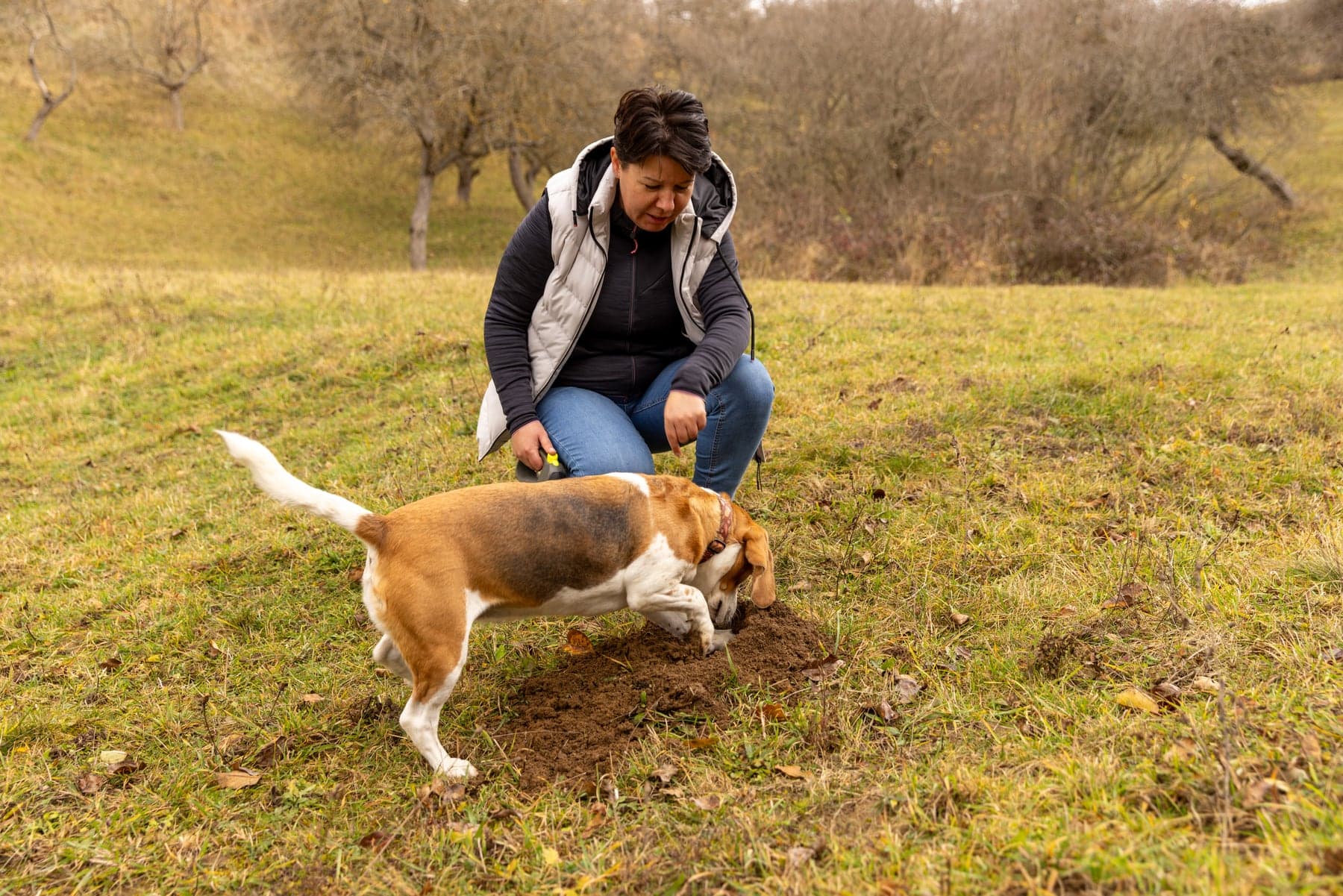
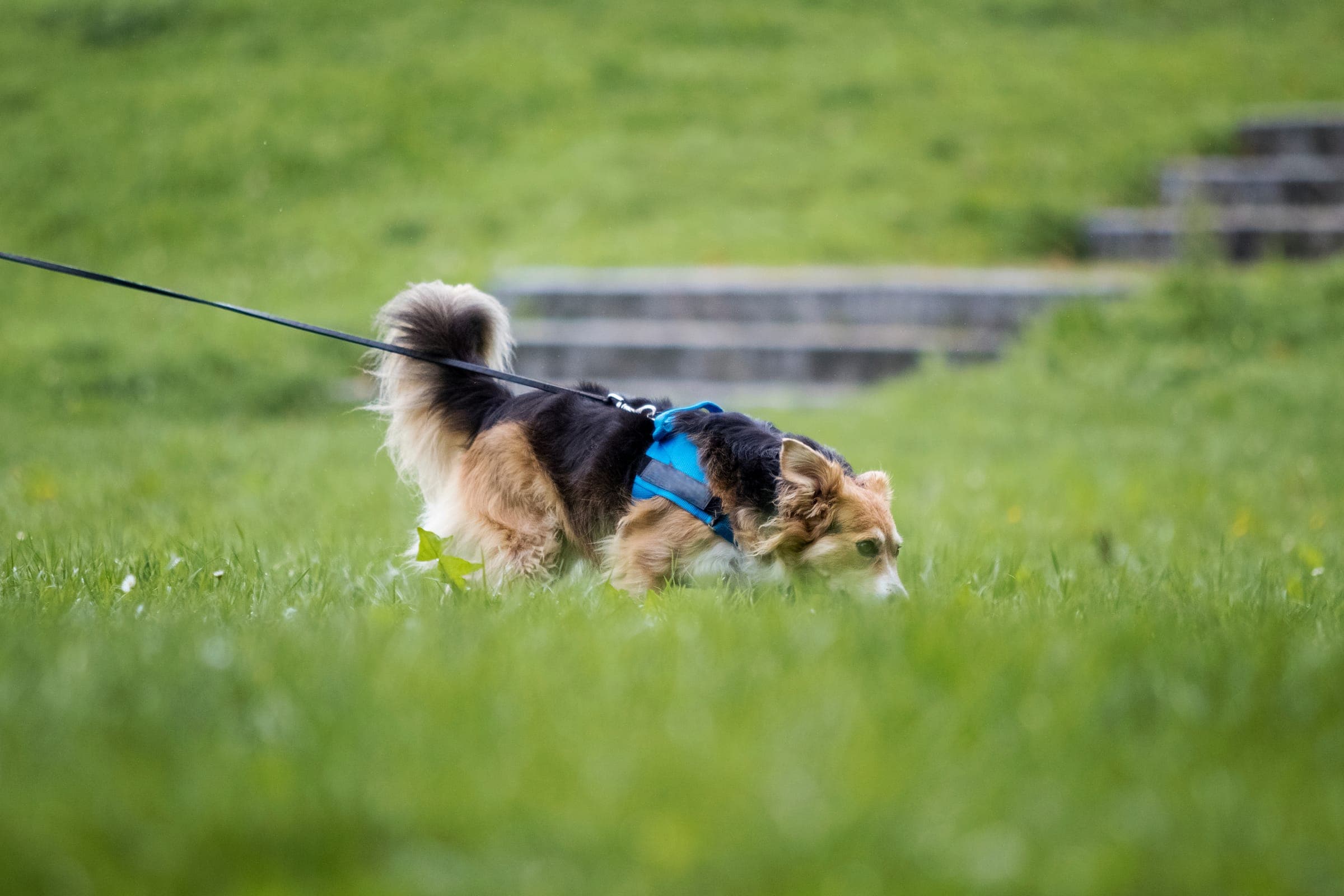
Mantrailing is a scent sport where the dog locates a specific person — the "missing" runner — using that person's odor on a scent article like clothing, a hat, or a worn glove. The dog wears a harness and works on a long line, with the handler behind reading line tension, pace, and body language. Unlike tracking, where the dog stays close to the precise footstep path, the mantrailing dog discriminates the runner's individual odor from everyone else's and follows the scent wherever it goes — including pools at doorways, cones drifted on the wind, and shortcuts that skip the actual route the runner walked. The find can be a formal indication (sit, down, bark) or the dog clearly making contact with the runner; the school decides.

Mantrailing welcomes a wide range of dogs. Success comes from olfactory ability and problem-solving more than athletic build, so high-drive scent hounds, working breeds, herding breeds, and small companion dogs all show up on instructor rosters. Teams work one at a time, with other dogs crated or parked away from the working area, which is why many US instructors describe the sport as suitable for reactive or socially uncomfortable dogs — though human proximity and environmental triggers still need to be managed honestly. Physical impact is lower than agility, dock diving, or protection sports: sustained walking on uneven ground, occasional inclines, weather exposure. The handler workload is real — line management, reading the dog, navigating safely past traffic and obstacles — and is part of what the sport teaches.

Origins
Working roots
Mantrailing comes out of centuries of bloodhound use for locating people and from the broader SAR discipline of "trailing," where a dog follows one person's individual odor rather than a generic ground track. SAR and police K-9 literature distinguishes tracking (precise footstep work) from trailing (scent-cone work, the dog may travel parallel to or off the footstep line as long as it's following the right person).
European sport consolidation
Recreational mantrailing — trailing as a sport for pet handlers, structurally separate from operational SAR — consolidated first in Europe. Germany and the UK developed private schools offering structured curricula and trail days for companion dogs. Mantrailing Global emerged from this European context with a standardized "mantrailing for fun" curriculum and an instructor accreditation process.
North American adoption
Mantrailing concepts spread to North America through SAR cross-pollination, imported European training methods, and visiting instructors running workshops. Unlike Nose Work or Barn Hunt, mantrailing never coalesced around a single US registry. A patchwork formed: working-dog bodies (NPBA, NNDDA), the American Bloodhound Club's sporting trailing program with formal trial titles (MT, MTI, MTX), and independent sport schools — some Mantrailing Global–accredited, some home-grown.
Today
Interest in scent-based sports has grown sharply among pet handlers since the late 2010s, and mantrailing has risen with it. Mantrailing Global publishes US-accredited instructor listings; ABC continues to license trailing trials for bloodhounds; SAR-oriented workshops continue through NPBA and NNDDA. National championship structures comparable to AKC's events have not emerged — recognition takes the form of ABC club titles, internal level certificates, instructor accreditations, or pure training-journal milestones.

02 · Shape of a trail

Mantrailing instructors frame the work as scent problems, not "courses." Difficulty scales by stretching trail age, adding contamination, multiplying decoy runners, and moving the team from quiet rural paths into busy urban environments.

Phase 01
The scent article and the start
The runner lays the trail in advance and leaves a scent article — a worn item carrying their odor — for the dog. The handler presents the article at the start point, the dog samples the scent, and the team commits to a direction. A clean start looks like clear commitment, not a wide cast searching for any human scent. Some schools fully randomize start direction so the handler can't help.
Phase 02
Trail age, weather, and surface
Beginner trails are fresh and short; advanced trails age for hours and stretch across mixed terrain. Working-dog trailing tests cite reliability at 4–6 hours of trail age. Heat, humidity, wind, and surface (grass, gravel, pavement, hard surfaces near doorways) all change how scent behaves and where the dog has to work the scent cone to recover the line.
Phase 03
Contamination and cross-runners
Contamination — adding other people's scent — is the central distinction between mantrailing and easier scent games. Decoys walk near, across, or away from the trail. Bystanders pass through. At higher levels, multiple people stand at the end and the dog must indicate the correct runner from a group. This is the discrimination test that defines the sport.
Phase 04
The find and the indication
Trails end at the runner — a live person, not an article. Some schools teach a formal indication (sit, down, bark) on contact; others treat clear engagement with the runner as the find. The handler reads body language at the find moment and rewards immediately.
Person, not article

03 · ABC trailing

The American Bloodhound Club runs a sporting trailing program with three published titles. The program is restricted to bloodhounds. Teams must first pass an Event Entry Certification Test (EECT) before entering titling events. Trials are judged by two judges, run on a one-hour time limit, and include cross-runners and harder scent-discrimination problems at higher levels. ABC explicitly designates its program as a sport rather than SAR qualification; titles are eligible for AKC recognition as parent-club titles, but AKC does not run mantrailing events itself.

PR
EECT
Event Entry Certification Test. Confirms the team is ready for trial conditions before entering titling events. Pass / fail. Functions as the entry gate to the title ladder, similar in spirit to the NACSW ORT.
01
Mantrailer (MT)
Entry-level trailing test. The dog must trail a specific person and correctly identify the runner. Moderate length and age, with limited contamination compared to higher levels. One pass earns the MT.
02
Mantrailer Intermediate (MTI)
Longer and older than MT. Cross-runners and additional scent-discrimination challenges added. Handlers must maintain a dog-led approach — restraining or steering the dog can cost the run. One pass earns the MTI.
03
Mantrailer Excellent (MTX)
Highest published level. Maximum trail age and length for the ABC ladder, with the most difficult scent-discrimination problems and multiple-person finds. One pass earns the MTX.
Key facts
Eligibility
Bloodhounds only
Levels
MT · MTI · MTX
Scoring
Pass / fail · 1-hour limit · 2 judges
Prereq
Pass EECT before titling
Recognition
AKC parent-club titles
Good to know
ABC trials use a one-hour time limit. Common disqualifications include failure to report to the start on time, aggression toward judges or runners, and failure to identify the correct runner. Females in season, intact-dog handling, and any other recent rule updates should be confirmed against the current ABC trailing rulebook before entering.

04 · Mantrailing Global

Mantrailing Global is an international organization that publishes a standardized recreational mantrailing curriculum and accredits instructors who teach it. The program is open to dogs of all breeds and sizes, with explicit framing as "mantrailing for fun" rather than SAR or operational certification. Teams progress through internal levels under their instructor; instructors progress through Mantrailing Global's accreditation pathway. The US footprint is a growing list of accredited instructors and the active US community group rather than a national championship.

01
Introductory / Foundation
Build the dog's understanding that the scent article means "find this person." Short fresh trails, runner sometimes in line of sight, quick rewarding finds. Short distance, fresh trail age, minimal contamination, simple environments. Instructor-assessed readiness to progress.
02
Progression
Add trail age, distance, cross-runners, and environment changes (suburban streets, parking lots, mixed surfaces). Aged trails, contamination layered in, more complex turns and scent pools. Instructor-assessed readiness to move into advanced work.
03
Advanced
Multi-hour-aged trails, dense urban environments, multiple-person finds, and the kind of scent puzzles that resemble — but are not equivalent to — SAR-style work. Long-aged trails, complex contamination, multiple decoys at the find, varied surfaces. Instructor-assessed advanced certificate. No nationally recognized title equivalent.
04
Independent layer
Many US sport-mantrailing teams train with instructors who are not Mantrailing Global–accredited. These schools use similar terminology and similar progression logic, but their certificates of completion are local to that school. Cross-school transfer credit doesn't exist — a team moving regions re-baselines with the new instructor regardless of certificates.
Key facts
Eligibility
All breeds and mixes
Levels
Intro · Progression · Advanced
Scoring
Non-competitive · instructor-assessed
Prereq
None — open enrollment
Recognition
Course certificates only
Insider vocabulary
"Scent article" (sometimes shortened to "article"), "trail aging" (time between trail laying and running), "contamination" or "cross-tracks" (extra human scent added to increase difficulty), dogs being "in odor," "working it out," or "losing the trail." Community phrases like "trust your dog," "let the dog lead," and "don't over-handle the line" are not slogans — they're the technique cues handlers give each other on trail days.

05 · Compare them

Two structurally distinct ecosystems sit side by side. ABC titles can be recorded on AKC pedigrees through parent-club recognition. Mantrailing Global level certificates have no AKC or UKC pedigree pathway. NPBA and NNDDA — operational law-enforcement and SAR bodies — sit outside the hobbyist field and are the right answer only if you're already in that work.

ABC Trailing
Eligibility
Bloodhounds only
Style
Formal trial · published rules
Levels
MT · MTI · MTX
Scoring
Pass / fail · 2 judges
Best for
Bloodhound handlers wanting titles
Mantrailing Global
Eligibility
Any breed or mix
Style
Recreational · low pressure
Levels
Intro / Progression / Advanced
Scoring
Non-competitive · instructor-led
Best for
Pet handlers, reactive-friendly format

06 · Getting started

Most US newcomers enter mantrailing through an introductory workshop or a short course with a local instructor rather than through an ABC trial. Self-training from videos or written materials is widely discouraged — poor line handling, over-helping the dog, or setting unsolvable trail problems can build lasting training issues that take longer to fix than to prevent. The biggest practical barrier is finding qualified instruction.

What you'll need
The kit
A well-fitting trailing harness with full shoulder range — pulling into the line is part of the work. A long line (20–30 ft is standard). Scent articles — worn clothing, hats, gloves, stored in sealed plastic bags. A high-value reward, food or toy, delivered at the find. Field gear: boots, weather layers, water for the dog, reflective gear for low-light trails. ABC registration and scorebook for bloodhound handlers pursuing titles; instructor enrollment for Mantrailing Global and independent-school students.
Typical timeline
How fast it moves
Month 0–1: introductory workshop or first few starter sessions. Line handling, body language reading, short trails with visible or briefly-out-of-sight runners. Quick successful finds to build the dog's commitment. Months 1–6: regular trail days or class sessions, with trail age, distance, and contamination growing under instructor guidance. Year 1 and beyond: aged urban trails, multiple-person finds, and — for bloodhound handlers — EECT preparation followed by MT trials.
Before you enroll
Eligibility
A dog physically able to sustain walking on uneven ground in variable weather. Orthopedic and respiratory issues should clear veterinary review before longer or more demanding trails. A handler comfortable letting the dog lead — mantrailing punishes over-handling. Realistic expectations about access: mantrailing is not a drop-in class sport in most US regions; finding a workshop or regular instructor takes research and often travel.
Common myths
What newcomers get wrong
"Mantrailing is the same as AKC tracking." It isn't — tracking dogs stay on the precise footstep line; mantrailing dogs follow the runner's individual odor wherever it goes. "I can learn this from YouTube." Poor line handling and unsolvable problems build training issues faster than skills. "My dog has to be a bloodhound." Any breed or mix can sport-train; ABC titles are the bloodhound-only exception.
Who mantrailing welcomes
Any breed or mix with a working nose and the stamina for sustained walking. Reactive-friendly format with caveats — teams work one at a time with well-spaced staging, but human proximity at the find must be managed honestly. Handlers willing to drive for qualified instruction. The binding constraint is instructor density, not breed or temperament.

07 · Trail day

Most mantrailing events for pet handlers are workshops or trail days rather than formal trials. Teams work one at a time across a property, park, neighborhood, or urban area, with other handlers parked at a distance and other dogs crated or in vehicles. ABC trailing trials are more structured — check-in, judge briefings, scheduled trail start times, scorebooks, and stricter rules on dog temperament and runner identification.

Workshop or trail day
How a typical day runs
Briefing: safety, scent theory, the day's trail plan, runner assignments. Equipment checks. Trail rotations: each team runs several short trails through the day, with other handlers acting as runners and bystanders. Rest between runs: teams sit out for substantial stretches; crates, water, and shade matter. Debrief: instructor walks the trail with the handler post-run, points out where the dog was in odor, where it lost or recovered the line.
ABC trial day
How a formal trial runs
Check-in and identification: scorebook presented, dog verified. Judges briefed on the trial schedule. Trail laid in advance: the runner walks the trail, articles placed, trail ages under the rule book. Run the trail: one-hour time limit, two judges follow, handler must let the dog lead — overt restraining or steering can disqualify. Identify the runner: at the find, the dog has to identify the correct person. Wrong identification fails the trial.
What to bring
The kit
Trailing harness, long line, and high-value reward for the post-find moment. Crate and rest setup in the vehicle — mantrailing days run long; rest between runs is the difference between focused dogs and overworked ones. Water, weather layers, sun protection, and food for both dog and handler. A training journal — recording trail length, age, environment, weather, and dog behavior is how mantrailing handlers track progress.
Common mistakes
What to avoid
Starting too fast — pulling the dog out of the start before it has committed to direction. Talking the dog through the trail — constant verbal cueing replaces scent commitment with handler dependence. Steering with the line — pulling through corners or away from scent pools trains the wrong habit. Missing the dog's small changes — subtle shifts in head carriage, pace, and line tension at corners and hard-surface transitions are the difference between a recovered line and a wide miss.

08 · What it costs

Mantrailing's cost structure reflects its workshop-led, instructor-driven nature rather than a standardized trial-fee model. Per-session costs are moderate; the variability comes from how often a team trains, how far they have to travel to reach an instructor, and whether they pursue ABC titles or stay in the Mantrailing Global / independent recreational layer.

One-time setup
$50$140
Trailing harness $30–80 · long line $20–60 · scent articles improvised from worn clothing
Workshops & classes
$100$250
Intro workshops $100–150 for a half-day or full-day · multi-session class series higher · privates $60–120/hr
Trail days
$30$75
Per team per session in school listings · some donation-based, others structured workshops
Active annual
$500$4k+
Casual $300–700 · active competitor low four-figures with travel · ABC title-track or instructor-track several thousand
The honest truth
Compared to sports with packed weekly trial weekends, mantrailing's per-event costs sit lower. The total bill is driven by how far the handler has to drive to reach qualified instruction — the binding constraint in many US regions. Casual participation stays cheap; consistent advanced work does not.
Related sports

If Mantrailing interests you, look at these too.