Sport Profile

Discover NASDA

A multi-game scent program where dogs trail safely caged rats through fields and parking lots, hunt shed antlers in cover, and locate lost personal items against a clock — five real-world tests of independent hunt drive under one governing body.

Jump to a section

01 · What is it

NASDA Scent Games are a set of five outdoor scent disciplines run by the North American Sport Dog Association, each asking the dog to find a target (a caged rat, a shed antler, or a personal item) inside a defined search area and time limit. The five games are Trailing & Locating, Trailing Brace, Urban Locating, Shed Dog, and Lost Item Recovery. The handler manages the line, reads the dog, and calls the find. The dog hunts.

NASDA's identity is real-world scent — outdoor, environmental, less rule-mapped than container-and-element nose work. The judging standard is whether the dog has located the target, not whether it executed a formal indication; the judge calls 'yes' when satisfied. Open to all breeds and mixes — the founding pitch was admitting dogs that aren't terriers or hunting hounds into traditional working tasks. One team works the search field at a time, which helps reactive dogs (staging-area density varies by host). Physical demands are moderate — walking and trotting on varied terrain, low-impact relative to jumping sports, but the days are long.

Origins
2016
NASDA founded to give working-dog tasks — vermin location, shed hunting, practical search — competitive venues outside working-terrier circles and hunting communities. Founding pitch: admit pet and non-traditional breeds into work that registry-driven sports had kept narrow.
Codification
A single Master Handbook defines classes, levels, time limits, scoring, and trial conduct across all games. Trailing & Locating and Shed Dog ran from the start; Urban Locating, Lost Item Recovery, Trailing Brace, and Den hunts came later.
Recent
Regional Championships and a national Invitational with host sites published through 2028. Versatility Awards aggregate points across the five core games. Junior handler programs have dedicated IDs, divisions, and Invitational invitations.
Today
Open to all breeds and mixes. NASDA dog registration is $30 per dog, a single number that covers the dog across every NASDA game for life.

02 · How a run works

Every NASDA game is a timed search inside a judge-defined area, with a target appropriate to the game and a clear protocol for what counts as a find. The five games share that skeleton. They diverge on what the dog hunts, whether the team is on or off leash, and how complex the scent picture and environment become at higher levels.

Game 01
Trailing & Locating
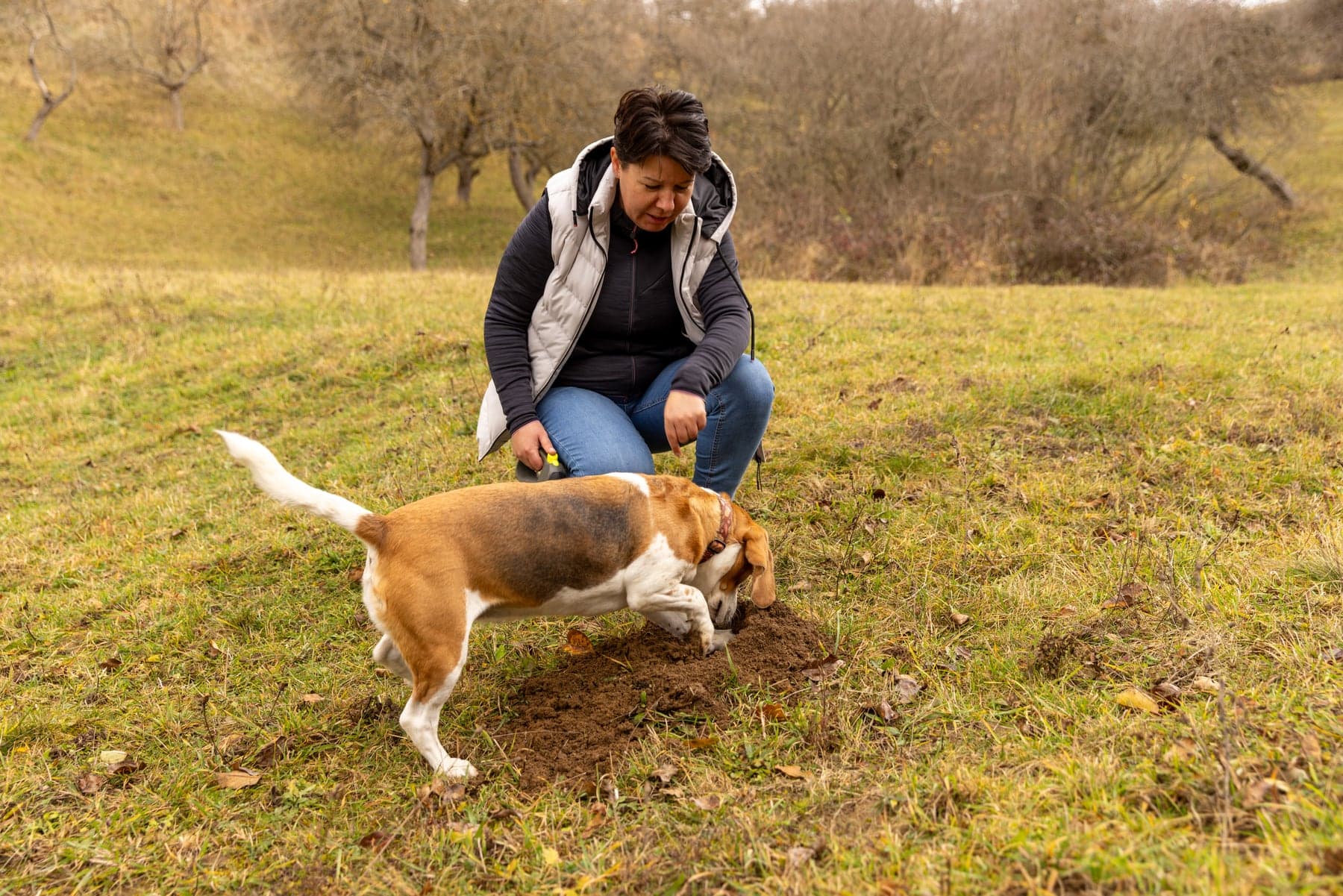
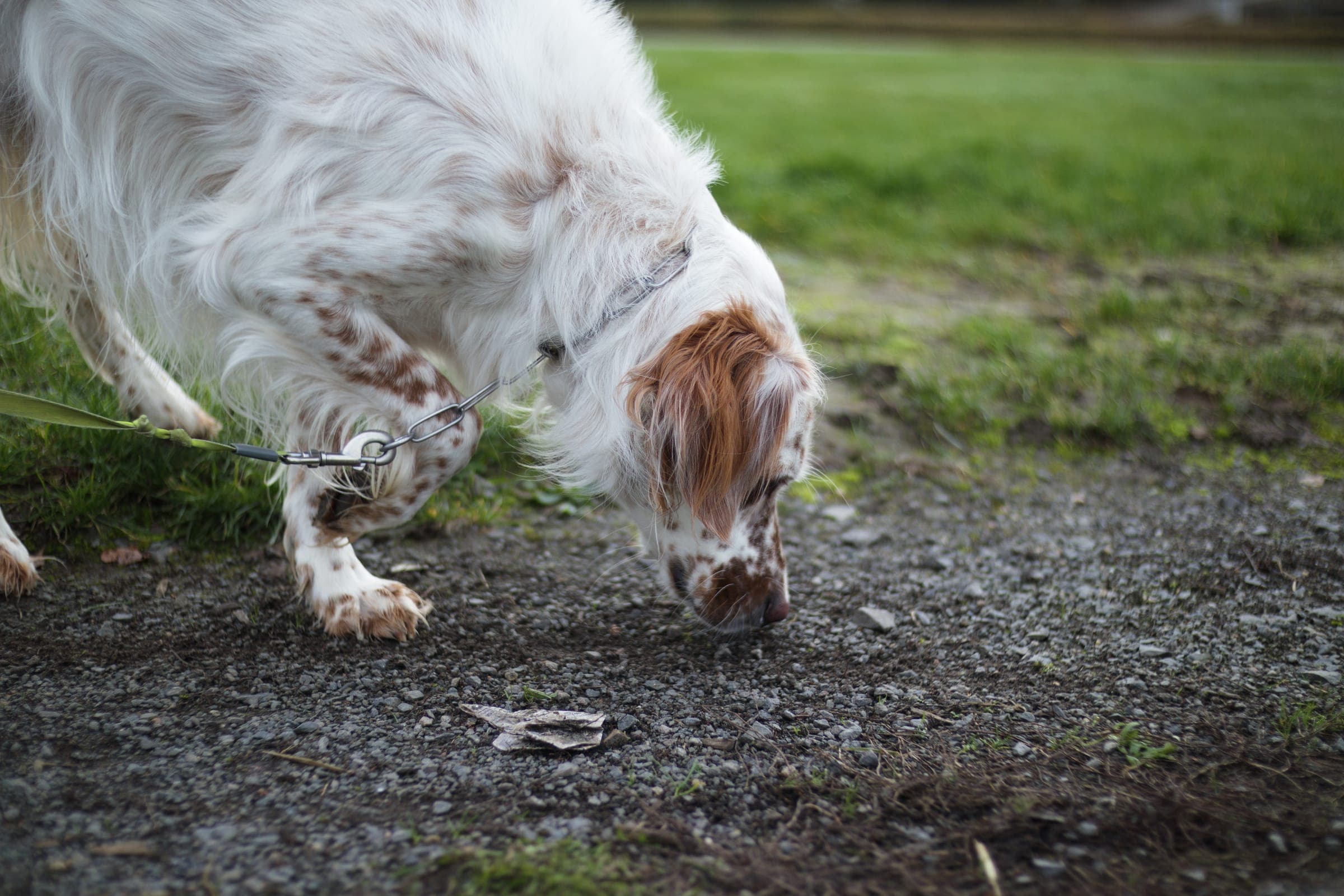
The dog follows a laid trail of rat scent across natural terrain to a caged-rat quarry positioned above ground or in cover. Lower levels: shorter trails on cleaner ground. Higher levels: distance, complex terrain, decoy scent, or false quarry. Nose-deep and methodical — the dog stays on the line, problem-solves through scent breaks, and indicates at the cage.
Game 02
Trailing Brace
Two dogs run the trail together off leash, with the same caged-rat quarry and trail mechanics as Trailing & Locating. The added difficulty is cooperation, control, and reading two dogs simultaneously. Judges weigh safe interactions at the cage.
Game 03
Urban Locating
All levels on leash. Caged-rat quarry hides in or around man-made structures — parking lots, alleys, vehicle lines, building exteriors. The scent picture is broken by exhaust, foot traffic, and warm pavement. Higher levels add hide complexity and environmental distractions.
Game 04
Shed Dog
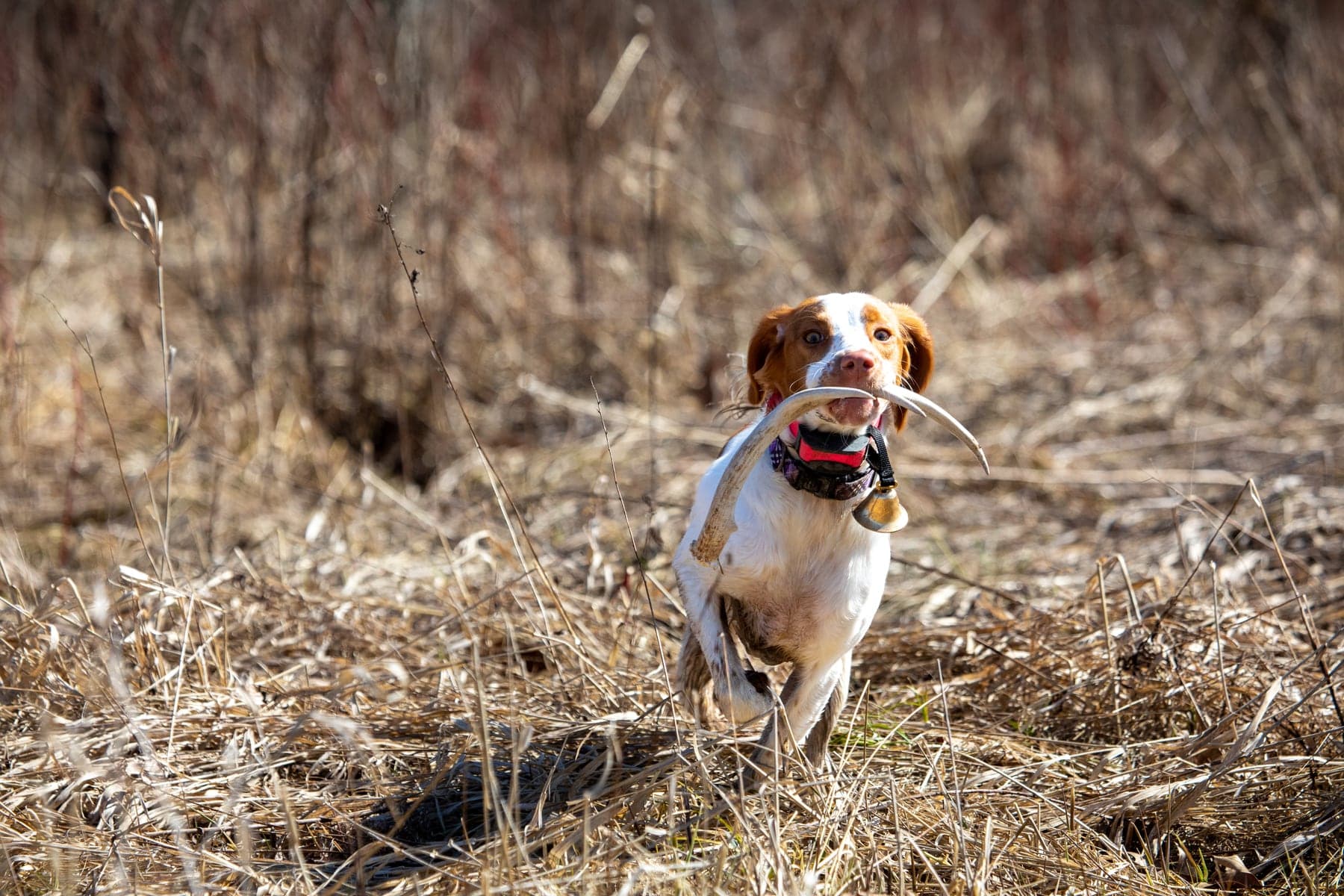
The dog searches field, brush, or wooded ground for naturally shed ungulate antlers. Lower levels hide one antler in lighter cover. Higher levels: multiple antlers, larger search areas, denser cover, greater distance from the handler. The skill is staying in the search area, working into wind, and either retrieving or clearly marking the find.
Game 05
Lost Item Recovery
The dog searches a defined area for a single personal item — keys, wallet, phone — among multiple distractor objects. Higher levels add inaccessible hides. The online format imposes strict handler protocol: start position, five-foot distance, alert-call timing. Handler-rule violations negate otherwise correct finds.
Across all games
Time, area, and the find
The judge defines the boundaries, the time limit, and the target. The dog wins or loses on whether it locates the target inside the area within time. NASDA does not require a specific trained alert — the judge calls 'yes' when satisfied that the dog has located the target. Handlers are encouraged to know their dog's natural indication rather than impose a fixed behavior.
The protocol

03 · NASDA the org

NASDA owns the program. There are no parallel sanctioning bodies offering the same titled games in the United States, and AKC and UKC do not operate Title Recognition Programs for these formats. Cross-training is common — barn hunt, earthdog, AKC and UKC scent work, NACSW K9 Nose Work — but the titles do not transfer. A NASDA-titled dog earns its titles inside NASDA.

01
Governance
NASDA writes the Master Handbook, sanctions clubs, supplies judges, and records titles. The handbook is the single source of truth and is revised periodically as new games and rules are added.
02
Eligibility
All breeds and mixes. No pedigree, registry, or breed-group restriction. Mixed-breed and rescue dogs compete on equal footing with purebred, AKC-registered, or UKC-registered dogs.
03
Five games, one rulebook
Trailing & Locating, Trailing Brace, Urban Locating, Shed Dog, and Lost Item Recovery — all governed by one Master Handbook. Cross-training across games builds toward Versatility rankings.
04
Championship infrastructure
Regional Championships and a national Invitational anchor the calendar; future Invitational host sites are published through 2028. Versatility Awards aggregate points across the five core games. Juniors have dedicated IDs and Invitational invitations, with stated 2026 goals around free or near-free junior entries.
05
Identity
The judge calls 'yes' when satisfied the dog has located the target — no formal indication required. The cultural framing handlers use is real-world scent — outdoor, environmental, less pattern-driven than container nose work. Trial culture skews welcoming and low-key.
Key facts
Games
5 — T&L · Brace · Urban · Shed · LIR
Eligibility
All breeds & mixes
Prereq
NASDA dog # only
Reg fee
$30 per dog
Founded
2016
Good to know
A single $30 lifetime dog number covers every NASDA game. Mixed-breed and rescue dogs compete on equal footing — no pedigree or registry required.

04 · Title progression

NASDA structures each of the five core games on a multi-level ladder, with championship and Versatility titles layered on top. Lower levels run shorter trails, simpler hides, and single quarry; higher levels stack distance, complex terrain, decoy scent, and harder hide placement. Exact title abbreviations and points formulas live in the Master Handbook, which is revised periodically — handlers pull the current handbook before entering.

01
Trailing & Locating
The program's anchor game. The dog follows a laid rat-scent trail across natural terrain to a caged-rat quarry. Lower levels: shorter trails on cleaner ground. Higher levels: distance, complex terrain, decoy scent, or false quarry.
02
Trailing Brace
Same trail mechanics as T&L, with two dogs working the trail off leash together. Difficulty adds cooperation, control, and reading two dogs simultaneously. Brace pairings — familiar dogs, mixed-handler braces, sibling pairs — are part of the strategy.
03
Urban Locating
All levels on leash. Caged-rat quarry hidden among parking lots, alleys, vehicle lines, and building exteriors. The scent picture is broken by exhaust, foot traffic, and warm pavement. Pottying on course is a disqualifier — a real factor in built environments.
04
Shed Dog
Naturally shed ungulate antlers hidden in field, brush, or wooded ground. Higher levels: multiple antlers, larger search areas, denser cover, greater distance from handler. Qualifying depends on locating the required number of antlers and retrieving or marking per level standard.
05
Lost Item Recovery
A single personal item — keys, wallet, phone — among multiple distractor objects. Advanced levels add inaccessible hides. Online entries impose strict handler protocol (start position, five-foot rule, alert-call timing); handler-protocol failures NQ otherwise correct finds.
Key facts
Levels
Multi-tier per game + championship
Championships
Regional + Invitational
Versatility
Aggregates across all 5 games
Juniors
Dedicated program + Invitational
Source
NASDA Master Handbook
Versatility, Regional, Invitational
Versatility Awards aggregate points across all five games; handlers who title in multiple games rank against the top 50. Top 25 placements per class and level determine Invitational invitations. Active competitors layer entries across multiple games per weekend — the calendar drives the math as much as the dog does.

05 · Which game fits

NASDA is one organization. The real decision a newcomer faces is which of the five games — for this dog, this handler, and this environment. The games share a scent-and-search foundation but ask for different temperaments, environments, and handling styles.

Trailing & LocatingTrailing BraceUrban LocatingShed DogLost Item Recovery
TargetCaged ratCaged ratCaged ratShed antlerPersonal item
EnvironmentField, natural coverField, natural coverParking lots, alleys, structuresField, brush, wooded groundOutdoor or semi-urban with distractors
On / off leashPer levelOff leash, both dogsOn leash, all levelsPer levelPer level; online enforces start-line distance
Solo or pairedSoloTwo dogsSoloSoloSolo
Handler protocolStandardBrace controlLeash + boundary disciplineStandardStrict — start position, five-foot rule, alert timing
Common NQ sourceOff-trail, handler error at cageBrace dog interactionsPotty on course, leash mistakesOut-of-area, missed antlerHandler-protocol failures
Best fit dogMethodical scent workerTwo trail-driven dogs that work togetherConfident in built environments, traffic-tolerantDog with shed-hunt interest or strong scent generalizationIndependent searcher willing to indicate at distance
Which game sounds more like you?
You want the most traditional NASDA experience and a dog that loves to read a line of scent.
Trailing & Locating is the program's anchor game and where most newcomers start. Trail in, find the rat, indicate. The handler stays back and reads the dog.
You and a friend (or your two dogs) want to run together off leash on a real trail.
Trailing Brace. The mechanics match T&L; the test is two dogs and two handlers cooperating around the same scent picture and the same cage. The right pairing is the project.
You live in a city, your dog is built for noise and concrete, and you want a sport that fits where you walk.
Urban Locating. On-leash work in parking lots and alleys looks like the rest of your dog's life. The handler discipline is real, but the environment is the point.
You hunt, you handle a dog that retrieves, and shed antlers are already part of the conversation.
Shed Dog. NASDA gives shed work a structured competitive home. Higher levels — multiple antlers, denser cover, greater distance — reward dogs already doing functional shed hunting outside the trial calendar.
You want a sport you can practice in a backyard with everyday objects, and your dog has nose without needing live quarry.
Lost Item Recovery. Keys, wallet, phone, and a scattering of distractor objects. The handler protocol is the steepest rule curve — start position, five-foot rule, alert-call timing — but the practice setup is the cheapest of the five.
You want to chase a Versatility ranking or an Invitational invitation.
Multiple games, layered across the calendar. Versatility points aggregate across all five core games, and active competitors stack entries to build the math. The dog and the calendar both have to be ready.

06 · Getting started

Most NASDA teams come in through a local club running real-world scent or NASDA-style classes, or through a private trainer with a NASDA judge or seminar background. NASDA hosts exhibitor-resource lessons online — including guidance for Lost Item and T&L online entries — but hands-on coaching matters for reading dogs, line management, and meeting the handler-protocol bar.

What you'll need
The kit
A NASDA dog number ($30 lifetime). A flat collar or harness plus a long line — 10 to 30 feet depending on the game (T&L runs longer; Urban runs leashed). Rewards. The host club supplies the caged rats for T&L, Brace, and Urban; antlers and personal items are typically handler-provided for practice and host-supplied for trial. Outdoor day kit — crate or vehicle setup, water, shade canopy, weather layers.
Optional but useful
Specialty gear
Practice antlers and antler scent for Shed Dog ($20–$50). A small distractor-object set for Lost Item Recovery — five to ten 'junk' items rotated for practice (under $30 from household objects). A cooling vest or shade-management plan for summer trials on exposed ground.
Typical timeline
How fast it moves
With consistent training, most teams run their first NASDA entry within 3–9 months. Prior scent-sport experience (NACSW, AKC Scent Work, barn hunt) compresses the timeline. Active teams reach advanced levels in one or two games inside years 1–3 and start cross-training a second or third game for Versatility points. Travel is the throttle, not training — sparse-region teams progress more slowly simply because there are fewer trial dates.
Before you enroll
Eligibility
Minimum competition ages are codified in the Master Handbook and may shift with revisions; pull current minimums before committing. Comfort working around other dogs in staging matters — NASDA runs one team on the field at a time, but staging and warm-up areas can be tight. Bitches-in-season policy varies by venue; confirm with the trial secretary. Rule density matters — equipment, potty, leash, and Lost Item handler-protocol rules NQ teams that otherwise nose-work cleanly. The community line: more dogs lose to handler error than to dog error.
Who NASDA welcomes
All breeds and mixes — the founding pitch was opening traditional working tasks to dogs that aren't terriers or hunting hounds. Reactive-friendly format with caveats — one team on the search field at a time, with staging density varying by host. Cross-training friendly — handlers often run NASDA alongside barn hunt, earthdog, and nose work.

07 · Trial day

NASDA trials feel like small- to mid-sized outdoor scent events. Multiple search areas run in parallel and teams rotate through rather than gathering ringside. First-time handlers most often report nerves around unfamiliar rules and reading their dog under pressure — most dogs adapt within a run or two.

Day flow
How the day runs
Check in, confirm your NASDA dog number, pick up running orders by game and level. Judge's briefings before each game walk through search boundaries, time limits, and any site-specific rules. Teams rotate one at a time through each search area. A full day is 60–90 minutes of search and the rest is waiting, walking between search areas, managing the dog between games, watching weather. Regionals and the Invitational compound the load with multi-day weekends and mixed terrain.
What to bring
The kit
Crate or secure vehicle setup, water, shade canopy, weather layers. Multiple leashes and lines for different terrains, plus a long line for trail games. Rewards that comply with venue rules. Comfortable shoes for fields and uneven ground. A folding chair, snacks, printed premium and Master Handbook references for rules you're still learning. Cooling gear for warm-weather regions; layers for shoulder seasons.
Common mistakes
What to avoid
Skimming the rulebook — NQs for pottying on course, crossing boundaries, leash mistakes in Urban, and handler-protocol failures in Lost Item are the most common preventable failures. Over-handling on the trail — trying to steer the dog instead of letting it work scent. Underestimating walking and day length. Treating Lost Item like containers nose work — the handler-protocol rules are stricter than container work and NQ otherwise correct finds.
What handlers say
The vocabulary
A trail run is shorthand for a T&L or Brace search. Quarry boxes or rat boxes is barn-hunt-imported slang for the caged-rat hide. Real-world scent is the cultural framing handlers use to contrast NASDA with more pattern-driven nose work — outdoor, messy, environmental. Junk fields describes Lost Item setups dense with distractor objects.

08 · What it costs

NASDA sits in the moderate range for titled scent sports — entries are reasonable, equipment is modest, and the recurring cost driver is travel. Versatility math rewards layered entries across multiple games, and Regional or Invitational qualification rewards travel.

One-time setup
$30$500
NASDA dog # ($30 lifetime). Starter gear — collar/harness, long line, crate, chair, shade canopy. Antler tools or Lost Item distractor set add a small premium.
Training & classes
$25$300
Group classes $25–$45 per session, or $150–$300 for a 6–8 week series. Privates $60–$120/hr where available. Seminars $80–$200/day for working spots.
Per-trial fees
$20$110
Local trial entries $20–$35 per run. Championship-level (Showcase, Invitational) entries $65–$110. Versatility entries (four sports) $270–$380.
Active annual
$500$5k+
Casual local participant $500–$1.2k. Active competitor across multiple games $2k–$5k. Championship-track with sustained travel $5k–$10k+.
The honest truth
Per-entry costs are reasonable — $20–$35 at local trials, $65–$110 at championships. The recurring expense newcomers underestimate is the calendar. A casual first-game title is reachable for well under $1,000 all-in if a club is local. A Versatility ranking belongs to handlers who travel.
Related sports

If NASDA Scent Games interests you, look at these too.