Sport Profile

Discover Paddleboard with Dogs

Stand-up paddleboarding with a dog on the deck — flat-water paddling, a calm dog, and a sport that runs on outfitter clinics and one-off records rather than a national rulebook.

Jump to a section

01 · What is it

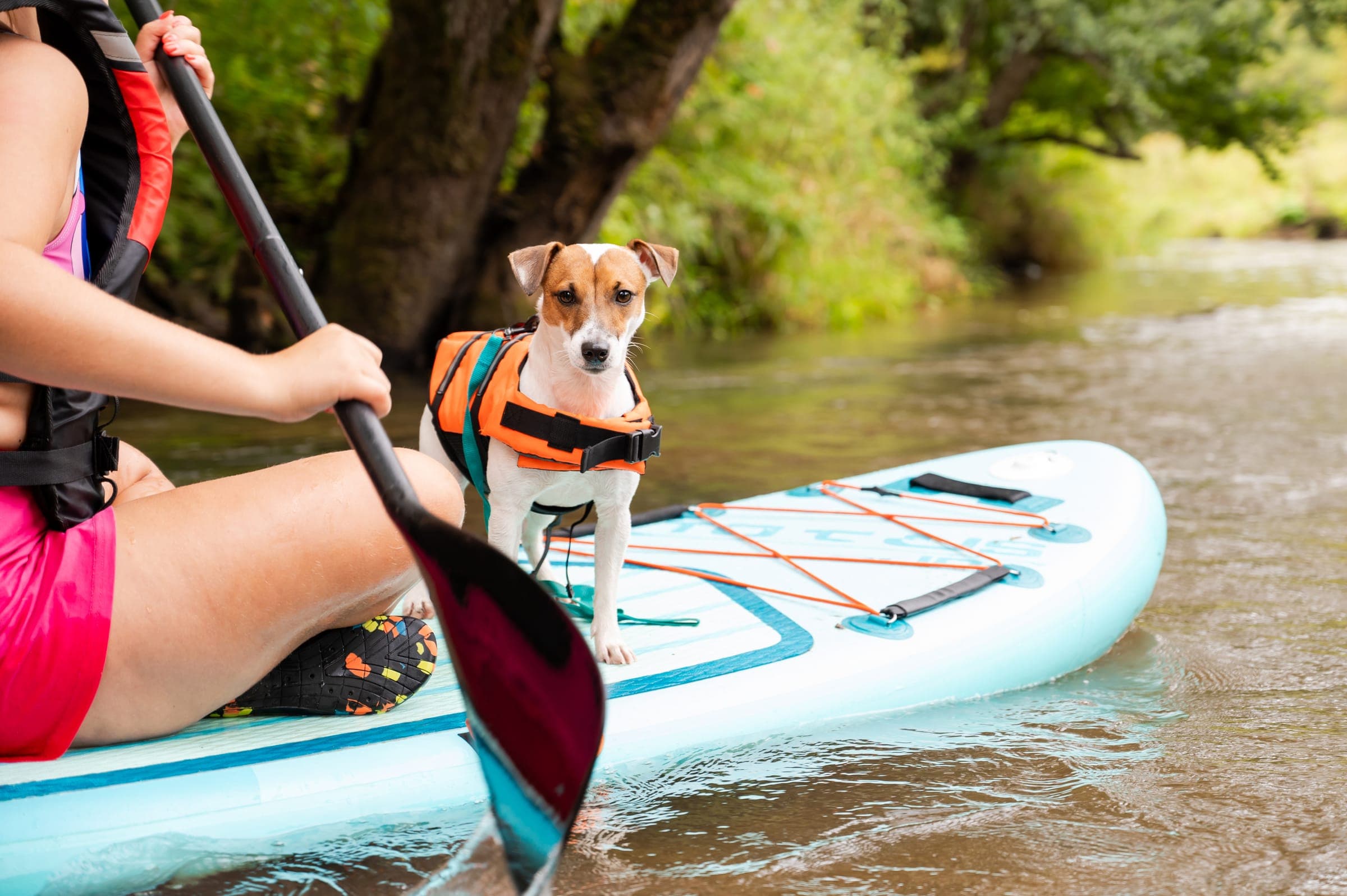
Stand-up paddleboard with dogs (SUP) is flat-water paddling with the dog riding on the deck of a stand-up paddleboard. The handler kneels or stands, paddles with a single-blade SUP paddle, and the dog stays in a taught position — most often forward of the handler's stance. The water is a calm lake, a slow river, a sheltered bay, or a quiet stretch of coastal water. The picture is simple from the shore: a wide board, a dog low and steady on the deck, a handler reading the wind and the wakes. The craft is in board choice, weight distribution, and the dog's ability to settle while the world is moving underneath them.

The sport rewards a specific dog: water-tolerant, comfortable settling on an unsteady surface, not noise-reactive to splashes or other paddlers, and reliable on a stay around distractions. Medium to large dogs add stabilizing weight; small dogs ride well on the same boards but bail more easily on chop. The activity is loosely competitive at best — fun races, costume paddles, and Guinness World Record attempts at dog-surfing championships are the closest things to formal competition. Most of what counts as the 'sport' is recreational outings, outfitter clinics, and a handful of public socials. Reactivity is the hardest gate: public-water socials and group classes operate at close quarters with other dogs and unpredictable boat traffic; outfitter program pages explicitly require dog-friendly and people-friendly participants. Highly reactive dogs need 1:1 lessons in quiet water rather than group classes. Physical readiness adds another gate — brachycephalic breeds, dogs with IVDD risk, dogs with cardiac or respiratory compromise, and seniors with orthopedic history all need veterinary clearance before the balance demands and potential falls of any new water sport.

Origins
Early 2000s
Recreational SUP grows out of surfing and outrigger canoeing. Paddleboards become an everyday item in coastal markets, then in lake-state markets. Dogs join within a few years; coastal and lake-town owners who already bring dogs on boats and surfboards start carrying them on paddleboards too.
Early 2010s
'SUP with your pup' framing appears in outfitter marketing and lifestyle articles. Early dog-inclusive paddle events piggy-back on dog-surfing contests and human SUP races, with novelty heats for tandem human–dog runs and costume paddles.
Mid-2010s
Dog-surfing championships in the UK and US add paddleboard divisions with event-level rules for safety gear, distance, and judging. Guinness World Records — not a canine-sport governing body — formalizes specific dog-SUP records: most dog/human pairs paddleboarding simultaneously, fastest 50-meter run, most dogs on a single board.
Late 2010s
Dedicated SUP-with-dog clinics and 1:1 lessons appear at marinas and paddle schools, with progressive acclimation as the standard curriculum: on-land board work, shallow-water practice, then open water.
Early 2020s
Event organizers experiment with fun-race formats — Halloween dog paddleboard races, costume contests, short buoy courses. Safety expectations mature: fitted canine PFDs, heat management, and explicit rules about puppies and medically fragile dogs become baseline at most organized programs.
Today
No US canine-sport sanctioning body has emerged. ACA governs human SUP; Guinness records the one-off dog-SUP achievements; the outfitter ecosystem runs the day-to-day programming.

02 · How a paddle works

A SUP-with-dog session isn't one game. It's a sequence of phases, and most outfitter clinics teach them in this order. A fun race or social compresses the same sequence into a buoy loop with a clock. Six phases cover what a newcomer will see across a clinic and an event.

Phase 01
On-land board acclimation
The board sits on grass or sand. The dog learns to step onto it, sit or down, and hold position while the handler gently rocks the board. The marker for readiness is relaxed body language and willingness to settle, not a flashy obedience picture. Many dogs need several short land sessions before the board moves to water.
Phase 02
Launch and re-entry
The handler kneels first, gets the dog into a taught position, and pushes off from a beach, dock, or shallow shore. Re-entry is the same in reverse. Small mistakes here — the dog jumping early, the handler stepping off-balance — are the single most common cause of falls. Outfitter clinics dedicate a meaningful chunk of class time to clean launches and dignified returns to shore.
Phase 03
On-board positions and stability
The dog rides in a designated position — front, middle, or behind the handler. Front of the paddler is most common; it lowers the board's center of gravity and keeps the dog visible. Stability is measured by the dog's ability to absorb small wakes and turns without shifting weight or bailing. Most failures look like a dog standing up and walking the deck, rather than dramatic flips.
Phase 04
Paddling and steering
The handler paddles, switches sides, and turns while accounting for the dog's mass and any movement on the board. In a fun race, this phase is expressed as navigating a short buoy course without falls, collisions, or losing the dog overboard. Boat wakes and crosswind force the handler to weight-shift through the legs rather than the upper body — abrupt corrections tip both teammates.
Phase 05
Water entries and exits by the dog
Some sessions add deliberate fall-in and recover drills: the dog bails on cue or by surprise, the handler assists from the board or the water, and the team practices either re-mounting at a cue or swimming the dog to shore. The mark of a steady team is a dog that handles an unplanned swim without panic and a handler who can read whether to recover or land.
Fall-in drills
Phase 06
Group-water manners
In classes, socials, and fun races, the dog must tolerate other boards and other dogs at close quarters without lunging, vocalizing, or bailing toward another team. Calm spacing and responsiveness to handler cues amid distractions are the working benchmark. Group sessions on busy urban lakes are a meaningful jump in difficulty from a quiet 1:1 lesson — and not every dog scales up.

03 · ACA

The ACA is the US national governing body for paddle sports — flat-water and whitewater canoeing, kayaking, and stand-up paddling. It runs human SUP racing under FCI/ICF-aligned rules, certifies SUP instructors, and writes the safety standards that paddle schools and clubs reference. It does not run a dog-SUP program and does not sanction canine titles. ACA shows up in this profile because its instructor curriculum, PFD standards, and race-day safety templates are what dog-inclusive outfitters lean on when they write their own house rules. If you take a SUP-with-dog clinic in the US, the human side of the curriculum is almost certainly ACA-derived.

01
ACA-certified SUP instructors
A teaching credential that matters when choosing a clinic. The human-side competency — paddle technique, board control, self-rescue, water reading, weather assessment — is what keeps a dog-inclusive session safe. Most reputable 'SUP with your pup' clinics list the ACA credential of the lead instructor.
02
Safety and PFD standards
ACA writes the safety standards reputable paddle schools reference. The water-reading and weather-assessment protocols, the PFD requirements, and the race-day safety templates that dog-inclusive outfitters adapt all originate in ACA instructor training.
03
Human SUP racing
Sprint, technical, and distance classes over flat or open water under FCI/ICF-aligned rules. Some local ACA-affiliated clubs informally tolerate dogs on recreational paddles or fundraisers, but this is a club-level call, not an ACA-sanctioned activity.
04
What ACA does not do
No dog registry, no dog-SUP rulebook, no dog-specific titling. ACA membership is not a path into dog-SUP — but ACA standards are the closest thing this sport has to a written safety baseline. When evaluating a clinic, ask whether the instructor is ACA-certified.
Key facts
Role
Human SUP governing body
Dog program
None
Certifies
SUP instructors, judges
Safety standards
PFD, water-reading, rescue protocols
Practical signal
Look for ACA-certified instructor at any dog clinic
Membership for dog-SUP
Not required
Practical implication
ACA membership is not a path into dog-SUP, but ACA standards are the closest thing this sport has to a written safety baseline. When evaluating a clinic, ask whether the instructor is ACA-certified, what PFD standards the program uses, and whether the program's water-reading and weather-assessment protocols come from ACA instructor training.

04 · Guinness

Guinness is the only formal body that has codified dog-SUP performance metrics with written, repeatable criteria. The records are one-off achievements rather than cumulative titles, but they're real entries with documentation, witnesses, and verification protocols — and they generate the bulk of mainstream dog-SUP coverage. For a sport otherwise built on outfitter clinics and lake-town fun runs, Guinness is the closest thing to a championship rung.

01
Most dog and human pairs paddleboarding simultaneously
A group record set at organized events with measured staging areas, photographic and video documentation, and witness signatures. Most attempts are tied to brand sponsorship or dog-surfing championships.
02
Fastest 50 meters by a human and dog pair
Speed record over a fixed measured distance, with certified timing and verified course measurements. The pair-form of the record makes handler-dog coordination part of the eligibility.
03
Most dogs on a single paddleboard
Capacity record measured by number of dogs simultaneously on one board for a defined duration. Verification protocol includes timing, board-size documentation, and welfare oversight.
04
How records get set
Most often at dog-surfing championships that include paddleboard divisions, or at organized record-attempt events — often UK-based and often tied to brand sponsorship. Eligibility is event-specific; there is no Guinness membership and no cumulative ranking. The status from a successful record is 'world record holder' in that specific category, valid until the next attempt breaks it.
Key facts
Role
Record-keeping, not titling
Records tracked
3 dog-SUP categories
Cumulative rank
None — one-offs only
Where attempts happen
Dog-surfing championships, sponsored events
Verification
Timed, witnessed, documented
Entry barrier
High — fees and event production
Practical implication
If a handler wants a verifiable, citeable dog-SUP achievement on a public ledger, a Guinness record is the only structured path. The cost is real — Guinness charges fees for record verification and on-site adjudication, and event production for record attempts adds organizer cost on top. The entry barrier is high. For most handlers, Guinness functions as an aspirational ceiling and a media reference point rather than a practical pathway.

05 · Side by side

ACA shapes the safety culture and Guinness keeps the records, but most actual dog-SUP programming runs through paddle schools, marinas, and lifestyle-fitness outfitters. There is no national calendar, no central registry, no AKC-style title ladder, and no governing-body membership. This is not a gap that the research missed — it's the structural shape of the sport. The comparison below frames the absence honestly.

ACA
American Canoe Association. Human SUP governing body — runs racing, certifies instructors, writes safety standards. Does not run a dog program. The framework dog-inclusive outfitters lean on when writing house rules.
americancanoe.org →
Guinness
Record-keeping body for three established dog-SUP categories. One-off achievements, not cumulative titles. The only structured path to a verifiable citeable dog-SUP achievement, but a high-barrier one.
guinnessworldrecords.com →
Outfitter ecosystem
Local paddle schools and marinas — Urban Ocean SUP Pups in Kentucky, B'More SUP in Baltimore, and similar coastal and lake outfitters. The bulk of dog-inclusive SUP programming runs here. Each outfitter sets its own age minimums, behavior standards, and PFD requirements.
ACAGuinnessOutfitter ecosystem
Role in US dog-SUPHuman SUP framework that shapes safety culture and instructor certificationRecord-keeping body for specific dog-SUP categoriesDay-to-day programming — clinics, lessons, socials, fun races
Primary focusHuman SUP competition, instructor certification, safety standardsVerifiable one-off record attemptsRecreational instruction and event hosting
Levels / titlesHuman-only (no dog program)One-off records, valid until brokenNone — local placements and personal achievements only
Dog eligibilityNot applicable (no dog program)Event-specificSet by host outfitter; 6-month minimum is common where disclosed
Title transferN/AN/A — records are single events, not cumulativeNone — no transferable credential exists
Known forACA-certified SUP instructors, paddle-sport safety standardsUK Dog Surfing Championship records, sponsored brand attempts'SUP with your pup' clinics, 1:1 lessons, costume paddles, charity paddles

There is currently no US canine-sport sanctioning body for SUP with dogs comparable to NACSW for nose work, BHA for barn hunt, or USCA for IGP. No national rulebook, no title ladder, no centralized event calendar, no transferable credential. This is a structural feature of the sport, not a research gap. Readers used to titled progressions in scent or protection sports should expect a different shape here: skill development is real, instruction is increasingly structured, and the safety culture is maturing — but you don't earn anything that gets recorded on a pedigree.

Which path fits you?
Outfitter path · recreational
Want a relaxed, lifestyle-oriented sport you can do on local water with a calm dog. Take a 'SUP with your pup' clinic, build to a regular paddle routine, and treat the sport as cross-training and adventure-dog enrichment. The default path for most handlers.
Guinness path · record attempt
Want a verifiable, citeable achievement on a public ledger. Guinness World Record attempt at a dog-surfing championship or organized record event. High effort, high entry barrier, real status, no cumulative ranking.
ACA path · instructor track
Want the human side of paddle sport to be tightly governed even if the dog side isn't. ACA membership and instructor certification put you in a structured human paddle community while you build dog-side skills outside any formal canine framework.
Consider another sport
Want titled progression with structured trial standards and pedigree-eligible credentials. Most handlers who want that experience cross into nose work, barn hunt, dock diving, or another sport with a real titling body — and treat SUP as a side activity for the warm-water months.

06 · Getting started

SUP with dogs has a higher entry bar than most 'any dog can try this' sports. The gate isn't equipment — boards and PFDs are widely available — and it isn't titling fees because there are none. The gate is two-sided: the handler needs basic paddling competency before adding a dog, and the dog needs settled foundation behavior before adding water. Most teams begin through a clinic at a local paddle school, often after the handler has taken a general human SUP introduction first.

The board and PFD
Wide all-around + handle PFD
A wide all-around SUP board — 32 to 36 inches wide is the standard for dog-and-handler stability. Inflatable boards are most common: durable enough for canine nails, easier to transport, forgiving in light chop. A canine PFD with a strong handle ($40–$100) is the equipment detail that matters most — the handle is what lets a handler lift a swimming dog back onto the board. A human PFD per local law; a SUP paddle sized to the handler.
Foundation · weeks 1–4
Land first, then shallow water
On-land board acclimation and basic obedience polish — sit, down, stay, leave it, settle. The dog should hold a position on a stationary board on grass before any water enters the picture. Foundation human SUP class for the handler runs parallel. Weeks 4–8: shallow-water work, then short calm-water paddles in a quiet location. First open-water clinic with the dog around this point for handlers in a structured program.
First social · months 2–6
Calm water with a clinic
Most water-comfortable, dog-savvy teams progress from first dog-on-board outing to short calm-water paddles and a low-stakes social or fun race within a single warm-water season. Hesitant dogs or handlers without prior paddle experience may need a longer foundation. Year 2 and beyond: expanding the range of safe conditions — light boat wakes, longer distances, slow rivers, mild coastal waters — is the closest thing to advanced progression. There is no formal level ladder.
Before you enroll
Age: 6 months or older at most disclosed programs, physically mature for the conditions planned. Reactivity: hard gate at most group sessions — outfitter program pages explicitly require dog-friendly and people-friendly participants; reactive dogs need 1:1 lessons. Vet clearance: brachycephalic breeds, IVDD-risk dogs (Dachshunds, Corgis, basset types), seniors, and dogs with cardiac or respiratory compromise all need veterinary clearance — the fall-in-and-recover phase is the highest-risk component of the sport. Bitches in season are excluded from most group classes by host policy.

07 · Event day

Most dog-SUP events are afternoons rather than full days, and they sit closer to a coursing fun match in tone than to a structured agility weekend. The atmosphere is festival-style: rented or owned boards stacked at a launch point, a sign-in table, a handful of staff with clipboards, dogs and handlers waiting in shade between short bursts of on-water action. First-time handlers find the on-shore choreography — gear, waiting, weather decisions, dog management — more demanding than the paddling itself.

The flow
How the day runs
Check-in and waivers at a registration table at the launch point. Outfitter clinics often request a brief on-shore demonstration of the dog's settle and stay before launch. Safety briefing covers PFD checks, leash protocol, fall-in procedures, the buoy course or planned route, and the recall signal that ends the session. Staggered launches in small groups or singly. A 'heat' in a fun race is short — a buoy loop or marked distance with informal timing or judged novelty elements (costume, style, fastest time, longest stay on board). Most events run 1–3 short on-water heats per team across the day.
The kit
What to bring
A canine PFD with a handle, a human PFD, and a paddle. A crate or shaded mat for on-shore downtime, plus a folding chair. Fresh drinking water, a non-tip bowl, and an umbrella or shade canopy. Towels, dry bags for phones and keys, a change of clothes for the handler. Leash for shore, sunscreen, snacks, and high-value treats or a tug for between-run reinforcement.
The mistakes
What goes wrong
Skipping on-land board acclimation — a dog that has never stood on a board on grass is not ready for one on water. Underestimating sun and heat for the dog — multi-hour outdoor events with reflected light off water are harder on dogs than newcomers expect. Bringing a reactive dog to a group session — group classes operate at close quarters; reactivity manageable at a quiet park becomes a real safety issue at a busy launch point. Going without a canine PFD because the dog 'swims well' — a swimming-comfortable dog can still tire, panic in chop, or hit the board on a fall.
The reality
What videos don't show
The waiting — highlight reels show the on-water minutes; the day is mostly on-shore logistics and weather watching. The setup — loading and unloading boards, finding shade near a launch point, managing a wet dog and wet gear in a vehicle on the way home. The sensory load — splashing, paddles knocking on boards, kids and other dogs, boat-traffic noise, and reflected glare make the on-shore environment more demanding than the on-water environment for many dogs.

08 · What it costs

SUP with dogs has no canine sanctioning-body fees, no trial entry stack, and no required registry. The annual budget runs on three things: the board (one-time, amortized across all SUP use), instruction (the dog-specific bit), and travel to dog-friendly water. A handler who paddles a local lake with their own gear spends materially less than one who travels to coastal markets for clinics and dog-surfing events.

Board + gear
$600$1.6k
Wide all-around SUP $600–$1.2k new; canine PFD $40–$100; human PFD $50–$150; paddle $80–$250
1:1 lesson
$75$120
Urban Ocean SUP Pups KY $75/person/dog (+$15 second dog); FL women-and-dogs clinic ~$78
Per-event entry
$30$80
Dog-inclusive socials and fun races; sometimes including board rental or food/venue tie-ins
Active annual
$600$3k+
Casual $300–$600 (rentals); active recreational $600–$1.5k (own board); adventure-oriented $1.5k–$3k+ (travel)
The honest truth
The recurring expense newcomers underestimate is the second board. Many handlers buy a narrow performance board for human paddling, then realize they need a wider, dog-stable board for sessions with the dog, and end up owning both. Travel is the second-largest variable — local-water handlers spend a fraction of what coastal-event handlers spend.
Related sports

If Paddleboard SUP with Dogs interests you, look at these too.