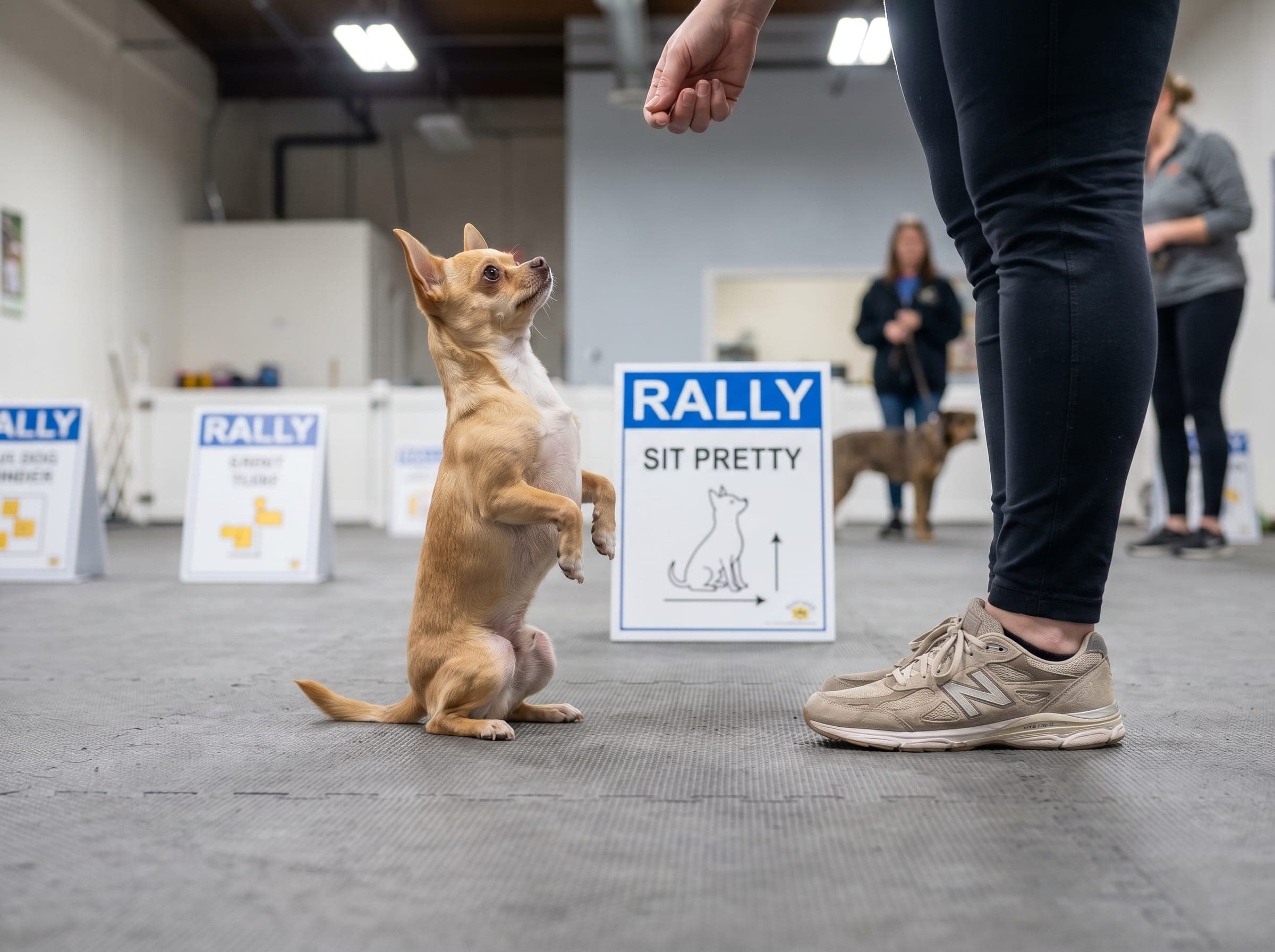
A small dog in sit-pretty position next to a handler with a numbered Rally-FrEe sign visible in the background.

Photo · AI generated · Sporting Hound

Sport Profile

Discover Rally-FrEe

A signs-based heelwork sport that blends rally-obedience structure with the spins, weaves, and position changes of musical freestyle — scored on precision, flow, and the close working partnership between dog and handler.

Jump to a section

01 · What is it

Rally-FrEe is a signs-based heelwork sport. A dog and handler work a numbered course of printed signs — like rally-obedience — but instead of standard obedience exercises, the signs cue freestyle moves: spins, leg weaves, pivots, position changes, backing in heel, and creative transitions between stations. Courses are designed by judges from a fixed catalog of signs, organized into Newcomer, Novice, Intermediate, Advanced, and Championship difficulty.

Most classes run off-leash; lower divisions allow leashes for safety and training progression. Handlers can use voice and body cues but cannot bring food or toys into the ring at standard titling levels. Judging weights accuracy of signs, heeling quality, smoothness of transitions, and the connection between dog and handler — not raw speed. The sport was built for handlers who want a structured way to train freestyle technique with a clear score sheet, without committing to the full choreography and music of a freestyle routine.

Origins
Late 1980s
Canine musical freestyle — the sport where dog and handler perform a choreographed routine to music — emerges as a recognized canine performance discipline.
2005
Rally-obedience, where teams move through a numbered course of skill-based signs, is formalized by AKC.
The gap
Both communities had devoted handlers, but each asked something the other didn't — freestyle asked for performance and music; rally asked for traditional obedience. Neither offered a structured way to train freestyle technique on a score sheet.
Early 2010s
Rally-FrEe is developed by Julie Flanery, a Northwest-based trainer with a deep freestyle background, and codified under Rally Freestyle Elements, Inc. — designed from the start as a sign-based format that lets handlers train freestyle technique systematically and earn titles through clear scoring rather than artistic placement.
Online-first growth
The sport grew through online courses, DVDs, instructor seminars, and a video-based Skills Test program that lets teams worldwide submit runs against a published course map and earn titles without local trial access — a structural choice that still shapes the sport's culture.
Current (2026)
RFE remains the sport's only sanctioning body. Rules were consolidated into a single Rally-FrEe and Musical Freestyle document in January 2024. A bridge sport for handlers who came in through rally, freestyle, or trick training and wanted something more structured than freestyle and more creative than rally.

02 · What it requires

A Rally-FrEe run is a sequence of stations performed in numbered order. Each station calls for a heelwork move, a freestyle element, or a transition. Courses range from roughly 15 to 22 signs depending on level. A qualifying score is 125 or higher on a 200-point scale.

Element 01
Heelwork in multiple positions
Heelwork is the spine of the sport. Signs cue the dog to work in left heel, right heel, front, and behind — and to change between positions cleanly. Pivots, backing in heel, and side-stepping all show up. Judges look for straight position, attention, and accurate sits, downs, and stands when the sign calls for them.
Element 02
Freestyle elements
Many signs cue freestyle moves: spins, circles, leg weaves, bow-style behaviors, and similar tricks integrated into the heelwork pattern. The element should look intentional, take a single cue, and flow back into the heel position the next sign requires.
Element 03
Transitions and flow
Unlike rally-obedience, where the movement between stations is incidental, Rally-FrEe judges the transitions themselves. Choppy or wandering movement between signs costs points. Handlers are expected to choreograph how they will move from one station to the next — the moment the sport feels most like freestyle.
Element 04
Married stations
Multiple signs can be placed at a single physical location — called a married station. The team performs the full mini-sequence at that one spot before moving on. Married stations let judges raise difficulty without using more ring real estate, and they show up more often at higher levels.
Element 05 · The verdict
Scoring and Qs
Each run is scored on a 200-point scale, with deductions for repeated cues, missed elements, sloppy execution, and loss of attention. A score of 125 or higher qualifies. Specific leg counts per title and multi-judge requirements live in the current rules PDF and should be drawn from there directly.
Format-defining

03 · RFE

Rally Freestyle Elements, Inc. is the only organization that sanctions Rally-FrEe. It defines the sign catalog, levels, and divisions, certifies judges, and runs both live and video-based events. The same organization sanctions Musical Freestyle as a separate program with its own progression — registration and many divisions are shared between the two. Qualifying scores at 125 or higher on a 200-point scale apply at every level.

01
Newcomer
The on-ramp. Introductory courses using the simplest signs. Leash allowances depend on division. Some sources frame Newcomer as a titling class; others as feedback-only — verify against the current rule book before assuming title math.
02
Novice
First full titling level. Lower-numbered signs with simpler heelwork and basic freestyle elements. Shorter courses than higher levels. Where most teams enter the sport for real.
03
Intermediate
More complex transitions, more position changes, more demanding freestyle elements. Signs drawn from a wider section of the catalog.
04
Advanced
Higher-difficulty signs including more backing in heel, tighter pivots, and precision-heavy movements. Married stations show up more frequently.
05
Championship (CH-RFE)
Courses at this level can draw from signs 1–62 and must include at least three Intermediate signs (33–56) and three Advanced signs (57–62). Earning CH-RFE in Regular opens the door to Elite division competition.
06
Grand Championship (GrCH-RFE, Elite)
Reserved for teams that have already earned CH-RFE. Courses are constructed from the full sign catalog with Elite-level expectations on precision, transitions, and overall teamwork.
Key facts
Sole sanctioning body
Rally Freestyle Elements, Inc.
Eligibility
All breeds and mixes; no registry required
Qualifying score
125+ on a 200-point scale
Course length
~15–22 signs depending on level
In-ring rewards
Not allowed at standard titling levels
Rules consolidation
Single document, Jan 2024
What sets RFE apart
Detailed sign catalog with explicit move descriptions. Multi-judge requirements for higher-level titles. A culture organized around training mechanics and progressive skill-building, not artistic interpretation. Open to all breeds and mixes — no breed registry requirement, no AKC Canine Partners equivalent needed.

04 · Other paths

RFE runs more than one kind of event and more than one kind of division. The Skills Test program and the alternative divisions are part of why the sport reaches the kinds of teams it does — and what makes Rally-FrEe structurally different from most titled sports.

Video titling
Skills Tests
Teams record a run against a published course map under specified filming rules, submit it, and are scored as if they had run live. Some titles can be earned with a single qualifying score. The sport's structural answer to limited live-event access — a handler in a state with no RFE clubs can title their dog from home. Unlike most sports where video titling is a workaround, Rally-FrEe treats Skills Tests as a first-class option.
Ages 9–17
Youth division
Classes for handlers ages 9 to 17 — Starters, Entry, and Expert — with leash allowances at the lower levels. A real on-ramp for younger handlers, not a cosmetic add-on.
Post-Championship
Elite division
For teams that have earned CH or GrCH in Regular. Higher-difficulty courses and recognition for handlers staying in the sport past Championship.
Senior · Veteran · Challenge
Alternative division
For older dogs, older handlers, and teams managing physical limitations on either side of the leash. Modified criteria within the same scoring framework. Exact age cut-offs and modification specifics live in the current rule book.
Training on rails
Provisional division
Allows in-ring reinforcement (food or toy) during the run. Used by handlers as a structured training step before moving to standard titling, where in-ring rewards are not allowed. A way to take a green dog into a real ring environment without forcing all-or-nothing performance.
Important to know
Standard Regular-division titling runs do not allow food or toys on the handler in the ring. Provisional is the explicit exception. Newcomers sometimes assume in-ring reinforcement is broadly allowed because some divisions and Skills Tests permit it — it isn't. Read the division rules for the class you're entering, not the sport in general.

05 · Adjacent programs

Because Rally-FrEe is a single-organization sport, this comparison is contextual rather than a true choice. Most Rally-FrEe handlers stay inside RFE. C-WAGS ARF is included here for handlers researching where the rally-meets-freestyle space lives.

C-WAGS ARF
Canine-Work And Games (C-WAGS) offers a class called ARF (Agility-Rally-Freestyle) that mixes rally exercises, light agility obstacles, and freestyle elements into a single off-leash class with 19 to 22 exercises drawn from multiple level lists. It is not the same sport as Rally-FrEe and does not share titles with RFE. Handlers occasionally cross-train, but they enter ARF and Rally-FrEe as separate programs.
C-WAGS ARF Rules (PDF) →
RFE Rally-FrEeC-WAGS ARF
RoleSole sanctioning body for the sportMixed-discipline class within C-WAGS — separate sport
FormatNumbered course of signs cuing heelwork and freestyle elements19–22 exercises from multiple level lists, off-leash, mixing agility, rally, and freestyle
LevelsNewcomer → Novice → Intermediate → Advanced → CH-RFE → GrCH-RFE (Elite)Starter, Advanced, ARF
DivisionsRegular, Youth, Elite, Alternative (Senior, Veteran, Challenge), ProvisionalC-WAGS standard divisions and height classes
Title transferRFE titles don't transfer to ARFARF Qs don't transfer to RFE
Known forDetailed sign catalog, video Skills Tests, freestyle-centric heelingMulti-discipline challenge class within the broader C-WAGS framework

Titles and qualifying scores do not transfer between RFE Rally-FrEe and C-WAGS ARF. They are separate sports with separate governing bodies. The dog's underlying skills (heelwork, position changes, basic tricks) transfer between the two; the titles do not.

Which one fits *you*?
The canonical Rally-FrEe experience
If you want the structured sign catalog, the Skills Test path, and the freestyle-centric heelwork progression, RFE is the program. The community is small but stable, the rules are explicit, and the video-titling option means a low-density region doesn't have to mean no progress.
A multi-discipline challenge class
If you want rally, freestyle, and light agility under one roof — and the broader C-WAGS framework — ARF is a different sport with its own community and rules. Most handlers pick one and stay; a few cross-train.

06 · Getting started

Rally-FrEe is a class-and-curriculum sport. The fastest path in is a foundation course — usually called something like Rally-FrEe Foundations, Heelwork & Tricks, or Freestyle Rally Basics — taught by an instructor who knows the sign catalog. A growing share of instruction is online; some handlers train and title entirely through Skills Tests before ever attending a live event.

Months 0–3 · Foundation
Engagement and small mechanics
Build engagement, basic heel position, and a few clean tricks (spin, pivot, leg weave). Run mock courses at home with printed signs. Cones, household objects, or makeshift station markers stand in for a real ring. Handlers with prior obedience or trick experience get more from this phase faster than total newcomers.
Months 3–6 · Foundation course
Novice-ready window
A foundation course finishes. Dogs with prior obedience or trick experience can be Novice-ready in this window. Greener teams should plan on 9–12 months to build reliable heelwork and proof behavior around distractions — proofing matters as much as raw skill at the entry levels.
Year 1+ · First entry
Skills Test or live Novice
First Skills Test or live Novice run. The Skills Test path is the lower-friction option for teams in low-density regions or teams managing reactivity. Championship-level titles take dedicated teams several years. The math is set by titling cadence, not by raw talent.
Before you enroll
A foundation in positive-reinforcement training and shaping helps — handlers who already know how to mark and reward small behaviors have a shorter ramp. Comfort with detailed work matters more than athletic ability. For dogs with reactivity or environmental worry, plan to start in Skills Tests rather than live trials — the video path is the sport's structural accommodation. Minimum age is most commonly 6 months across freestyle-adjacent sports; confirm against the current RFE rules before entering.

07 · Your first event

Live Rally-FrEe events are small and quiet compared to large obedience or agility shows. Most teams know each other or know each other's instructors. Video Skills Tests have their own rhythm — much of the event happens at home in front of a camera.

Live event day
Check-in, briefing, run
Check in at the secretary's table; present RFE registration and any documentation called for in the premium. A judge's briefing or course walk-through clarifies sign interpretations before runs start. Running orders post in advance or day-of. The run itself is short; the day is mostly downtime between classes. Bring a crate, water, weather-appropriate gear, a comfortable chair, and high-value rewards for warm-up and after the run (food and toys come off in the ring at standard levels).
Skills Test day
Download, set up, film, submit
Download the published course map and filming rules from the host. Set up the course at home or in a rented training space following the diagram exactly. Film the run in a single take, following camera-placement rules. Submit the video by the entry deadline. Scoring and feedback come back from the assigned judge — sometimes with notes that read like a private lesson from across the country.
The mistakes
What to avoid
Misreading sign descriptions and missing a required pivot or position change because the briefing was skimmed. Over-cuing the dog — repeating a cue costs points; the rule book treats the second cue as a deduction even when the first cue worked. Drilling tricks in isolation but never running full-length courses in practice. For Skills Tests: under-estimating camera-placement rules — a run that would have qualified live can be disqualified for filming errors.
The reality
What videos don't show
The downtime between classes at a live event, the cumulative effect of early mornings, travel, and ring-nerves on both ends of the leash. For Skills Tests: the logistics of filming — setting up the course exactly, getting the camera right, and re-filming when the dog or handler has an off run is real work that does not appear in the final clip.

08 · What it costs

Rally-FrEe is one of the more affordable sports to start. Equipment is light, the at-home setup is small, and the Skills Test path eliminates trial travel for teams that want to title without leaving home. Costs scale up with regular live trials and seminars.
One-time setup
$60$200
RFE team registration + printed sign set with holders (~$30–$100)
Class series
$150$250
6–8 week group program; private lessons $50–$120/hr where available
Per-run / Skills Test
$20$35
Comparable small-org rate — verify against current RFE premiums
Active annual
$1k$3k
Regular classes plus a handful of live events; serious CH-track scales higher
The honest truth
The Skills Test path is what makes Rally-FrEe affordable in practice. A handler with a small training space, printed signs, and an internet connection can earn titles for the cost of class instruction plus per-run video entries. The sport scales up if you want it to — but it does not require you to.
Related sports

If Rally-FrEe interests you, look at these too.