Sport Profile

Discover Scooterjoring

A dryland mushing sport where one or two dogs pull a handler standing on an unmotorized kick scooter over off-road courses between two and eight kilometers — testing pulling drive, voice command, and team trust without snow.

Jump to a section

01 · What is it

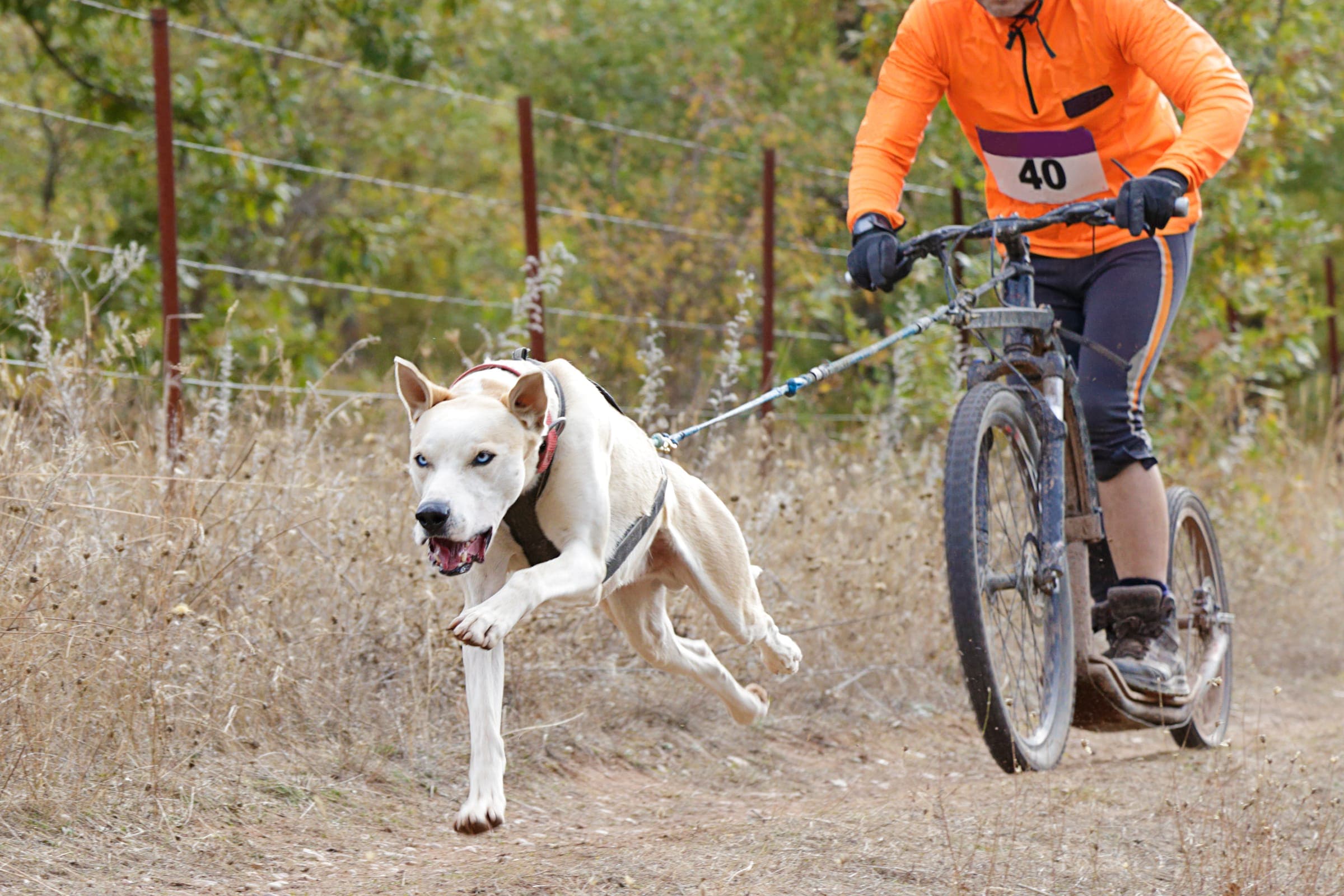
Scooterjoring is a dryland mushing class where one or two dogs in pulling harnesses tow a handler standing on an unmotorized kick scooter over a marked off-road course. The dogs run ahead on a shock-absorbing gangline; the handler steers the scooter, brakes on the descents, and cues direction with mushing voice commands — 'gee' for right, 'haw' for left, 'hike' to drive on, 'whoa' to stop. Courses run between two and eight kilometers on dirt, gravel, or forest tracks. Most events run two heats over a weekend, and combined times across heats determine placings. Teams start at one-minute intervals from a controlled chute. The sport is primarily testing pulling drive, line-handling, command response under speed, and the team's ability to make and accept passes cleanly.

The sport suits athletic medium-to-large dogs with cardiovascular capacity, drive to run ahead, and confident behavior around other dog teams, bikes, and spectators. Northern breeds and Eurohound or Greyster-type crosses are common at the competitive end, but mixed-breed sporting dogs, pointers, and herding-type mixes race regularly when they're structurally sound and want to pull. Reactivity is a real consideration: courses involve close passes, staging areas are loud, and handlers managing reactive dogs are expected to crate away from congestion and withdraw if the dog can't cope. Within the dog-powered sport world, scooterjoring is a small-team class that gives single-dog or two-dog handlers an entry into mushing without the kennel size or snow access that traditional sled work requires. Community shorthand: 'scooterjor,' 'wheel dogs,' 'new to wheels.'

Origins
Dryland roots
Scooterjoring grew out of dryland sled-dog training in low-snow regions, where mushers needed a way to keep teams conditioned off-snow. The unmotorized kick scooter — fitted with mountain-bike-style brakes and large knobby tires — adapted naturally to one- and two-dog teams.
Eurohound ecosystem
Purpose-bred Eurohounds and Greyster crosses (typically German Shorthaired Pointer × Alaskan Husky or Greyhound × Pointer breeding) emerged from the sprint-mushing community and dominate the competitive end of dryland racing, including scooter classes.
IFSS codification
The International Federation of Sleddog Sports folded scooterjoring into its dryland rule set alongside canicross, bikejoring, and rig classes, with standardized Scooter 1-dog and Scooter 2-dog class structures and distance brackets.
WSA parallel
The World Sleddog Association codified its parallel World Trophy class structure, with similar Scooter 1-dog and 2-dog classes and matching age and equipment requirements.
Today
The 2024–2026 IFSS rule cycle and current WSA rules define course distances at 2–8 km, dryland scooter and bikejoring age minimums at 18 months, and stack scooter classes alongside other dryland disciplines at most US race weekends. Concentration is in the Pacific Northwest, Upper Midwest, Northeast, and Mountain West.

02 · The course

A scooterjoring race has five moving parts. Knowing what each one does makes the day readable from the staging area on your first weekend.

Element 01
The team
Classes are split by number of dogs — Scooter 1-dog and Scooter 2-dog — and sometimes further by musher age or sex (junior, senior, men's, women's). One- and two-dog classes both run within the same overall course distance bracket. Eurohound and Greyster crosses dominate competitive fields; recreational classes run a much wider range of breeds and mixes.
Element 02
The course
Off-road dirt, gravel, or forest track between two and eight kilometers, with rolling hills and corners but rideable on a scooter. Courses are marked, run as interval starts (one-minute gaps in most classes), and use combined times across two heats to determine placings. At IFSS World and Continental Championships, teams exceeding 150% of the class winner's time can be disqualified from results.
Element 03
The gear
An unmotorized kick scooter — usually a mountain or off-road model with reliable brakes — connected to the dogs by a shock-absorbing gangline. Many current rules require brakes on both wheels and helmets for the musher; some events specify maximum scooter width. Dogs wear X-back or comparable pulling harnesses. Failed equipment checks at the line can stop a team from starting.
Element 04
Voice commands
The handler does not steer the dogs physically — direction comes from voice cues and body position. 'Gee' means right, 'haw' means left, 'hike' or 'let's go' drives the team forward, 'whoa' stops them, and 'on by' cues the team to ignore distractions and continue past. Reliable cues separate teams that finish clean from teams that crash on technical corners or tangle on close passes.
Element 05
The pass
Interval starts mean teams catch and pass each other on the course. The team being overtaken is expected to yield by moving aside and slowing where it's safely possible; the overtaking team calls the pass and stays in control. Improper passing draws penalties or disqualification. This is the single highest-skill demand in the sport — and the reason 'new to wheels' handlers are sometimes excluded from certain wheeled classes for safety.
Highest-skill demand

03 · IFSS

IFSS is the principal international governing body for sleddog sports across both snow and dryland disciplines. Most US races run under IFSS-derived rules, adopted by national federations and regional sleddog clubs.

01
Classes + distances
The current race rules (the 2024–2026 cycle) define Scooter 1-dog and Scooter 2-dog as standard classes alongside canicross, bikejoring, and rig classes. Course distances run two to eight kilometers. Dogs in dryland scooter and bikejoring classes must be 18 months old; some other dryland sprint classes accept 15-month-old dogs.
02
Title and recognition
IFSS does not operate a stepwise title ladder. Progression is reputational and standings-based: teams build results in national races, qualify into IFSS World Cup events through their federation, and compete at IFSS World and Continental Championships at the elite end. Championship titles attach to specific events; long-term standings live in the World Cup ranking system.
03
Safety + equipment rules
The 150%-of-winner's-time rule, mandatory helmets, and minimum-distance and minimum-age requirements all live in the IFSS rulebook. The most widely referenced dryland rulebook for North American events.
04
IFSS Masters
A separate IFSS Masters track exists for older athletes and runs in parallel — mushers cannot enter both Masters and the open Championship in the same discipline in the same season.
Key facts
Role
Principal international governing body
Current rules
2024–2026 race rule cycle
Scooter classes
1-dog · 2-dog
Distance
2–8 km
Dog age minimum
18 months (dryland scooter + bikejor)
Marquee
World Cup + World/Continental Championships
Federation pathway
Mushers compete under their national federations and may need a race license for higher-level events. High-prestige World Cup and World Championship events. Detailed safety and equipment regulations.

04 · WSA

The World Sleddog Association is the second international federation handlers will encounter, with its own dryland rulebook and a strong sprint and championship identity. WSA's emphasis is more European-rooted, but its rules govern races globally through national affiliates and its World Trophy event series.

01
Classes + structure
WSA defines Scooter 1-dog and Scooter 2-dog as standard classes within its World Trophy class structure, sitting alongside skijoring, canicross, rig, and other sprint and dryland disciplines. Dryland scooter and bikejoring require 18-month-old dogs, matching IFSS. Some other dryland classes allow 15-month-old dogs.
02
Eligibility variation
Eligibility for specific divisions can vary between purebred and open classes depending on event organizer. Some events accept all athletic dogs meeting age and equipment requirements; others split into purebred-only divisions.
03
Title and recognition
Like IFSS, WSA awards championship placements rather than running a unified incremental title ladder. Teams earn recognition through World Trophy and Championship results, and standings build over the season at the level the team enters.
04
Race rules vs IFSS
Cover the same core scooter requirements as IFSS — interval starts, brake and helmet specifications, course-marking standards — with detail differences that handlers learn race by race. Many handlers cross-compete between events under both frameworks rather than treating them as exclusive ecosystems.
Key facts
Role
Second international federation
Roots
European-rooted
Marquee
World Trophy series
Scooter classes
1-dog · 2-dog (World Trophy structure)
Dog age minimum
18 months (matches IFSS)
Cross-competition
Common — many handlers race both IFSS + WSA
When WSA matters
WSA's most distinct identity move is the World Trophy class naming structure, which standardizes class labels across affiliated international events. For US handlers, the practical question is which framework the local club has adopted; once that's settled, the rules read very similarly.

05 · Side by side

US scooterjoring decisions are usually less about IFSS versus WSA and more about which regional or national club hosts the closest races — and which framework that club has adopted. The comparison below maps the two international frameworks alongside the regional-club layer, since regional clubs are where most US racing actually happens.

IFSS
Principal international governing body for sleddog sports across snow and dryland. Most US races run under IFSS-derived rules. World Cup, World Championships, Continental Championships. 2024–2026 rule cycle is current.
sleddogsport.net →
WSA
International federation with strong sprint and dryland championship presence. World Trophy class structure standardizes labels across affiliated international events. European roots, global reach through national affiliates.
wsa-sleddog.com →
Regional sleddog clubs
Where US scooterjoring actually happens. National federations and regional clubs (Pacific Northwest, Upper Midwest, Northeast, and others) run the seasons under IFSS-style or WSA-style rules with local amendments. Scooter classes mirror the international structure; novice or 'new to wheels' divisions common.
IFSSWSARegional clubs
RolePrincipal international governing body for sleddog sportsInternational federation with strong sprint and dryland championship presenceWhere US scooterjoring actually happens
FocusWorld Cup, World Championships, Continental ChampionshipsWorld Trophy seriesLocal series with novice-friendly accessibility
Scooter classesScooter 1-dog and 2-dog; distances 2–8 kmScooter 1-dog and 2-dog within standardized World Trophy class structureMirror international classes; novice or 'new to wheels' divisions common
Dog age minimum18 months18 monthsGenerally 18 months
Title shapeEvent-specific championship titles + World Cup ranking pointsEvent placings + World Trophy resultsSeason point standings, club championships, breed-club working certificates
Known forMost widely referenced dryland rulebook; high-prestige championshipsStandardized class naming; European championship rootsPragmatic local rule amendments; community-driven culture

Under IFSS and WSA, 'earning a title' means winning placings and accumulating points at recognized events — not collecting a fixed number of qualifying legs the way Nose Work or Barn Hunt structure their progressions. Most US handlers under either framework build up through national-federation and regional-club series, then move toward continental and world events as their team and budget allow.

Which one fits you?
Local US racing · regional club + IFSS-style rules
Entering scooterjoring through a local club in the Pacific Northwest, Upper Midwest, Northeast, or Mountain West. Race under whichever framework your closest series uses. IFSS rules are more commonly cited in North American dryland documentation, but WSA-affiliated events run alongside them.
World-level competition · IFSS or WSA via federation
Aiming at international championships. IFSS World Championships and WSA World Trophy events have separate qualifying paths through their national federations. The framework matters most at this tier.
Cross-compete · both frameworks in a season
Many US handlers race under both frameworks in a season, treating them as complementary rather than exclusive. The core scooter requirements overlap heavily; learning rule differences race by race is the practical norm.
Closest club is the limiter
For most US handlers, the decision sits one level down: which regional club is closest, which has races on a calendar that works for you, and which has a community you can train alongside through the off-season.

06 · Getting started

Scooterjoring is not a drop-in class sport. The first step for almost every team is finding a local dog-powered sport club, attending a training day or beginner workshop, and building pulling cues and line manners on foot or behind a slow bike before the scooter ever comes out. A few weeks of foundation work prevents the most common newcomer crash patterns — runaway descents, tangled passes, dogs that don't yet know what 'gee' means at speed.

The scooter
Off-road, not pet-store
A scooter built for off-road work — a mountain or dryland-specific kick scooter with large wheels and brakes on both wheels. Pet-store kick scooters do not hold up. An X-back or comparable pulling harness for each dog — fit matters; a poor harness causes shoulder and back issues over the course of a season. A shock-absorbing gangline with a neckline for two-dog teams. A helmet for the musher. Standard dog gear — collars, leads, water bowls, a crate or stake-out for staging.
Foundation · months 0–4
Cues + slow-bike work
Months 0–2: foundation work — harness acclimation, voice cues, controlled starts and stops on foot or behind a slow bike on easy terrain. Visit a local club training day to watch how teams stage and pass. Months 2–4: move onto the scooter on flat, low-traffic trails. Build to short timed runs at scooter pace. Practice passing scenarios with another team if the club runs group sessions.
First race · months 6–12
Novice or fun-race entry
Months 4–8: enter a low-stakes club event — a training run, a fun race, or a novice-friendly class — to expose the dog to staging, the start chute, and other teams in motion. Months 6–12: first sanctioned race. Many teams need this much time before they're race-ready; some need longer.
Before you enroll
Age: the dog must be at least 18 months old for sanctioned dryland scooter and bikejoring under IFSS and WSA rules. Foundation training (low-intensity, short distances, command focus) starts earlier under veterinary guidance. Vaccinations and identification are required at most events; some federations and clubs add membership or race-license requirements. Reproductive status: females in season are commonly restricted from competing or have to be securely separated at events. Physical readiness: dogs with significant orthopedic, cardiovascular, or respiratory issues are not good candidates for repeated race-pace runs — a sports-medicine consult is the responsible starting point.

07 · Race day

Dryland race weekends have a focused but busy character. Staging areas fill with vehicles, crates, and stake-outs; dogs are vocal and excited; volunteers direct traffic on and off the course. First-time handlers regularly describe the start area as more intense than they expected, while many dogs read the energy as fuel and amp up further. The day rewards handlers who plan for waiting and weather as much as for the actual run.

The flow
How the day runs
Check-in: confirm entries, present vaccination or membership documentation, pick up bib numbers and start times. Musher's meeting: trail layout, hazards, passing rules, last-minute changes. Mandatory at most events. Equipment check at the line: scooter brakes, harness fit, gangline, helmet — anything failing inspection can stop a team from starting. Interval starts: teams launch from the chute at one-minute gaps in most classes. In two-heat formats, the second heat runs later in the day or on day two; combined times determine placings.
The kit
What to bring
Crate or stake-out for the dog between heats. Long staging waits, often outdoors, often weather-variable. Water, bowls, weather-appropriate clothing for both dog and handler. Spare lines, clips, and basic scooter tools in case something fails inspection or breaks on course. Warm-up and cool-down plan for the dog — not just for the handler; race-pace running on cold or unconditioned muscles is the most preventable injury cause in the sport. Snacks, chairs, shade — the day involves more waiting than running.
The mistakes
What goes wrong
Underestimating braking and control demands — riding a scooter behind running dogs on a descent is nothing like a flat-pavement scooter; crashes and near-misses cluster here. Arriving late to the start chute — interval starts do not wait. Misreading passing protocol — either failing to yield when overtaken, or attempting to pass in unsafe spots; both draw penalties; both create real crash risk. Skipping warm-up and cool-down for the dog. Not acclimating the dog to the staging environment before race day.
The reality
What videos don't show
The amount of idle time in parking areas — multi-hour staging is normal. Heat management on warm or shoulder-season days — dryland mushing has hard limits on ambient temperature; events are routinely shortened, delayed, or cancelled for heat. Community discussion suggests around 50–55°F as a soft ceiling for many events. The mental fatigue of managing logistics, weather, and dog welfare across a multi-day weekend with early starts and travel between venues and lodging.

08 · What it costs

Scooterjoring's cost structure is the most uncertain area of this profile. Equipment costs are well-documented; race-entry and training-class costs are sparsely published in scooter-specific form, with most numbers buried in club emails and Facebook posts rather than public premiums.
The scooter
$500$1.5k+
Purpose-built mountain or dryland kick scooter. Pet-store scooters don't hold up. The dominant one-time line item.
Pulling gear
$60$300
Pulling harness $30–$80/dog; gangline and hardware add similar; helmet $30–$150
Per-race entry
$30$80
Sparse published data; aligns with general dryland race pricing. Multi-day weekend events with travel cost more per starting team
Active annual
$1.5k$10k+
Casual modest after initial scooter; active competitor accumulates entry + travel + maintenance; championship-oriented resembles competitive horse sport more than weekly obedience
The honest truth
The scooter is the line item most newcomers underestimate going in. A pet-store kick scooter is not a starting point — the brakes, frame, and wheel size aren't built for the speeds dogs pull at. Most teams enter the sport expecting to invest in real equipment from the first season, and most of the residual budget after that is travel rather than entry fees.
Related sports

If Scooterjoring interests you, look at these too.