Sport Profile

Discover Surf Dog

A judged board sport where dogs ride real ocean waves on foam surfboards — scored on length of ride, balance, and confidence, run as one-day festivals on the California coast and a handful of other beaches.

Jump to a section

01 · What is it

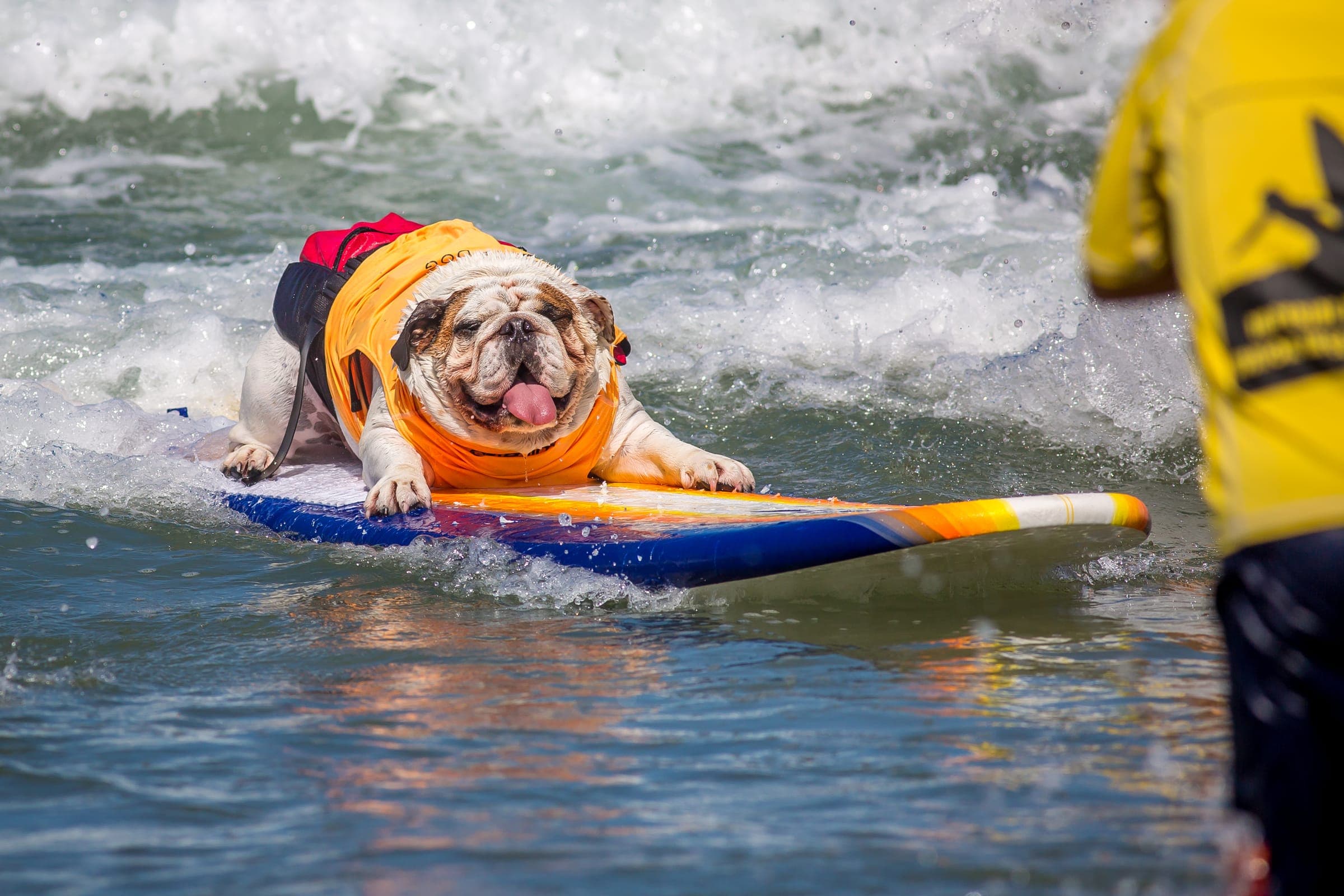
Surf dog is a judged competition where dogs ride foam surfboards on real ocean waves, launched and assisted by a handler from shallow water. The handler wades the dog out, sets the launch, and lets go; the dog rides the wave alone while judges score length of ride, balance, stance, apparent confidence, and the size or difficulty of the wave. Heats run roughly 10 minutes. Each judge can award up to 10 points per scoring wave, and most rule sets either take the single best ride or sum the best two rides for a heat total. Dogs work off the leash on the board — leashing a dog to the board is explicitly prohibited at every event with a published rulebook. Handlers may steady the dog at the launch and at the recovery, but once the wave is caught, the dog is solo on the deck.

The sport rewards a water-confident dog comfortable balancing on a moving surface, neutral around crowds and amplified noise, and physically sound enough to handle wipeouts and repeated swims back to shore. Medium and large dogs dominate media coverage, but small dogs compete in dedicated weight-class divisions — Surf Dog Championships' published classes run small (1–20 lb), medium (21–40 lb), large (41–60 lb), and very large (61+ lb), plus tandem dog–dog and tandem human–dog heats. Reactivity is a real gate: beach festivals run with PA systems, dense crowds, other dogs at close quarters, and surf-team staging areas, so dog-reactive or noise-sensitive dogs struggle even when they're water-confident. Brachycephalic breeds, dogs with cardiac or respiratory compromise, and dogs with shoulder or spinal history need a sports-medicine consult before training, not after. Success depends more on overall partnership and the handler's judgment about safety than on any obedience cue list — the work is environmental.

Origins
Mid-20th c.
California surfers start putting dogs on boards as a novelty or for photos. The earliest documented dog-on-surfboard moments are personal and informal, not competitive.
Early 2000s
Dedicated dog-surfing contests emerge in Southern California, often as charity fundraisers attached to existing human surf events. Early contests are unstandardized and emphasize costumes, crowd engagement, and fundraising as much as athletic performance.
Mid-2000s
Imperial Beach Surf Dog Competition establishes itself as one of the recurring SoCal anchor events.
Late 2000s–2010s
World Dog Surfing Championships launches on the Northern California coast, branding itself as the sport's first 'world championship' and publishing the rulebook that most other organizers reference for weight classes and judging.
2010s
Ricochet, the SoCal surf dog who rode tandem with adaptive surfers, drives major charity coverage and pulls the sport into mainstream media without changing its underlying structure.
Today
Surf dog is a high-visibility niche with a dozen-plus organized competitions a year clustered in California, occasional events in Florida, Hawaii, and the Carolinas. Rules have matured around safety — canine flotation mandatory, board-tethering banned — but no national governing body has emerged.

02 · The heat

A surf dog event isn't one ride. It's a sequence of phases that compress a full surf session into a 10-minute scoring window. Six phases describe what a newcomer sees from check-in through the final placement.

Phase 01
Launch and assist
The handler wades the dog out from the shore break, holding the collar or harness, and times the launch to a rideable wave. Most rulebooks allow the handler to push the board, position the dog on the deck, and let go as the wave catches. Once the dog is riding, the handler is not allowed to physically support the board or the dog except in tandem human–dog divisions. Clean launches are the foundation of the rest of the heat.
Phase 02
The ride
The dog rides the wave alone (or with a co-rider in tandem heats). Judges watch for length of ride — distance traveled and whether the board reaches the inside or shore — plus stance (standing, sitting, prone), balance through chop, apparent confidence, wave size, and style elements like body shifts to control the line. A wipeout-free ride that travels meaningfully beats a short, dramatic ride at most events.
Phase 03
Recovery and re-paddle
After the ride, the dog is recovered by the handler — swum back, met at the inside, or carried out for the next launch. Recovery is not scored, but slow or unsafe recoveries eat the heat clock. Most heats run 10 minutes (12 minutes for some shredder or final rounds), and a team can score 2–6 rides in a heat depending on conditions, the dog's stamina, and how aggressively the handler resets between waves.
Phase 04
Scoring window and the heat clock
Judges score every scoring wave the dog catches in the heat window. Three judges at 10 points each puts the per-ride ceiling at 30. Some rulebooks combine the dog's best two rides for a heat total, putting the heat ceiling at 60. Other events take only the single best ride. The heat clock runs continuously regardless of wipeouts, recoveries, or missed waves.
How scoring works
Phase 05
Tandem rides
Tandem dog–dog heats put two dogs on the same board, scored on coordination and the spectacle of shared balance over distance. Tandem human–dog heats put a dog and an adult human on the board together; the human's body provides stability but the dog's positioning is what's judged. Wipeouts cost more in tandems because both riders are usually lost.
Phase 06
Placements and championship round
At the end of the heat, judges' scores are tallied. The top scorers in each division earn placements. At Surf Dog Championships, the top two from each division (excluding tandems) advance to a Top All-Around Surfing Championship round — another timed heat under the same conditions, with placements decided purely by judges' scores in that final. There is no points-carry from heats into finals.

03 · WDSC

The World Dog Surfing Championships, held on the Northern California coast, is the closest thing surf dog has to a national title. It markets itself as the sport's first 'world championship,' publishes a detailed rulebook with weight classes and judging criteria, and pulls media coverage at a scale most surf dog events don't match. Status from a WDSC win attaches to that specific event — there's no national points ladder it feeds — but a 'World Dog Surfing Champion' credit is the highest-recognition achievement in the sport.

01
Weight-class heats
Small (1–20 lb), medium (21–40 lb), large (41–60 lb), very large (61+ lb). Plus tandem dog–dog and tandem human–dog divisions. The most codified division structure in the sport — most other organizers reference WDSC's weight classes.
02
10-minute heats, 3 judges, 10 points each
Three judges award up to 10 points per scoring wave on length of ride, technique, confidence, wave size, and style. Heats run 10 minutes (12 minutes for the championship round). Most thorough rulebook in the sport.
03
Top All-Around Surfing Championship round
Top two from each non-tandem division advance to a championship round — another timed heat under the same conditions, with placements decided purely by judges' scores in that final. No points-carry from heats.
04
Eligibility and registration
Open by registration and acceptance, subject to organizer safety review. No pre-qualification, no points minimum, no membership tier. Handlers register the dog for a specific division and pay the entry fee — $50 per dog per heat category as listed on the 2024 registration page.
Key facts
Location
Northern California coast
Branding
World championship
Divisions
4 weight classes + 2 tandems
Heat format
10 min (12 min final) · 3 judges × 10 pts
Entry fee
$50/dog/heat category (2024)
Title transfer
None — event-internal
What makes WDSC distinctive
The most codified rulebook in the sport, the most explicit safety language (mandatory canine PFDs, ban on board-tethering, conditions-based call-offs), the largest media footprint, and the only event with a published 'world championship' branding handlers reference outside the home market. Charity-aligned production at vendor-village scale.

04 · Imperial Beach

The Southern California surf dog scene is a cluster of recurring events at Imperial Beach and adjacent venues, supported by local communities like SoCal Surf Dogs and repeatedly covered by AKC editorial. There is no single Imperial Beach governing entity; the scene is a loose federation of named competitions, surf-dog clubs, and charity-festival hosts. What the scene shares is a common safety culture, weight-class structure, and a stronger emphasis on community and fundraising than on world-championship branding.

01
Imperial Beach Surf Dog Competition
The anchor event for the SoCal scene. Mid-to-late 2000s founding; recurring annual format. Rule sets mirror WDSC's safety floor — mandatory canine flotation, no board-tethering, weight-class divisions — but house-rule details vary by event.
02
SoCal Surf Dogs community
Local community group running informal points or recognition for repeat placements across the year at some events. Functions as local prestige rather than a transferable credential.
03
Heat and division norms
10-minute heat / 10-points-per-judge norms anchor the sport, with event-specific tweaks for tandem classes, costume classes, and charity-themed heats. The SoCal scene is where most surf dog viral media originates.
04
Eligibility
Open at most events, with safety screening at organizer discretion. Title status is event-specific — first through third in each division, 'top dog' or 'best of show' awards at some events. No longitudinal ladder.
Key facts
Location
Imperial Beach + adjacent SoCal venues
Structure
Loose federation of named events
Anchor event
Imperial Beach Surf Dog Competition
Tone
Festival-style, community-first
Media
AKC editorial + viral media origin
Title transfer
None — local prestige
What makes the SoCal scene distinctive
The densest community scene in the sport. AKC editorial coverage, dramatic surf conditions, and a substantial share of surf dog viral media — Ricochet, the SoCal surf dog who rode with adaptive surfers, is the canonical example. Festival-with-competition tone rather than competition-with-festival.

05 · Side by side

WDSC is the codified flagship. The Southern California cluster is the densest community scene. Outside California, surf dog runs through regional charity festivals and one-off summer events that share the same 10-minute heat / 10-points-per-judge skeleton with looser house rules and lower entry barriers. The comparison below names the absence of a national governing body and describes the three tiers that exist in practice.

WDSC
World Dog Surfing Championships. NorCal flagship with the most codified rulebook, the 'world championship' branding most handlers recognize, and the largest media footprint. Top All-Around Championship round.
surfdogchampionships.com →
SoCal scene
Imperial Beach + adjacent venues. Densest community scene with multiple recurring events a year, AKC editorial coverage, and the bulk of surf dog viral media. Loose federation rather than single governing entity.
Helen Woodward Surf-A-Thon →
Regional festivals
Charity festivals and one-off summer events outside California. East Coast Dog Surfing Festival (Brevard Humane Society, Cocoa Beach FL) is the canonical example — $25 surf comp entry + $10 'Intro to Dog Surfing' on-site lesson. Hawaii, Carolinas, Texas Gulf, occasional Pacific Northwest.
WDSCSoCal sceneRegional festivals
RoleFlagship 'world championship' event with the most codified rulebookDensest community scene with multiple recurring eventsOn-ramp tier — charity-festival format with simplified divisions
Primary focusStructured heats, media presence, charity fundraisingCommunity, recurring events, charity, AKC editorial coverageIntroductory participation, lessons, fundraising
Levels / classesWeight-class heats, tandem divisions, Top All-Around Championship roundWeight-class heats, tandems, costume/special classes at some eventsSimplified classes; intro lesson segments alongside competition heats
DivisionsSmall (1–20 lb), medium (21–40 lb), large (41–60 lb), very large (61+ lb), tandem dog–dog, tandem human–dogSimilar size-based and tandem divisions, varying by eventOften fewer size classes; novelty and intro classes more prominent
Entry fee$50 per dog per heat category (2024 registration page)Event-specific; sits alongside comparable West Coast surf events$25/dog at East Coast Dog Surfing Festival; intro lesson $10
Title transferNone — placements attach to the specific eventNone — local prestige, no transferable credentialNone — ribbons and local recognition
Known forCodified rulebook, 'world champion' branding, largest media footprintCommunity culture, AKC editorial, dramatic surf, viral mediaAccessible entry, on-site intro lessons, fundraising orientation

There is no national governing body for surf dog. No central rulebook, no transferable title ladder, no AKC or UKC sanctioning, no membership registry. Each event publishes its own rules and scoring system. A 'World Dog Surfing Champion' is a champion of that specific event, that specific year — there is no points-carry to other competitions. This is a structural feature, not a research gap. Prestige is event-specific, status is local, and the resume that matters is the event-by-event placement history.

Which scene fits you?
WDSC fit · NorCal flagship
Live within a day's drive of Northern California and want the most codified, highest-prestige event in the sport. Detailed rulebook, clear weight classes, the only published 'world champion' branding most handlers recognize.
SoCal scene fit · community depth
Live in or near Southern California and want a recurring community scene with multiple events a year, AKC editorial coverage, and a deeper bench of titled handlers to learn from. Where the depth is.
Regional festival fit · on-ramp
Live outside California and want to try the sport without traveling. East Coast Dog Surfing Festival or a comparable summer event in your market is the on-ramp. Simplified divisions, on-site intro lessons, fundraising orientation.
All three over time
Many serious competitors run regional festivals as season-openers and warm-ups, the SoCal scene for repeated competition reps, and WDSC as the season highlight. The skills transfer fully — the credentials don't.

06 · Getting started

Surf dog has a higher entry bar than most 'any dog can try this' sports. The gate isn't a registration fee — there are none — and it isn't equipment alone. The gate is two-sided: the handler needs basic surf and ocean-water competency before adding a dog, and the dog needs solid swim foundations and balance work before adding waves. Most teams begin through a surf-dog clinic at a coastal training facility, an on-site intro lesson at a charity festival like East Coast Dog Surfing Festival, or 1:1 instruction with a surf-dog-specialized trainer.

Equipment
PFD with a handle, foam board
A canine flotation device with a strong handle ($40–$100) is mandatory at every event with a published rulebook — the handle is what lets a handler lift a swimming dog back onto the board or out of a wipeout. A soft-top foam surfboard sized to the dog and handler — wide, stable, forgiving ($200–$500 used or starter). Harness with grab handles, a long line for beach management. The leash is for shore — never for the on-water ride. Tethering a dog to the board is explicitly prohibited.
Foundation · weeks 1–12
Land, then shallow water
Land balance work and swim conditioning. The dog learns to mount and dismount a stationary board on grass or sand, holds a sit or down on the board, and demonstrates comfortable flat-water swimming. Weeks 4–12: shallow-water board work in calm conditions, riding whitewater (the foam from broken waves) close to shore. First exposure to small unbroken waves for water-comfortable dogs.
First event · months 3–9
Clinic, then festival
First clinic with a surf-dog-specialized trainer. Repeated short ocean sessions in mild conditions. Most water-confident, dog-savvy teams reach a first low-stakes contest entry — a regional charity festival or a SoCal community event — within this window. Reaching reliable placements at a major event is a multi-year arc for most teams.
Before you enroll
Age: at least 2 years old at most events with published age guidance, and physically mature enough for repeated wipeouts and swim-backs. Reactivity: hard gate at festivals and competitions — beach events run with PA systems, dense crowds, other dogs at close staging quarters. Vet clearance: brachycephalic breeds, cardiac/respiratory compromise, prior shoulder/spinal history, IVDD risk, and seniors need a sports-medicine consult before training. The handler needs ocean-water competency — reading rip currents, shore break, cold water, and changing conditions is not optional. A surf-dog clinic is not a substitute for the handler's own surf foundation.

07 · Event day

A surf dog event is a beach festival with a competition skeleton inside it. The day starts early — parking, staging, and tide windows force a first-light arrival — and runs through long stretches of waiting between short, high-stakes heats. First-time handlers find the on-shore choreography more demanding than the surf phase itself. The atmosphere is festival-style: vendor village, music, PA, sponsor presence, dogs everywhere.

The flow
How the day runs
Check-in and waivers at a registration tent at the beach venue. Competitors' meeting walks through heat order, surf zone boundaries, judging criteria, safety protocols, and conditions-based call-off rules. Heats run in division order — small, medium, large, very large, tandems, then the championship round. Tide and conditions can shift heat order on short notice; no-shows or late arrivals get scratched. Each heat is a 10-minute scoring window.
The kit
What to bring
Canine PFD with a handle, wetsuit for the dog if conditions warrant, harness, long line for shore. Wetsuit, rash guard, and surf paddle or board for the handler. Crate or shaded mat for on-shore downtime, folding chair, shade canopy. Fresh drinking water, non-tip bowl, electrolyte supplement, fresh-water rinse jug for the dog after sessions. Towels, dry bags for phones and keys, change of clothes.
The mistakes
What goes wrong
Underestimating sun and heat load — multi-hour beach days with reflected glare off water are harder on dogs than newcomers expect. Skipping pre-event acclimation to crowds and PA — a dog that's water-confident in quiet conditions can melt down in the staging area. Pushing into waves the dog isn't ready for — bigger waves and dramatic rides score better only if the dog completes them. Forgetting right-of-way etiquette — a dog already riding a wave has the right of way; crossing the path of a riding dog is a real safety hazard.
The reality
What videos don't show
The waiting — highlight reels show the on-water minutes; the day is mostly on-shore staging, weather watching, and tide management. The early arrival — most events start at first light to catch the morning glass-off. The cumulative fatigue — multi-day festivals stack sun, salt, sand, and surf on dogs and handlers. The wipeouts — edited clips show the rides that scored; most heats include misses, bails, and wipeouts that don't make the social-media cut.

08 · What it costs

Surf dog has no governing-body fees, no titling registry, and no required membership. The annual budget runs on three things: equipment (one-time, amortized across multiple seasons), instruction (the dog-specific bit), and travel to coastal venues. Handlers within driving distance of a California surf beach spend a fraction of what inland handlers spend reaching the same events.
Gear
$390$1.1k
Canine PFD $40–$100; foam board $200–$500; handler wetsuit $100–$300; dog wetsuit $50–$150
Lesson / clinic
$30$150
Group $30–$60/session; private $80–$150/hr; East Coast on-site intro $10; festival workshop $75–$200
Per-event entry
$25$50
WDSC $50/dog/heat (2024); East Coast Dog Surfing Festival $25/dog; SoCal events $25–$50/dog/division
Active annual
$1.5k$5k+
Casual $300–$800; active competitor $1.5k–$3k; championship-focused $3k–$5k+ — travel dominates
The honest truth
The recurring expense newcomers underestimate is travel. A weekend at a Northern California or Southern California surf event from outside the state stacks flights, dog transport, hotel, ground travel, gear haul, and meals on top of the modest entry fee. Inland handlers who want a serious surf-dog season either commit to coastal travel as a real budget line or build a winter-and-summer pattern around regional festivals closer to home.
Related sports

If Surf Dog interests you, look at these too.