Sport Profile

Discover Urban Mushing

Dryland sled-dog work — dogs pull a handler on wheeled equipment or while running, on dirt trails year-round, with two parallel ecosystems: open-class racing and breed-club draft titles.

Jump to a section

01 · What is it

Urban mushing — also called dryland mushing — is what sled-dog work looks like without the snow. A dog or team wears a pulling harness, attaches via a bungee-dampened line to wheeled equipment or to a hip belt on the handler, and pulls forward on a dirt trail while the handler runs, bikes, or steers. The four core racing disciplines are canicross (handler runs with one dog on a hip belt), bikejoring (one or two dogs pull a handler on a bike), scootering (one or two dogs pull a handler on a foot-operated scooter), and rig racing (a team of two to eight dogs pulls a three- or four-wheeled cart). Voice cues do most of the work — gee for right, haw for left — because once the run begins, the dog leads.

Running parallel to all of that is a separate ecosystem of breed-club draft and carting tests, where Greater Swiss Mountain Dogs, Samoyeds, Newfoundlands, Rottweilers, and Great Pyrenees pull loaded carts through obstacle courses scored on obedience and control rather than speed. The two tracks share equipment categories and almost nothing else: racing is open to any dog, breed-club draft work is breed-specific. The sport fits high-drive working and sporting dogs with sound joints and the structural build for sustained pulling — northern breeds, German Shorthairs, Vizslas, mixed-breed athletes with the right frame. Brachycephalic breeds and toy breeds face significant challenges; the aerobic load and pulling mechanics aren't kind to short muzzles or twenty-five-pound bodies. Reactivity is a real obstacle in race environments — group starts, on-trail passes, and crowded staging areas are the norm. Canicross and solo training runs offer more controlled settings.

Origins
Off-season roots
Dryland mushing started as off-season conditioning for snow mushers — a way to keep working dogs fit when the trails were bare. Through the 1980s and 1990s it shifted from training tool to standalone sport.
Racing orgs form
The International Sled Dog Racing Association (ISDRA), already governing snow racing, codified dryland rules. The International Federation of Sleddog Sports (IFSS) followed, expanding global reach and standardizing championship formats. The four disciplines crystallized: canicross for handlers without wheeled equipment, bikejor and scooter for smaller teams at speed, rig racing to preserve the multi-dog team tradition.
Draft track parallel
Draft and carting work developed on a separate track through breed clubs — particularly for Swiss Mountain Dogs, Newfoundlands, Samoyeds, and other heritage draft breeds — focused on obedience, maneuvering, and freight-hauling rather than speed. The two ecosystems still rarely overlap.
Current (2026)
ISDRA and IFSS run hundreds of dryland races a year across North America and Europe; the 2025 IFSS Dryland World Championships ran in Minocqua, Wisconsin — the first time the event was held in the US. Breed clubs administer draft titles at specialty shows and designated test events. IFSS expanded its masters-eligible classes in 2023 to include canicross, bikejoring, and one-dog scooter. An IFSS Adaptive Sport Committee was established in 2026.

02 · The disciplines

Racing happens in four disciplines, distinguished mostly by what the handler is doing — running, riding, scooting, or steering. The breed-club draft track sits alongside, a fifth path that asks the dog to do something different entirely: pull a loaded cart through a control course rather than race across a trail.

Discipline 01
Canicross
Handler runs on foot, attached to one dog by a five-to-nine-foot bungee line clipped to a hip belt. The dog pulls; the handler runs faster than they could alone. Tests sustained pace, directional response, and team rhythm. The most accessible entry point — no wheeled equipment, lower equipment cost, the most controlled environment for dogs still building social tolerance.
Discipline 02
Bikejoring
One or two dogs pull a handler on a bicycle via a seven-to-twelve-foot bungee line attached to the front of the bike. Speeds climb fast. The dog must hold drive at pace, take turns cleanly without tangling the line, and respond to voice cues from a handler whose hands are on bars and brakes. Helmets are required at every sanctioning org.
Discipline 03
Scootering
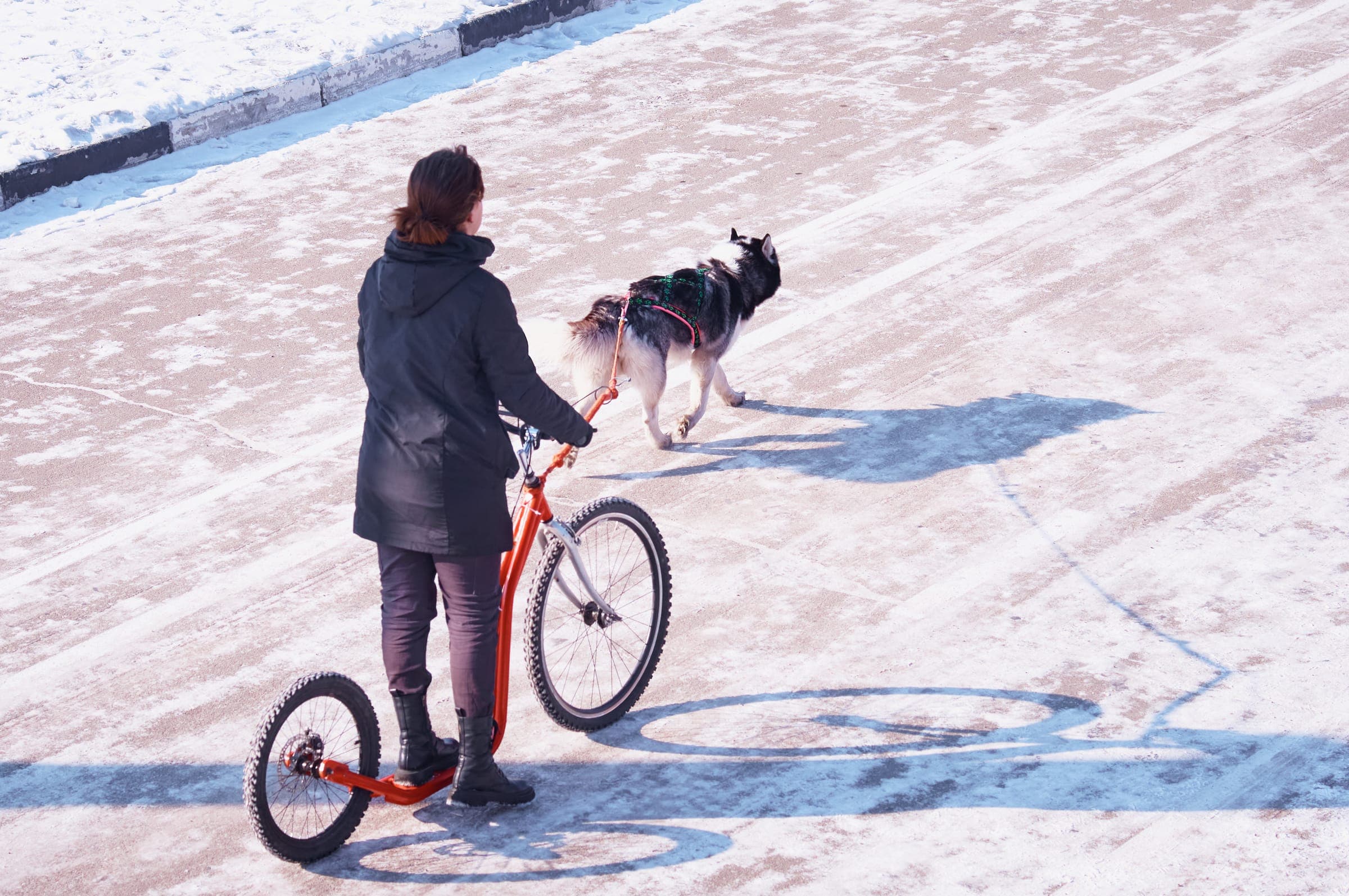
Same line setup as bikejoring, attached to a foot-operated dog scooter. Slower than bikejor, lower stakes on balance, and more handler input — you push when the dog needs help. Often the bridge between canicross and bikejor for handlers building confidence on wheeled equipment.
Discipline 04
Rig racing
Teams of two to eight dogs (twelve in some mid-distance events) pull a three- or four-wheeled rig with a seated handler. The dryland version of a sled team — a gangline, lead dogs out front, voice-cued turns, locking brakes, manual steering. The most equipment-intensive discipline and the steepest learning curve. Distances range from short sprints to forty-six kilometers in IFSS mid-distance classes.
Discipline 05 · Parallel track
Draft & carting (breed-club)
A different sport in the same family. The dog pulls a loaded cart through a course with turns, narrow passages, distractions, and freight-handling tasks like backing and load placement. Judged on smooth performance, control, and willingness — not speed. Novice levels run on-leash; advanced levels run off-leash. Restricted to specific breeds per the administering club.
Heritage-breed only

03 · ISDRA

The International Sled Dog Racing Association governs both snow and dryland mushing in the US and is the organization most American racers encounter first. ISDRA writes the rules, sanctions races across the continent, and sets the conduct and welfare standards regional clubs follow. It does not administer cumulative titles — placement and points accrue inside individual race series and regional circuits, not across a national ladder. Open to any dog regardless of breed or registration; mixed breeds and unregistered dogs race the same classes as registered northern breeds.

01
Canicross
Solo handler-with-one-dog class. Run by the same rules across the ISDRA circuit. The accessible on-ramp; the dog wears a pulling harness, the handler wears a hip belt, the line runs five-to-nine feet between them.
02
Bikejor (1–2 dogs) · Scooter (1–2 dogs)
Wheeled small-team classes. Helmets required by rule. Seven-to-twelve-foot line per ISDRA spec. The middle of the discipline ladder — the dogs are pulling enough to set the pace, and the handler is managing equipment plus voice cues plus passing protocols.
03
Rig 4-dog · 6-dog · 8-dog
Multi-dog rig classes — the dryland version of a sled team. Two minutes between starts on the eight-dog class (one minute on smaller classes). Some regional circuits run mid-distance variations stretching the format toward IFSS distances.
04
Welfare thresholds
ISDRA mandates a temperature / humidity review at the 50–60°F band — race marshals are required to assess conditions and decide whether to shorten, modify, or cancel runs. The threshold is a guideline, not a hard cancellation rule, which is the source of regular handler debate when a marshal calls go or stop near the line. Especially relevant in Southeast events where ambient temperatures push the threshold from spring through fall.
05
Passing rules · the sprint zone
The no-right-of-way zone — typically the final half-mile before the finish — is the section where an overtaking team doesn't have to stop and yield. Racers call it the sprint zone. Outside it, rules are explicit about how an overtaken team yields trail, and arguments about whether someone yielded fast enough are part of the post-race conversation.
Key facts
Role
Primary North American sanctioning body
Eligibility
Any breed or mix; no registration required
Disciplines
Canicross · bikejor · scooter · rig (4 / 6 / 8 dog)
Title structure
None — placement-based circuits
Welfare review
50–60°F temp / humidity threshold
Helmet
Required for all wheeled classes
No formal title ladder
ISDRA sanctions races; placements determine seeding for regional circuits. Reputation builds through results, not through a string of letters after a dog's name. Equipment-specific oddity: ISDRA permits motorized rigs in some classes provided spark plugs are disconnected by entry agreement — a rule that exists because some long-format rigs were built on motorized chassis. Purists view this as drift from the sport's heritage; the practical view is that a rig's frame is what matters, not what the frame was originally for.

04 · IFSS

The International Federation of Sleddog Sports governs world-championship-level competition for both snow and dryland mushing. Where ISDRA is the regional and national backbone, IFSS is the international layer — the org you compete under if you want to race against teams from Norway, Czechia, France, and Canada at the discipline's highest level. National federations sit beneath IFSS; in the US, that's USFSS (United States Federation of Sleddog Sports), which handles membership and qualification for American teams pursuing world-championship eligibility.

01
Masters-eligible classes
IFSS designates certain classes as masters-eligible — results in those classes can qualify a team for world-championship participation. As of the 2023 expansion, masters-eligible classes include canicross, one- and two-dog bikejor, one- and two-dog scooter, and four- and six-dog rig.
02
Dryland World Championships
IFSS hosts the Dryland World Championships every other year. The 2025 event in Minocqua, Wisconsin was the first time the championships ran in the US, bringing American competitors into direct contact with European programs that have been treating dryland mushing as an elite sport for two decades.
03
Mid-distance formats
IFSS leans into longer races. Multi-heat structures across a weekend are standard at the championship level, and mid-distance rig classes can run forty-six kilometers — substantially longer than the typical ISDRA sprint. The pacing, conditioning curve, and equipment durability requirements are different.
04
Junior pipeline
IFSS runs junior classes across multiple disciplines with adapted rules — for example, a single handler is permitted in the canicross starting chute for juniors, where adult races prohibit chute assistance. The junior pipeline is more developed at IFSS than at most American national orgs.
05
Adaptive Sport Committee
Established in 2026, focused on developing inclusive competition pathways for adaptive athletes. Early days, but signals direction — the international body has explicitly prioritized adaptive participation alongside its established masters and junior programs.
Key facts
Role
International governing body
Top event
Dryland World Championships (biennial)
US access
Through USFSS membership
Distinctive
Mid-distance formats · multi-heat championships
Junior program
Most developed in the discipline
Recent (2026)
Adaptive Sport Committee established
How US handlers access IFSS
Membership and qualification for American teams runs through USFSS (United States Federation of Sleddog Sports). USFSS is required for IFSS world-championship eligibility; it's not required for ordinary IFSS-rules events. Most US racers don't need USFSS unless they're targeting the Dryland World Championships.

05 · Side by side

ISDRA and IFSS are the two open-class racing orgs covered with full deep-dive treatment above. The breed-club draft track is its own ecosystem — administered by individual breed clubs, with no cross-recognition between programs — and lives alongside the racing orgs without sharing much beyond the equipment heritage.

The breed-club draft track
A parallel ecosystem entirely. GSMDCA (Greater Swiss Mountain Dog Club of America) restricts entries to Swissies; novice through advanced draft titles. The Samoyed Club of America runs Working Samoyed (WS), Working Samoyed Excellent (WSX), and Master Working Samoyed (WSXM) titles built from cumulative points across carting, sled racing, packing, herding, weight pull, and other working disciplines. American Rottweiler Club, Great Pyrenees Club of America, and Newfoundland Club of America run their own draft-test progressions. No cross-recognition between programs as of 2026 — the dog's titles live on its parent breed-club records, not on a unified draft ladder.
ISDRAIFSSBreed-club draft
RolePrimary North American racing org; sanctions regional and national-level dryland racesInternational governing body; hosts world championshipsPer-breed programs run by individual parent clubs
GeographyStrongest across the US and Canada (Northeast, Midwest, Mid-Atlantic, Pacific Northwest)Global; US access through USFSS membershipWherever the breed club's specialty events and designated test events run
Title structureNone — placement-based, no cumulative ladderNone — but masters-eligible classes qualify teams for world-championship participationPer-club ladders (novice → advanced for most clubs; WS / WSX / WSXM at SCA)
ClassesCanicross · 1–2 dog bikejor · 1–2 dog scooter · 4-6-8 dog rigCanicross · 1–2 dog bikejor and scooter · 4–6 dog rig · junior divisionsCart-pulling control courses with freight-handling tasks; scored on obedience and willingness, not speed
DistinctiveDetailed welfare rules · 50–60°F temperature review · sprint zone passing rulesMid-distance formats · multi-heat championships · junior pipeline · 2026 Adaptive Sport CommitteeNo cross-recognition between breed clubs · breed-restricted entry · obedience-and-control over speed
Best forHandlers building a regional racing recordTeams aiming at international competition, longer race formatsHeritage draft-breed handlers honoring breed function

Neither ISDRA nor IFSS runs a cumulative title system, so there's nothing formal to transfer between them. Race results from one don't roll into the other. In practice, most American handlers race in both — circuits overlap geographically, and a strong record in either feeds a regional reputation. The breed-club draft track operates on its own register entirely; a Greater Swiss draft title doesn't translate to a Samoyed working title or to anything ISDRA or IFSS recognizes.

Which path sounds more like *you*?
Regional racing on a regular US circuit
ISDRA. The race calendar is denser, the travel radius is friendlier, and the regional reputation work happens here. Most US racers start and stay in ISDRA-sanctioned events.
International competition + world championships
IFSS through USFSS membership. The path runs through national-federation qualifying events into world-championship eligibility. Required only if you're chasing the Dryland Worlds; ordinary IFSS-rules events don't need the USFSS membership.
Longer mid-distance formats with multi-heat scoring
IFSS. The format is more developed there than at most ISDRA events. Mid-distance rig classes stretch to forty-six kilometers; the conditioning curve and equipment durability requirements scale accordingly.
A junior handler in the family
IFSS has the more developed junior pipeline — junior classes across multiple disciplines with adapted rules. ISDRA also runs junior classes; the depth of the program is larger at IFSS.
A heritage draft breed
The breed-club draft track. GSMDCA, SCA, ARC, GPCA, Newfoundland Club — different sport, different rhythm, different community, but the right home for heritage draft work with Swissies, Samoyeds, Rottweilers, Pyrs, or Newfies.
A high-drive sport-mix and you don't own wheeled equipment
Canicross at any sanctioning org. The lowest barrier to entry, the most controlled environment, and a real path into the sport without committing to a bike, scooter, or rig first.

06 · Getting started

The accessible entry point is canicross — running with one dog, on a bungee line, on a dirt trail. Equipment cost stays low, the dog learns line-out and directional cues without the additional variable of wheels, and you find out fast whether your dog has the drive for sustained pulling work. Most handlers progress to bikejoring or scootering once the foundation is there. Rig racing typically comes later, requires more dogs (or more partners with dogs), and the equipment investment is meaningful. The breed-club draft track requires connecting with a breed mentor or a regional draft training group — there's almost no group-class infrastructure for it outside breed-club specialty events.

Months 0–3 · Foundation
Harness work + line-out cues
Foundation harness work, line-out cues, short conditioning runs. Build aerobic base in the dog and the handler. Pulling harness ($40–$120) fit matters more than brand — a poorly fitted harness causes shoulder rubbing, gait interference, and reluctance to pull. Bungee line ($30–$80), hip belt for canicross ($40–$100). Group classes are sparse outside major mushing regions; the International Dog Drivers organization runs a video-submission ground-driving program that works for handlers without local club access.
Months 3–6 · Discipline
Equipment + trail conditioning
Discipline-specific equipment introduction — bike, scooter, or rig if pursuing wheeled disciplines. Helmet ($50–$150) is required at every sanctioning org for wheeled classes. Scooters $200–$800; custom-built rigs $1,500–$5,000+. Trail conditioning and distance buildup at low intensity. No dog registration required for ISDRA or IFSS racing; breed-club draft tests require AKC or breed-club registration.
Months 6–12+ · First race
Canicross + novice draft
First race for canicross or first novice draft test. Bikejor, scooter, and rig handlers often need a longer runway — six-to-twelve months depending on the dog's prior fitness and the handler's experience. Year two and beyond: regional competitive racing for handlers staying in the sport. Breed-club draft work moves through novice, open, and advanced titles at roughly one-pass-per-level pace, with master and team titles taking multiple years.
Before you enroll
Mature growth plates required before sustained pulling work — twelve months is the floor, eighteen months is more typical for medium-to-large breeds, later for giant breeds. Foundation harness and command training can start at six-to-nine months at low intensity. Sound joints (hips, elbows, shoulders) are non-negotiable. Brachycephalic breeds (Bulldogs, Pugs, French Bulldogs) and dogs under thirty pounds struggle with the aerobic and mechanical demands — honest framing matters, dryland mushing is not a fit for every dog. Reactivity makes racing hard: group starts, on-trail passing, and crowded staging areas are standard. Canicross and solo training are friendlier.

07 · Race day

A dryland race is loud, chaotic, and very different from the calm one-dog-at-a-time atmosphere of scent sports. Multiple dogs bark in anticipation in the staging area; teams stage at one-minute intervals; helpers move dogs in and out of the start chute. Draft tests are the opposite — quiet, sequential, individual dogs working courses one at a time under judge observation. Both share early-morning starts, multi-hour days, and a working-dog community that's smaller and more tightly networked than most dog sports.

The day
Check-in, briefing, race
Check-in 30–60 minutes before scheduled start; receive racing bib (worn through the event), confirm running order, present rabies certificate. Drivers' meeting is mandatory at most ISDRA and IFSS events — race marshal covers trail conditions, temperature decisions, passing protocols, and any race-specific rule modifications. Don't skip this; half of post-race disputes trace back to a handler who missed the briefing. ISDRA races run interval starts (one-minute intervals; two minutes for eight-dog rig) or group starts depending on class. Multi-heat events run two or three heats across a weekend with cumulative-time final placement.
The kit
What to bring
Crate or shaded staging setup — hours of downtime between heats; a good staging spot makes the difference between a focused dog and a fried one by the third run. Water (multiple gallons) for the dog and the handler, cooling mats and towels for warm-weather events. Helmet required for every wheeled class. Discipline equipment: harness, line, bike or scooter or rig with functional brakes. Rabies certificate, scorebook if running breed-club draft. Dog first-aid kit — trail abrasions, paw injuries, and overheating happen.
The mistakes
What to avoid
Underestimating wait time — multi-heat races involve hours between runs, and handlers who didn't bring shade, water, and food fade by mid-afternoon. Losing control in the start chute — amped-up dogs in a crowded chute lead to false starts, tangles, and disqualifications. Trying to race a dog that hasn't been conditioned — two months of casual training won't carry a dog through a competitive sprint, and soft-tissue injuries show up in undertrained dogs with depressing regularity. Failing to yield trail fast. Running through unsafe heat — the 50–60°F threshold exists because dogs overheat fast under pulling load.
The reality
What videos don't show
The hours of downtime. The pre-dawn departures to reach distant trails. The equipment failures roadside. The four-hour drive home after a late finish. Multi-day race weekends are physically and mentally draining for handler and dog both, and most highlight reels don't capture the third day. The breed-club draft side is quieter but equally long — sequential test runs with no inter-team rhythm to keep energy up.

08 · What it costs

Costs vary widely by discipline. Canicross is one of the more affordable dog sports to enter; rig racing is one of the most expensive. The four spending profiles below cover most handlers honestly, and most teams move between them as goals evolve.

Casual canicross
$600$1.6k
One harness, hip belt, bungee line (under $250); 2–4 local events; regional travel only
Active competitor
$2.8k$7.2k
Bikejor / scooter equipment, 12–20 events / year, regional circuit travel
Rig / championship
$9k$25k+
Multi-dog teams, custom rigs ($1.5–5k+), 25–40 events including IFSS-level travel
Breed-club draft
$400$2k+
Cart and harness $400–2k+ for novice setup; test entries $25–75; varies by breed
The honest truth
You can start canicross for under $300 in equipment and a willingness to drive ninety minutes to your first race. You cannot start rig racing on a budget. The middle ground — bikejoring or scootering with one or two dogs — sits in the same cost band as competitive agility or dock diving for most active competitors. Pacific Northwest, Northeast, and Western Canadian events run higher entry fees than Midwest and Southern events — partly venue cost, partly travel distances inside the regional circuits.
Related sports

If Urban Mushing interests you, look at these too.