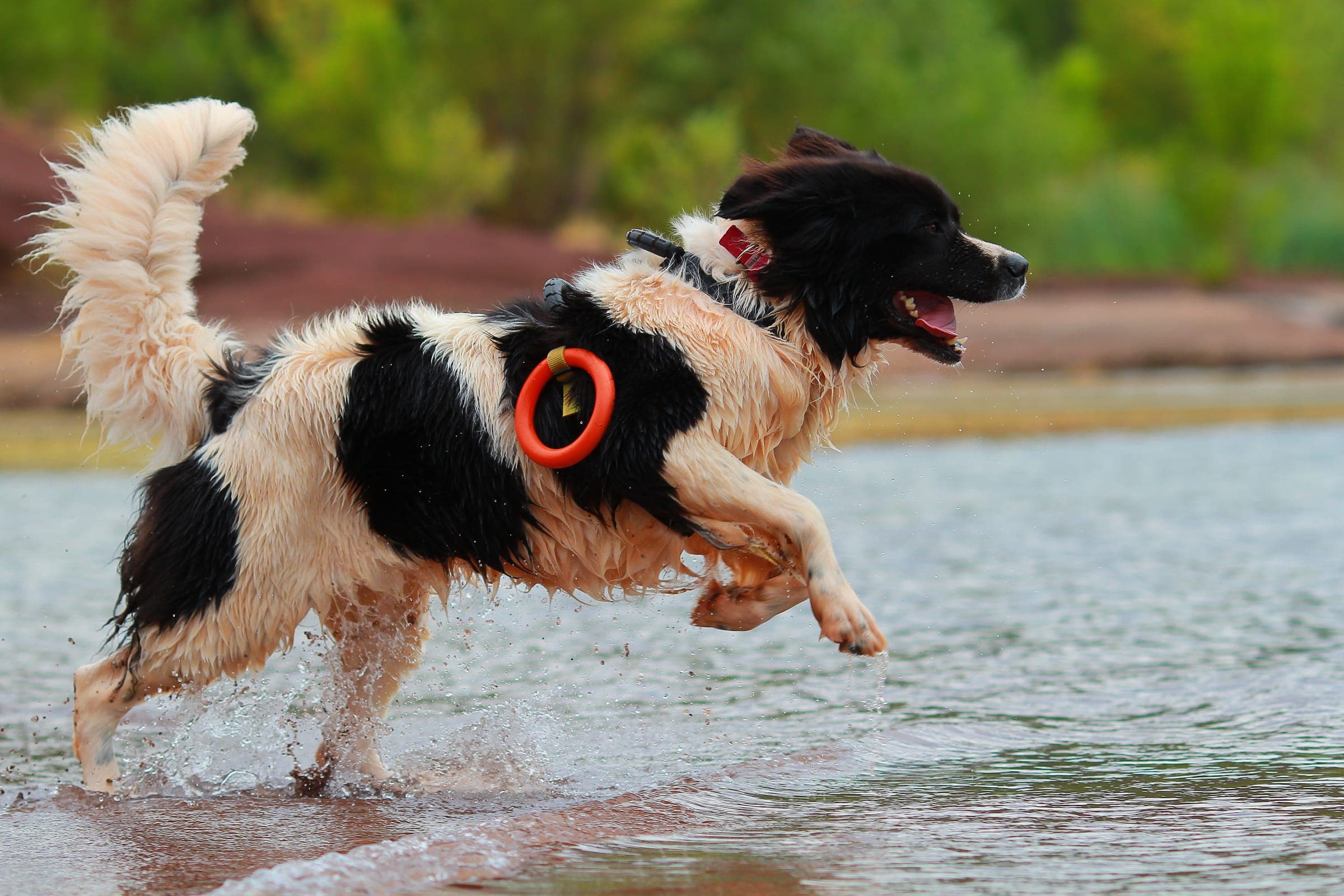
Sport Profile

Discover Water Rescue

A working-dog sport built around the practical tasks of historic water dogs — towing boats, delivering lines, retrieving from the water, and bringing a 'drowning' steward back to shore — judged pass/fail at a lakeside test.

Jump to a section

01 · What is it

Water Rescue is a working-dog sport that turns the historic jobs of water dogs — towing boats, delivering lines, retrieving gear, and bringing a 'drowning' steward back to shore — into a series of judged exercises run at a lake. In the breed-club programs (NCA for Newfoundlands, PWDCA for Portuguese Water Dogs), tests are pass/fail. A team must complete every exercise at a level, within set time limits, to earn the title. There is no head-to-head ranking, no points to chase. The dog either does the work or it doesn't.

Handlers cue from shore, from a boat, and from the water. Dogs work off-leash for the water tasks and on-leash for the land control portion. The exercises move from straightforward retrieves at the entry levels — swim out, pick up the bumper, bring it back — to multi-step rescue scenarios at the top, including searching for an abandoned boat, delivering a line from a stranded boat to shore, and retrieving a victim from under a capsized boat. The sport suits dogs who are confident in open water, comfortable with chop and splashing, and willing to work at distance from the handler while still checking back in. Newfoundlands and Portuguese Water Dogs are the breeds the formal programs were built around, but the all-breed Canine Water Sports framework opens the same kind of work to any water-loving dog six months or older.

Origins
Working roots
Water trials grew directly out of real working tasks. Newfoundlands hauled nets and lines for North Atlantic fishermen, carried messages between boats, and pulled people out of the water when things went wrong. Portuguese Water Dogs worked the Algarve fishing fleet — herding fish into nets, retrieving broken gear, and ferrying messages from boat to boat.
Late 1960s
The Newfoundland Club of America's Working Dog Committee begins designing standardized water tests.
1971
The 12-exercise plan with Junior and Senior divisions is finalized.
1973
First NCA-sanctioned water rescue test held. The structure — pass/fail per exercise, all required exercises at a single test — is essentially the same today.
1990–91
PWDCA Board approves a Water Trial program for Portuguese Water Dogs (1990); first PWDCA-sanctioned trial held in 1991. Where NCA leaned toward rescue scenarios, PWDCA leaned toward fishing-boat work: delivering messages between boats, retrieving floating and sinking gear, and a courier-style ladder from Junior Water Dog through Master.
Today
Water Rescue Dog Excellent (WRDX) anchors the top of the NCA ladder. PWDCA reported 38 trials over 19 weekends in 2022 with 343 qualifying performances across seven levels — modest but consistent. Canine Water Sports (CWS) operates as an all-breed, task-based framework for handlers without a Newf or PWD who still want to do the work.

02 · The test

A water test is a fixed sequence of exercises run in a set order at the lake. Each exercise has a defined setup, criteria, and time limit. To earn a title at a level, the team must pass every exercise at that level — there is no compensating strong work in one exercise for a fail in another. Across NCA, PWDCA, and CWS the categories below cover what shows up.

Element 01
Land control
Heeling, halts, and a recall, run on shore around the test site. The point is to show the dog can work safely and under control before it goes near the water. Distractions include other dogs in crates, boats being staged, and stewards moving in and out of position.
Element 02
Retrieves from the water
The dog swims out to a thrown bumper, life jacket, or boat cushion and brings it back. PWDCA Junior-level retrieves are thrown around 25 feet. Higher levels add weight, multiple objects, and — in PWDCA — underwater retrieves where the dog has to dive for a sinking object.
Element 03
Line delivery and tow work
The handler hands the dog a line or bumper attached to a line. The dog swims it out to a steward in the water, then either holds position or tows the steward back to shore. At higher NCA levels, the dog tows a boat with a passenger in it. The exercise tests straight-line swimming, target accuracy on a person in the water, and sustained pulling power.
Element 04
Boat work
The dog boards a boat, settles while it's underway, and either disembarks on cue or jumps from the boat to retrieve a marker buoy. Some advanced exercises have the dog swim a directed pattern beyond course markers and return, sometimes over distances exceeding 60 feet.
Element 05
Complex rescue
Advanced NCA exercises (WRDX) chain multiple behaviors: search for an abandoned boat and bring it back, rescue an unconscious victim, retrieve a victim trapped under a capsized boat, ferry a line from a stranded boat to shore, rescue two drowning victims behind a boat. The dog has to find, decide, and act with limited handler micromanagement. Where Newfoundlands earn the reputation that built the breed in the first place.
WRDX-level scenarios
Element 06
Teamwork and demeanor
Across all programs, judges score on willingness, controlled independence, and steady work — not mechanical obedience. A dog that completes every task with visible reluctance can fail; a dog that works with focus and joy under handler cuing passes. The handler's job is to balance clear cuing with letting the dog use initiative, especially in rescue-style exercises where micromanagement breaks the work.

03 · NCA

NCA runs the program for Newfoundlands. Its tests emphasize realistic rescue scenarios that reflect the breed's historical work in the North Atlantic — towing boats, retrieving lines, bringing victims back to shore. The program is organized as three regular divisions — Water Dog (WD), Water Rescue Dog (WRD), and Water Rescue Dog Excellent (WRDX). Each is six exercises, judged pass/fail, run at a single test. A title requires passing all six; there's no aggregate score. Tests are typically administered by regional NCA clubs; the rules and judging standards come from the national Working Dog Committee.

01
WD · Water Dog
Land control plus five water tasks — bumper retrieve, life jacket or boat cushion retrieve, line delivery to a steward, towing a boat, and a calm swim with the handler. Pass all six exercises at one test. No multiple legs. Where most Newfoundlands start their working titling; the land control segment screens out dogs that aren't ready before they get on the water.
02
WRD · Water Rescue Dog
Six Senior-division exercises that increase distance, weight, and complexity. Line deliveries get longer, tows include more weight, and rescue configurations chain more steps. Pass all six WRD exercises at one test under approved judges. Asks the dog to leave the handler, locate a steward in the water, and return with the steward or a boat in tow — where handlers stop directing every step and start trusting the dog to read the scenario.
03
WRDX · Water Rescue Dog Excellent
Six advanced rescue scenarios — search for and return an abandoned boat, rescue an unconscious victim, retrieve a victim under a capsized boat, deliver a line from a stranded boat to shore, rescue two drowning victims behind a boat. Pass all six at one test. Offered less frequently than WD or WRD and often has tighter entry caps. Community reports describe low pass rates and multiple attempts as common.
04
BWD · Beginner Water Dog (regional)
Some regional NCA clubs also run a Beginner Water Dog division alongside the regular titles. BWD's status as an official NCA title vs a regional-club practice division varies by premium and year.
Key facts
Breed
Newfoundland only
Levels
WD → WRD → WRDX (+ regional BWD)
Scoring
Pass/fail per exercise; all six required
Program founded
1971 (plan) · 1973 (first test)
Marquee
WRDX as the elite division
Test cadence
Regional clubs, single-day tests
Requalifier entries + club-level accommodations
NCA premiums commonly include a 'requalifier' entry option — a titled dog can re-enter at its current level for practice or recognition. Some clubs cap entries or prioritize untitled dogs when tests fill — premium-by-premium policy varies. Junior-handler and veteran-dog accommodations are handled at the club level rather than as formal national programs.

04 · PWDCA

PWDCA runs the program for Portuguese Water Dogs. Its tests emphasize fishing-boat heritage tasks: gear retrieval, message delivery between boats, courier work, and controlled swimming. The Water Trial Manual is the canonical reference. PWDCA's seven-level ladder is more granular than NCA's three, and the regional-club culture is heavy and tight-knit — handlers often travel between clubs for trials and camps. Exercises are pass/fail; titles require passing the full set at the level on a single trial day.

01
JWD · Junior Water Dog
Foundation water work — short retrieves (~25 feet), basic line delivery, controlled swimming with the handler. Single passing performance earns the certificate. Minimum age 6 months. The entry credential into the ladder; where new handlers find out whether their dog has the willingness, swim conditioning, and focus to keep going.
02
AWD · Apprentice Water Dog
Builds on JWD with longer retrieves, multiple objects, and slightly more independent work. Minimum age 1 year, or JWD-titled. Pass all required exercises at a single trial. Where handlers start cueing from a boat as well as from shore, and where boat boarding becomes a regular part of the work.
03
WWD · Working Water Dog
Adds tow work with weight, more complex retrieves (including underwater retrieves), and longer line deliveries. Pass all required exercises at a single trial. The level where the dog has to demonstrate sustained working power, not just willing participation.
04
CWD · Courier Water Dog
Courier-style tasks reflecting the breed's heritage — message delivery between boats, gear retrieval, directed swimming on cue. Pass all required exercises at a single trial. Courier tasks demand directional control at distance — the dog has to leave the handler, target the right boat, and return with the right object.
05
Master-level titles
The top of the PWDCA ladder is a sequence of Master-level titles, including Master Water Dog (MWD) and additional advanced titles requiring multiple passes or specific exercise combinations. Names, abbreviations, and pass requirements live in the current Water Trial Manual.
Key facts
Breed
Portuguese Water Dog only
Levels
JWD → AWD → WWD → CWD → Master tier (7 total)
Scoring
Pass/fail; full set required at one trial day
Program founded
1990 (approved) · 1991 (first trial)
2022 season
38 trials · 19 weekends · 343 qualifiers
Culture
Regional-club heavy, camaraderie-oriented
The PWDCA season
PWDCA reported 38 trials over 19 weekends in 2022 with 343 qualifying performances across seven levels. The modest scale matters because it shapes how the season runs — many Master-level titles require multiple passes, which means handlers travel to multiple regional trials within a season to chase a title. PWDCA culture is widely described by participants as cooperative and camaraderie-heavy rather than competitive, since titles are pass/fail and not ranked.

05 · Side by side

NCA is the Newfoundland program. PWDCA is the Portuguese Water Dog program. Canine Water Sports (CWS) is the all-breed alternative for handlers whose dogs don't have a breed-club home. The comparison below names the three programs and describes the third — CWS — that fills the all-breed slot.

NCA
Newfoundland Club of America. Three regular divisions — WD, WRD, WRDX — emphasizing realistic rescue scenarios. Program founded 1971, first test 1973. WRDX is the elite division.
ncadogs.org →
PWDCA
Portuguese Water Dog Club of America. Seven-level ladder from JWD through Master, emphasizing fishing-boat heritage tasks (message delivery, courier work, gear retrieval). Heavy regional-club culture; 343 qualifying performances in 2022.
pwdca.org →
CWS
Canine Water Sports. All-breed, task-based program for any dog 6 months or older. Exercises organized into Shoreline Skills, Mariner Dog Tasks, and Water Games — pass/fail for most tasks, Water Games ranked by speed/accuracy. Geographically sparse compared to NCA and PWDCA.
caninewatersports.com →
NCAPWDCACWS
RoleSanctioning body for Newfoundland water testsSanctioning body for Portuguese Water Dog water trialsAll-breed water-work program
LevelsWD → WRD → WRDX (some regional clubs run BWD as a practice division)JWD → AWD → WWD → CWD → Master-level titles (seven levels total)Qualifying Team Swim → Mariner Dog Task divisions; Shoreline Skills and Water Games run alongside
EligibilityNewfoundlands registered with AKC or eligible alternative listingPortuguese Water Dogs registered with AKC or eligible via PAL/ILPAny dog six months or older, any breed or mix
Cross-org transferNot transferable to PWDCA or CWSNot transferable to NCA or CWSNot transferable to NCA or PWDCA
Known forRealistic rescue scenarios, WRDX as the elite test, strong working-Newfoundland cultureFishing-boat heritage tasks, granular ladder, heavy regional-club cultureAll-breed access, task-based flexibility, geographic sparseness

Titles do not transfer between any of these programs. Handlers who cross over typically do it for variety or for an athletic mix that doesn't fit a breed-club program. NCA and PWDCA tests are run as separate seasons; CWS events are scattered enough that travel often determines which org a non-breed-specific handler can realistically pursue.

Which one sounds more like you?
Newfoundland owner · NCA
Want the historical rescue work — towing boats, retrieving lines, multi-victim scenarios at the top. WD and WRD are accessible with structured training; WRDX is the elite division and a multi-year project. The program your breed was built for.
Portuguese Water Dog owner · PWDCA
Want a granular ladder with seven titles and strong regional-club culture. The seven-level structure rewards consistent attendance at regional trials and gives you a clear progression to chase. Master-level titles require multiple passes — plan a season around regional trial geography.
Other water-confident dog · CWS
An athletic dog of any other breed or mix and want water work without a breed-club home. The most realistic option for a Lab, a Standard Poodle, a Chesapeake Bay Retriever, or a water-confident mix. Trade-off: geographic sparseness — you'll travel further, and the title structure is less standardized.
If travel is the limiter
If your closest water-test club is more than three hours away regardless of program, the limiting factor is travel, not org choice. Plan around the season you can actually attend.

06 · Getting started

Most handlers enter water work through a regional breed club's training days or a multi-day 'water camp.' Independent self-training is possible at a public lake, but the logistics — boats, stewards, and a safe shoreline — make club-based learning the standard path. The work splits cleanly into two seasons: shore work in spring (obedience, recall, equipment introductions) and water work once lake temperatures come up.

The club
Find stewards and a boat
A regional breed club's training days or a multi-day water camp is the on-ramp. Foundation training: reliable obedience, a recall that holds with distractions, and crate-comfort in busy outdoor settings. The land control segment of every test is non-negotiable. Access matters: a safe shoreline, a boat (often shared by the club), and helpers willing to play steward. Water work needs people, not just space — this is the part most new handlers underestimate.
Foundation · months 0–6
Land control + lake exposure
Months 0–3: land control and obedience. Casual lake exposure, short fun swims, basic retrieves with floating bumpers at home or at a quiet pond. Months 3–6: class series or club practice days — most run 4–8 weekly sessions of 1–2 hours, often paired with a weekend workshop. Introduce equipment in context: bumpers thrown at distance, line delivery to a steward, calm swims alongside.
First test · year 1+
WD, JWD, or Qualifying Team Swim
Build toward an entry-level test (NCA WD, PWDCA JWD, or CWS Qualifying Team Swim). Many teams take one to two warm-weather seasons to be ready. Year 2 and beyond: Senior, Working, Courier, and the upper rungs. Master-level titles like WRDX or PWDCA's top tier are multi-year projects even for committed teams.
Before you enroll
Age: 6 months minimum across all three programs; PWDCA Apprentice requires 1 year unless the dog has already earned JWD. Eligibility: NCA and PWDCA titling tests are breed-restricted; CWS and some regional all-breed days accept any breed or mix. Physical readiness: cardiovascular conditioning and shoulder/hip soundness matter. Giant breeds, heavily coated dogs, and short-muzzled dogs face higher risk in open water — a pre-sport wellness exam and, for older or giant-breed dogs, a sports-medicine consult are worth the time. Reactivity: tests are quieter than indoor sports, but there are still clusters of dogs on shore. Mild reactivity can usually be managed with distance and crate setups; severe reactivity is harder.

07 · Trial day

A water trial is quiet, slow, and weather-dependent. Most of the day is on the shoreline — checking in, watching wind and chop, cycling dogs in and out of warm-ups. The water work itself is concentrated and intense, but it's a small fraction of the time you're at the lake. Handlers who treat the day like a long camping trip with a few timed working windows have a better experience than handlers who treat it like a sport event.

The venue + flow
Lakeside, weather-dependent
Most tests run at lakes with a designated launch point, a staging area on shore, and a designated test zone in the water. Water temperature, wind, and chop change the course materially — a calm morning and a windy afternoon are two different tests. Check-in confirms registration and equipment. Judges' briefing walks through procedures, running order, and safety rules. Dogs work the full set of exercises at their entered level before the next dog or level change. Scoring is pass/fail per exercise — passing all six earns the qualifying performance and, if previously untitled at the level, the title.
The kit
What to bring
A sturdy crate plus shade — tarp, canopy, or vehicle. Water for dog and handler. Towels. Change of clothes. High-value food rewards for shore work. Toys used carefully so they don't conflict with formal retrieve objects. Dog life jacket, floating bumpers, lines that match the rulebook. Handler life jacket. Wetsuit if you're in a cold-water region. Folding chair, snacks, layers — wind off a lake at 8 AM is a different climate than the same lake at noon.
The mistakes
What goes wrong
Underestimating logistics — the walk between crate, staging area, and water is longer than it looks, and rushing it transmits straight to the dog. Overtraining the night before — dogs run flat at tests when they're tired going in. Skipping the briefing — most preventable errors at first tests come from not knowing exactly how the exercise is set up that day. Handler nerves on the boat — dogs read tension when they board.
The reality
What videos don't show
Online video shows the work, not the day. It cuts the four hours of waiting, the wind read on the water, the second-guessing about whether to enter at this level today, and the cumulative fatigue of cycling a dog in and out of cold water across a multi-day weekend. The work is real but it's a small slice of the time at the lake.

08 · What it costs

Water work costs split unusually — gear is moderate, but logistics are heavy. Lakes are not in cities. Tests require travel. A serious season means lodging, lake permits, and time off work.

Gear
$150$400
Dog life jacket, floating bumpers, lines, handler life jacket, wetsuit for cold-water regions. AKC PAL/ILP or breed-club registration $35–$75 on top.
Class series
$150$300
Multi-week series; club training days $25–$60/session; weekend camps $150–$300+; private lessons $75–$150/hr
Per-trial entry
$50$65
Per dog per day — $50 USD (PWDCA Texas regional), $65 CAD (NDCC BC); pre-entry standard, day-of rare
Active annual
$1.5k$6k+
Casual $400–$800; active WD/WRD or PWDCA mid-ladder $1.5k–$3k; serious WRDX/PWDCA Master campaign $3k–$6k+
The honest truth
The sport's biggest cost isn't gear or entries — it's time. A serious season is built around lake-accessible weekends from late spring through early fall, and the math of how many test weekends you can realistically reach in that window shapes how fast you can title. Suitable water sites are usually outside metro areas, so lodging examples like a Hampton Inn at $169 USD (with $50 pet fee) or a Quality Inn at $79 USD (with $25 pet fee) near a trial lake are the typical pattern. Many handlers car-camp or RV to manage costs.
Related sports

If Water Rescue interests you, look at these too.