The Man Who Turned a Dog Into an Engine
Mark Schuette built a safer way to mush — the dog beside the rider instead of way out front — after watching a woman, a stroller, and a dog each try to go a different direction on a sidewalk. Sixteen years and some 600 scooters later, the best part is still a stranger asking what that is.
By Sporting Hound

Most inventions start with a problem. Mark Schuette's started with a traffic jam between a woman, a stroller, and a dog.
He was standing on a bridge, looking down, when he saw her: a mother pushing a cart with a baby in it, and a dog on a leash tied to the cart. The dog wanted to go to the side. The mother wanted to go forward. Neither was winning.
“They were struggling with each other,” Mark says. “I thought — if she could figure out a way to only let the dog go where she wanted to go, forward — then maybe the dog could push the baby cart? Or at least it would be smart to get all the forces to go in the same direction.”
The wheel that turned into a dog
The first prototype was a three-wheeler: a kid's kick scooter with a bent steel tube attached to it — an outrigger bar that swung out to the right, high enough to clear a dog, then dropped down to meet a third wheel. He rigged up some rope connections, borrowed a friend's dog, and went.
It worked. But that third wheel nagged at him: on a left turn it lifted into the air, and on a right turn it fought him. So he took it off, figuring he'd have to redesign the whole thing.
Instead, the rig got better.
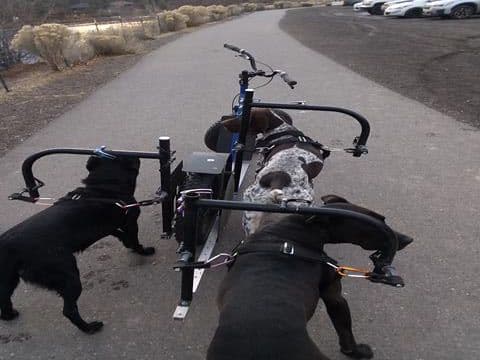
Clipped in on each side of the frame, the dog was doing exactly what the outrigger wheel had done — adding stability. The dog wasn't being dragged along behind a vehicle. The dog was the vehicle.
That's the whole difference. In sled, bikejor, or canicross, the dog runs out front — sometimes seventeen feet of line out front, or clipped high on a bike — where it picks the line, sees the squirrel first, and needs a trained dog and a capable rider. Mark put the dog beside and behind the steering instead: the rider stays in charge, the dog just powers. No special training, safe enough for an older rider or a kid, and it works where out-front never could — a sidewalk, a narrow trail, even indoors.
He needed a dog of his own by then, so he adopted one from the local rescue — a seventy-pound two-year-old who'd been abandoned.

The tree that made it safer
Here's the other way a design gets safer: you hit something.
“The first system had all non-moveable bars,” Mark says. “But after I hit a tree and flew over the handlebars, I made the outrigger bar flexible — it moves up and down and sideways if struck.”
The lesson from that crash is built into the product now: the outrigger bar flexes instead of staying rigid, and the parts come off easily — if you hit a fence, a car, or a person, you want the rig to come apart rather than hold everything together.
So what kind of dog can do this?
One who wants to run and pull.
“The dog needs to be a runner-puller to make this rig useful,” Mark says. “The human doesn't want to have to do a lot of the kicking and motivation. We want the dog to do all the flat work — and the rider to do the steering.”
And the pull itself is smaller than you'd guess. On level pavement or packed dirt, keeping the scooter at speed takes only six or seven pounds of steady pull — the dog isn't hauling you, it's just keeping you rolling.
That rules some dogs out. A couch potato won't enjoy this, and neither will an anxious one. But size matters less than you'd think, because the rider does some of the work too: figure forty-five pounds and up for a single dog, or thirty pounds and up each when several share the load. That's for an average-weight rider — heavier riders should check with Mark directly.
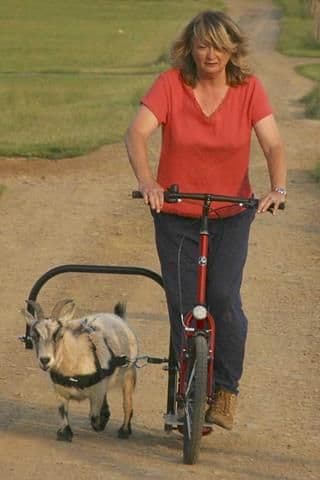
At the other end, the Fat Tire build has no upper limit at all. How far up does “no upper limit” go?
I've even had a mini-horse and a goat in it! I also could scale the concept up to full-size horses.
We're choosing to believe him — mostly because he sent proof.
How you actually start using the scooter
Ask Mark what beginners get wrong and he doesn't hesitate: it's the introduction. Before any speed, the dog has to get comfortable just being near the scooter and the tire, comfortable in the harness, and comfortable being clipped in on both shoulders. Then it has to learn the one rule that makes the whole system work: its only movement is forward. Mark is happy to walk you through initiating a dog to the system, in person or over the phone.
Clip the dog in with no scooter at all. Just the harness and the connections. Let them wear it and feel it.
One side only. Clip them in on their left side, outrigger bar rotated back out of the way. Then walk them. Just walk.
Then swing the bar over and clip in the right side. Now they're in the full two-point system — and still, you're not asking for speed.
“I'm not asking the dog to run and pull yet,” Mark says, “unless they want to. Then, if the dog is fine in the system, then we ask them to pick up the pace.”
Rush it and you don't get a faster dog. You get a dog with an opinion about the harness.
The moment he remembers
We asked Mark for the one moment from all these years that stands out. He couldn't pick one — and the non-answer turned out to be the best answer in the interview.
“Experiencing a training session with the dog's owner, where the dog takes to the system immediately,” he says. Or getting a new dog himself and watching them take to it. Or a customer's dog picking it up fast. Or running four dogs at once.
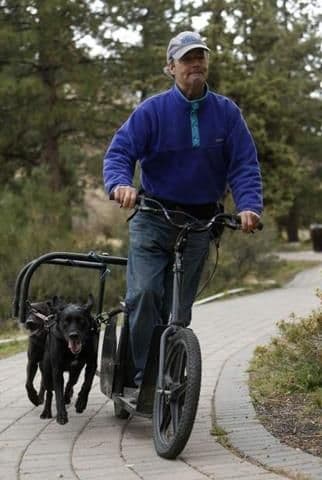
Or — and this is the one that says the most about him — “when I get a good comment when people see me scootering by, or I stop and show them the system and even let them demo it.”
Sixteen years in, the highlight is still a stranger on a sidewalk saying what is that.
A job for the dog, a ride for you, a sport for both of you
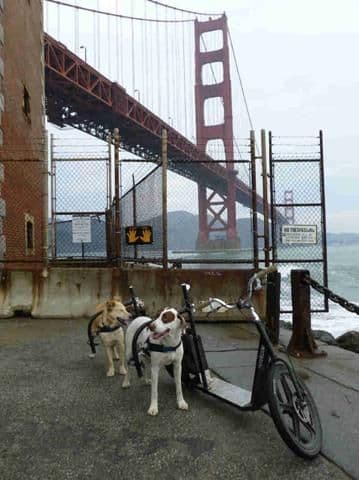
No snow, no sled, no team of huskies, no trial entry required. If you've got a dog who pulls on leash and looks miserable on a normal walk, this is the sport that takes the exact thing you've been fighting and makes it the point.
Mark builds and sells the scooters and bolt-on systems himself out of Bend, Oregon, at dogpoweredscooter.com. There's no shopping cart — you email or call him, tell him about your dog and your riding, and he builds the setup to fit. Some 600 units are out in the world, and he says he has never had a report of an injury to a dog or a rider.
Photos courtesy of Mark Schuette / Dog Powered Scooter. Interview conducted by email and phone, July 2026; responses lightly edited for length and clarity.