Agility
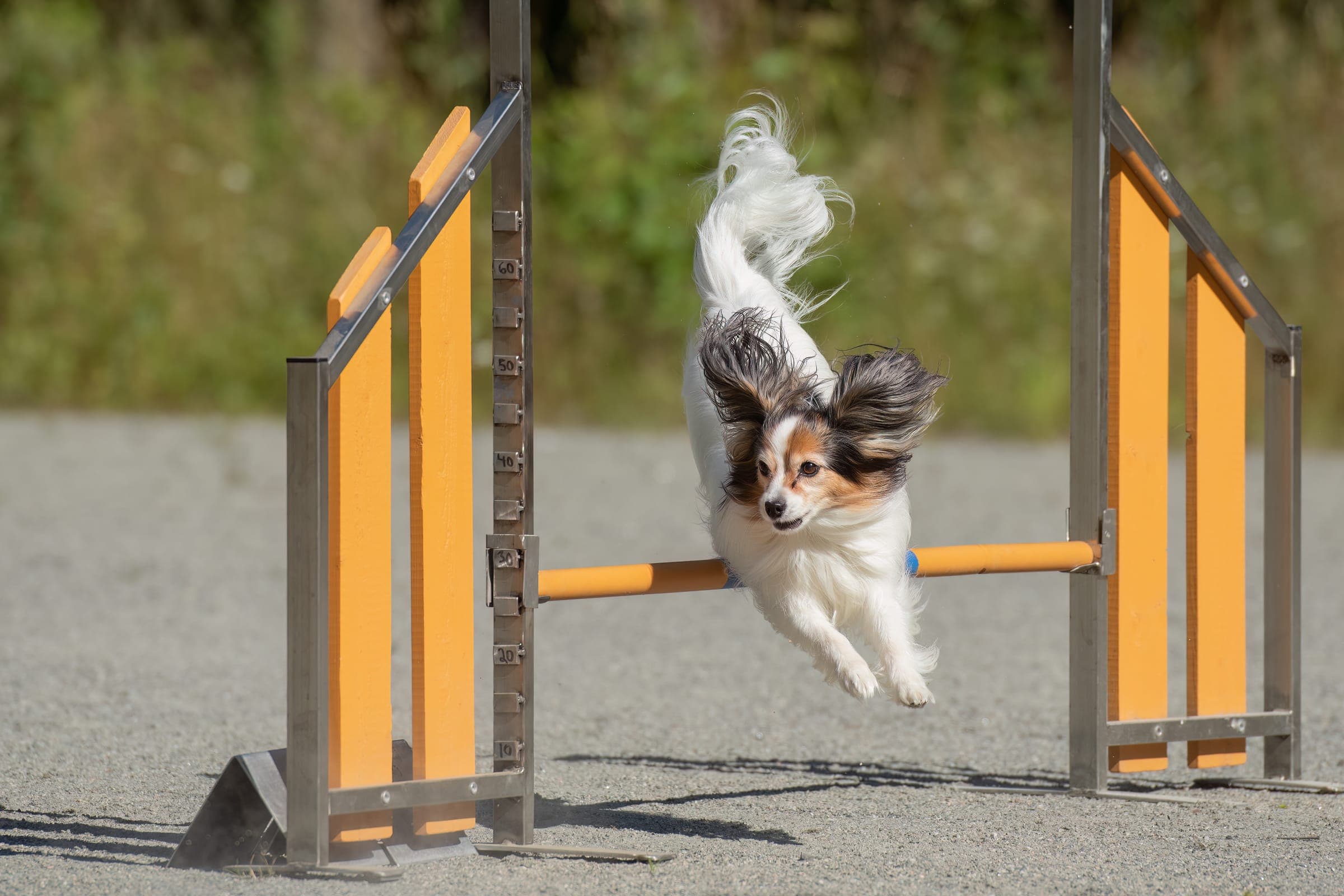
AKC is the largest and most accessible US agility organization for newcomers. Trials run nearly every weekend across the country. AKC is open to AKC-registered purebreds, mixed-breed dogs enrolled in the Canine Partners program, and unregistered purebreds enrolled via PAL (Purebred Alternative Listing). Title progression at AKC moves through Novice, Open, Excellent, and Master, with the MACH and PACH championships beyond Master. Each class type — Standard, JWW, FAST — has its own progression, so dogs earn titles like Novice Agility (NA), Novice Agility Jumper (NAJ), and so on across multiple class types in parallel.
Rally
The American Kennel Club program is the largest and most visible Rally structure in the US — the program that took the format mainstream when it codified titling in 2005. The AKC ladder runs from Novice through Master with an optional Intermediate bridge, then opens into combined and championship titles (RAE, RACH). Most US Rally weekends are AKC weekends, and the AKC Rally National Championship is the prestige finish. Eligibility covers all AKC-registered purebreds, plus mixed-breed and unregistered purebred dogs enrolled in the AKC Canine Partners program. Foundation Stock Service (FSS) and Purebred Alternative Listing (PAL/ILP) also qualify. Dogs compete from six months of age. Intact AKC-registered and FSS dogs of both sexes are eligible; Canine Partners and PAL dogs must be spayed or neutered; females in season are not permitted to compete. Deaf dogs are eligible; blind dogs are not, in line with AKC Obedience eligibility.
Obedience
The American Kennel Club program is the largest and oldest obedience structure in the US — the program that grew directly out of Helen Whitehouse Walker's 1933 test. Its core ladder has three traditional levels (Novice, Open, Utility) bracketed by an introductory Beginner Novice class and an extensive championship structure above Utility. Most US trial weekends are AKC trial weekends, and the National Obedience Championship is the prestige finish. Eligibility covers all AKC-registered purebreds plus mixed-breed and unregistered purebred dogs enrolled in the AKC Canine Partners program. Dogs compete from six months of age. Intact AKC-registered dogs of both sexes may compete (Canine Partners dogs must be spayed or neutered), but females in season are not permitted to compete — clubs refund the entry if notified in time.
Nose Work / Scent Work
AKC Scent Work runs on a clearly structured level system that walks teams from one known hide on a single odor up to integrated search environments at the highest tier. Four target odors are in play — birch, anise, clove, and cypress — across four search elements: containers, interiors, exteriors, and buried hides under sand or water. AKC's distinctive Handler Discrimination division has the dog searching for the handler's own scent on articles, and there's no prerequisite test — handlers enter Novice directly.
Fast CAT
Unlike most dog sports, Fast CAT has no parallel governing organizations in the United States. AKC writes the rules, licenses every titling event, maintains the records, and publishes the breed rankings. Independent clubs and non-AKC lure operations may run straight-line "fun runs" using similar equipment, but those events do not produce Fast CAT titles. There is one ladder, one rulebook, and one database. AKC launched Fast CAT in April 2016 under its Coursing and Herding department, building on the earlier Coursing Ability Test (CAT) framework. Eligibility runs through AKC's registration system: dogs need an AKC number via full AKC registration (recognized purebreds), Foundation Stock Service (FSS, for emerging breeds), Purebred Alternative Listing (PAL, for purebreds without papers), or Canine Partners (mixed breeds and ineligible purebreds). The one rule newcomers get wrong: the gate is registration, not reproductive status. Intact purebreds with full AKC or FSS registration can compete. Dogs entered through PAL or Canine Partners must be spayed or neutered as a condition of those programs. Bitches in season may not compete and are checked at inspection.
Tracking
AKC is the largest US all-breed companion tracking program. The progression runs from Tracking Dog (TD) and Tracking Dog Urban (TDU) to Tracking Dog Excellent (TDX) and Variable Surface Tracking (VST). A dog that earns TD (or TDU), TDX, and VST is awarded the Champion Tracker (CT) title — placed before the dog's registered name. Tests are pass / fail, no formal time limit while the dog is working, and one dog runs each track. AKC tracking is a one-leg-per-title sport: each test is pass / fail; earn the leg, earn the title.
Herding
AKC herding runs through a layered structure: an Instinct Test, two pre-trial tests (HT, PT), then trial classes at Started, Intermediate, and Advanced levels across Courses A, B, C, and D, with multiple stock types (sheep, ducks, cattle). Titles are earned per course / stock-type combination — a dog can hold a Started Course A on sheep title and an Intermediate Course B on ducks title in parallel. Eligibility is restricted to the Herding Group plus a listed set of other breeds — Norwegian Elkhound, Boerboel, Boxer, Bernese, Greater Swiss, Giant and Standard Schnauzers, Rottweiler, Samoyed, Kerry Blue and Soft Coated Wheaten Terriers, and the Dalmatian (from May 1, 2026). Mixed breeds can't enter AKC herding tests or trials.
Coursing Ability Test (CAT)
AKC's Coursing Ability Test is an AKC program (UKC runs a separate all-breed Coursing Aptitude Test with its own titles). Eligibility is open: any breed and any mixed breed can enter as long as the dog is at least 12 months old and holds an AKC number through full registration, PAL, Canine Partners, FSS, or an AKC-recognized foreign registry. There is no separate per-test sport registration the way NACSW requires an ORT before NW1 or BHA requires its own dog registration — an AKC number is the entire prerequisite. Titles come from accumulated passes, not points or speed.
Lure Coursing
The American Kennel Club integrates lure coursing into its broader performance calendar and runs the National Lure Coursing Championship (NLCC). Eligibility is restricted to sighthound breeds recognized by AKC plus certain Miscellaneous and Foundation Stock Service breeds. The title ladder runs JC → QC → SC → MC → FC → LCX, with cumulative LCX levels. For non-sighthounds and mixed breeds, AKC's Coursing Ability Test (CAT) and FAST CAT cover the lure-chase territory under separate programs. PAL/ILP dogs (spayed or neutered) and Limited Registration are allowed; since June 2025, monorchid and cryptorchid dogs without a breed DQ may enter. Bitches in season excluded.
Earthdog
AKC is the dominant US Earthdog program by event count, club coverage, and titled-dog population. Tests are non-competitive performance evaluations — pass/fail across a clear titling ladder from a non-titling introductory test through the Endurance Earthdog series. Eligibility is breed-restricted: listed small terriers and Dachshunds, plus a few terrier-type breeds such as the Miniature Pinscher and Miniature Schnauzer, and the dog must hold an AKC number through full registration, Limited Registration, PAL, or FSS. Mixed breeds cannot enter AKC Earthdog. Minimum age is 6 months.
Dog Hiking
AKC FIT DOG is the only widely available program that recognizes hiking miles for any titling purpose, and even FIT DOG is a fitness-recognition program rather than a hiking sport. There is no judged hiking trial, no qualifying-score system, no national hiking championship. Handlers who want a paper record of the miles they've walked have FIT DOG as the primary option and a small number of breed-club pack-title programs as a more demanding alternative.
Flyball
Title-recognition partner only. AKC does not run flyball trials. Through its Title Recognition Program, AKC records four NAFA titles — FDCh, FM, ONYX, and FGDCh — onto AKC pedigrees once the handler submits documentation. No equivalent pathway for U-FLI titles.
Trick Dog
AKC Trick Dog launched in 2017 as the registry's accessible-titling entry point, anchored to the Canine Good Citizen evaluator network. It is the most widely available Trick Dog program in the US: any AKC CGC Evaluator can administer the test, and most of the country can find a local titling option through a club or a private trainer. Titles are recorded on the dog's AKC title record, which matters to handlers already showing in conformation, agility, or rally and who want tricks on the dog's record. Eligibility is broad — purebreds, mixed breeds via Canine Partners, and unregistered purebreds via PAL are all welcome, with no breed-group or size restriction. Titles are awarded from 4 months of age. Title progression runs five levels: Novice Trick Dog (TKN), Intermediate Trick Dog (TKI), Advanced Trick Dog (TKA), Trick Dog Performer (TKP), and Trick Dog Elite Performer (TKE). At Novice, the dog performs 10 approved tricks, or 5 tricks plus a CGC title on AKC record. At Intermediate and Advanced, the dog performs 10 tricks from each level's list with progressively reduced luring — none at Advanced. At Performer (TKP), the dog performs 10 tricks, at least 3 of them Performer-level, with at least 3 using props. Elite Performer (TKE) is a scripted routine of 10 Advanced or Performer tricks, at least 5 of them Performer-level. Evaluations can be in person or virtual, and each title costs $32 to process.